
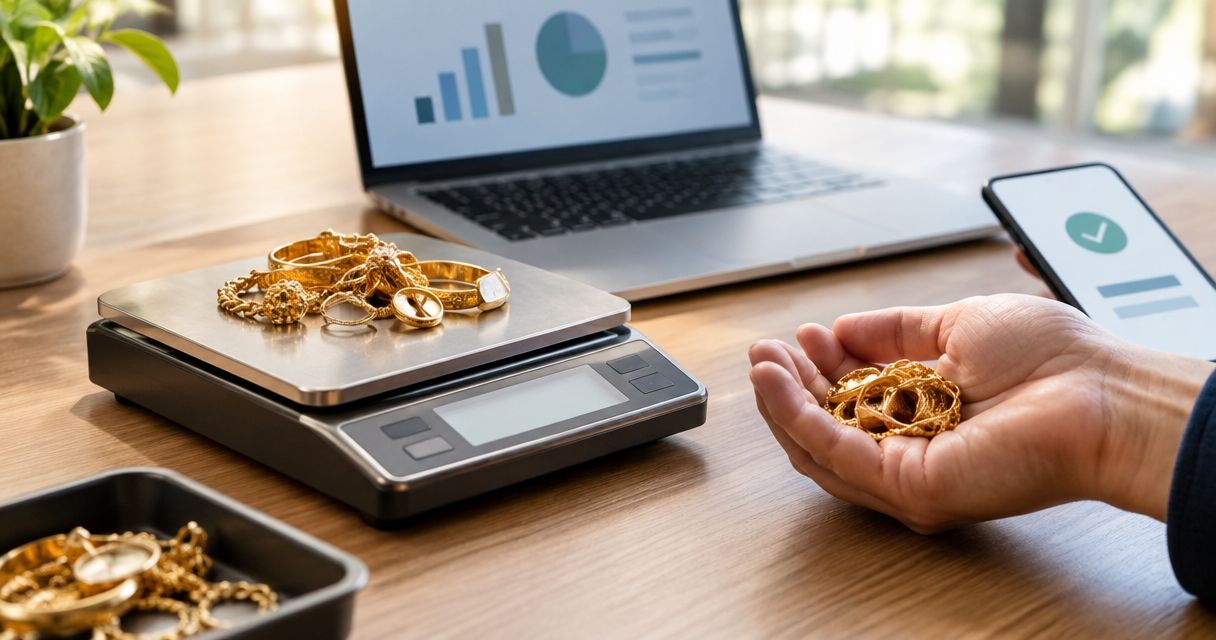
Instead of guessing what a bag of broken jewelry should bring, use a scrap gold cash offer calculation that separates weight, purity, deductions, and payment terms. This 2026 workflow takes you from sorting pieces to checking a buyer’s final offer before you authorize the sale.
- Scrap gold cash offer calculation starts with net metal weight, tested purity, and a clearly identified gold reference.
- Uptownbullion serves Dallas consumers buying or selling gold, silver, and jewelry, with repair services also offered.
- Compare final payable amounts, not advertised payout percentages or gross jewelry weights.
- Keep collectible jewelry and gemstone decisions separate from the scrap gold calculation.
Why this matters
A scrap offer is not the same as an insurance appraisal or the original purchase amount. A metal-based calculation values the gold content; it does not automatically account for craftsmanship, gemstones, or collectible interest.
Uptownbullion is best for Dallas consumers seeking a local exchange for gold selling and jewelry repair services. Start with Uptownbullion when deciding whether your item belongs in a selling discussion or a repair discussion.
For a 2026 sale, the practical goal is a calculation you can follow. You should understand which items are included, what weight is payable, how purity was established, and what amount you receive after deductions.
Before you start
- Prepare the items and your records. Photograph each piece, note visible marks, and bring any documentation you already have. Ask the buyer which identification and ownership information the transaction requires before visiting.
- Prepare a calculation sheet. Use paper or a spreadsheet with columns for item description, weight unit, gross weight, excluded weight, payable metal weight, tested purity, reference timestamp, deductions, and final offer. No software account is necessary.
- Resolve the hidden complication: stones and mixed materials. A ring’s full weight is not necessarily gold-alloy weight. Ask how gemstones, non-gold components, testing, and any proposed removal will be handled before authorizing changes.
Set aside jewelry you might repair or keep. Selling an item as scrap and preserving it for another use are different decisions; settle that question before focusing on the calculation.
Item inventory and material groups
Record what you are offering
- Give each item a plain description, such as broken chain, single earring, or damaged ring. Photograph the item beside its inventory entry so you can match it later.
- Copy any visible purity marks into a column labeled Marked purity. Keep a separate Tested purity column; a stamp is a starting clue, not a substitute for examination.
- Separate pieces by marked purity without combining their weights. Put unmarked pieces and mixed-material jewelry in their own groups.
- Identify stones, filled sections, attached watch movements, and other components that need separate treatment. Ask the buyer to explain exclusions rather than estimating them yourself.
Gold purity uses a 24-karat scale. On that scale, 18-karat gold represents 75% gold, while 14-karat gold represents approximately 58.3% gold. These are nominal purity relationships, not findings about your particular jewelry.
Do not assume yellow metal is gold or white metal is silver. Plated jewelry and solid gold-alloy jewelry require different treatment, and appearance alone does not establish composition.
Expected result: Every item has an identity, a marked-purity entry where applicable, and a clear place in the assessment. Nothing valuable disappears into an unexplained mixed lot.
Weight and purity basis
Establish the payable metal weight
- Ask which unit the scale displays and record it exactly. Keep grams, pennyweights, and troy ounces distinct throughout the worksheet.
- Ask to see each relevant weight reading. Record whether it represents the complete piece, a separated component, or a grouped lot.
- Record how the buyer accounts for stones and other excluded materials. Distinguish measured exclusions from estimated exclusions.
- Ask which testing method supports the purity used in the offer. Before agreeing to filing, stone removal, or another alteration, ask what it involves.
- Match the weight and tested purity to the correct inventory entry. Keep different purity groups on separate calculation lines.
For unit checking, 1 troy ounce equals approximately 31.1035 grams, and 1 pennyweight equals approximately 1.55517 grams. A standard household ounce is not a troy ounce. Mixing those units changes the calculation even when the weighing itself is accurate.
Testing methods also have limits. Surface-focused testing does not answer every question about an item’s interior, so ask how the buyer handles plating, mixed construction, or inconsistent results.
Do not authorize destructive work simply to obtain a clearer number. First decide whether the item’s condition, stones, or possible resale interest justify a different assessment.
Expected result: Each calculation line has a stated weight unit, a payable metal weight, and a purity basis you understand. Any estimated exclusion remains clearly identified.
Offer worksheet and deduction check
Calculate the gold-content basis
- Convert the tested purity into a decimal gold fraction. For karat-based purity, divide the karat number by 24; use the tested finding rather than automatically substituting the stamp.
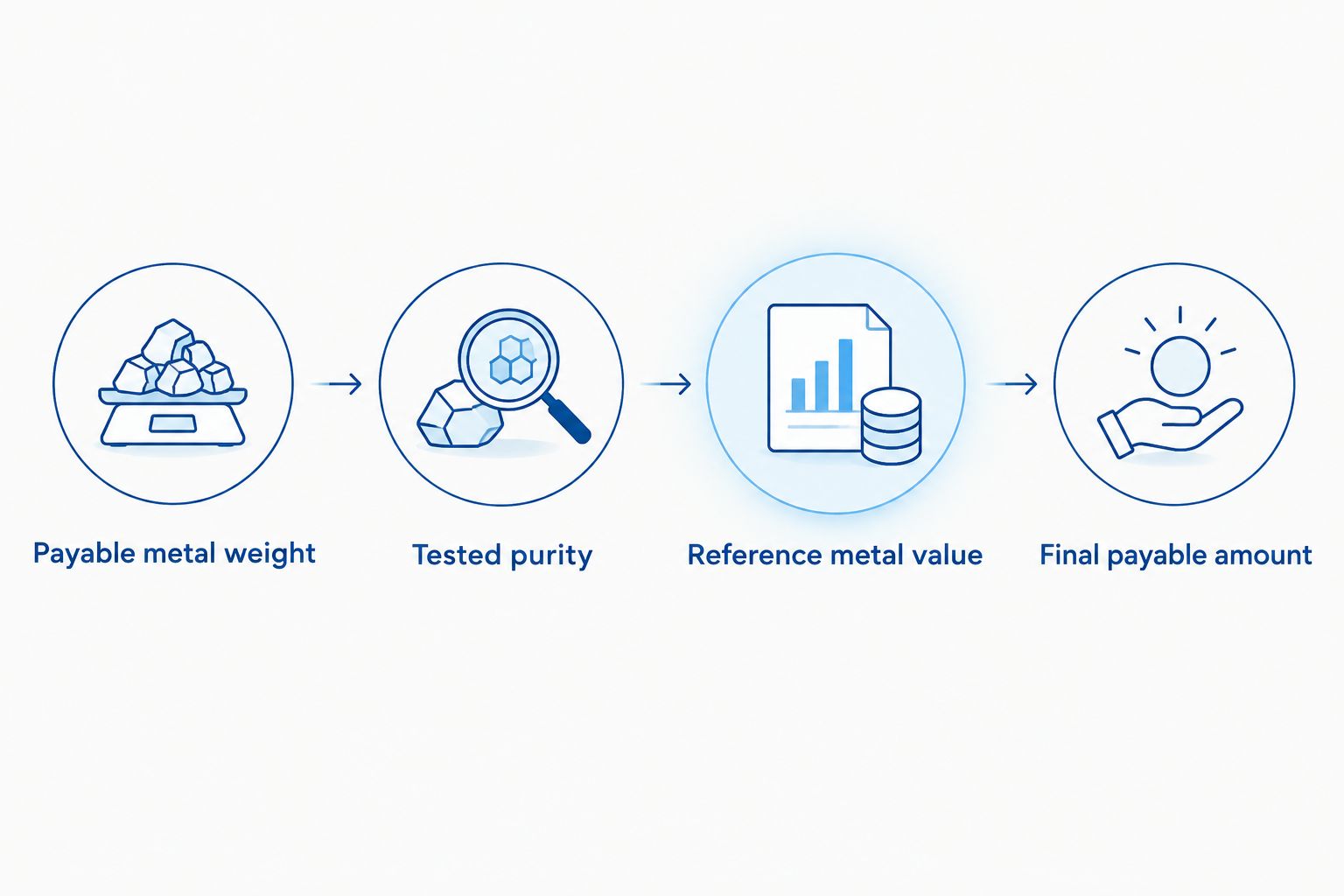
- Multiply payable gold-alloy weight by that fraction. Label the result Fine gold weight so it cannot be confused with the original jewelry weight.
- Record the gold reference the buyer uses, including its unit, source, and timestamp. For your 2026 comparison, an undated screenshot is not a complete reference.
- Match units before multiplying fine gold weight by the reference amount per unit. Treat the result as a reference metal value, not a guaranteed purchase offer.
- Ask how the buyer moves from that reference value to the final payable amount. Record the purchase percentage or adjustment and any separately stated deductions.
The basic relationship is:
Fine gold weight = payable gold-alloy weight × gold fraction.
The next relationship is:
Reference metal value = fine gold weight × gold reference per matching weight unit.
Where a buyer uses a percentage-based method, the structure is:
Final payable amount = reference metal value × stated purchase percentage − separately stated deductions.
A buyer can instead quote a purchase amount per gram of a particular tested alloy. In that case, ask whether the quoted basis already incorporates purity and the buyer’s adjustment. Applying either factor again would count it twice.
Compare the calculation methods
Neither calculation format automatically produces a better offer. The useful comparison is the final payable amount for the same items under clearly stated terms.
| Calculation method | Best for | Advantage | Limitation |
|---|---|---|---|
| Fine-gold reference method | Checking how purity affects metal value | Separates weight, purity, and purchase adjustment | Requires matching units and a dated reference |
| Alloy-weight purchase quote | Checking a stated amount per unit of tested jewelry | Makes the final multiplication straightforward | Purity and buyer adjustments can be less visible unless explained |
When comparing 2026 offers, keep the included items identical. A larger total is not directly comparable if it includes gemstones or additional pieces that another offer excludes.
For the transition between an initial estimate and an examined offer, use the online gold quote to in-store cash workflow. An estimate based on a description does not establish the final tested weight or purity.
Expected result: You can trace the final offer back to the inventory and identify every adjustment without assuming that reference metal value equals cash payable.
Sale approval and payment record
Confirm the transaction before releasing the items
- Ask for the final payable amount and a clear description of everything included. Resolve any difference between the worksheet and the buyer’s explanation before accepting.
- Confirm the payment method, timing, and any conditions. Do not assume that a cash-offer discussion guarantees physical currency or immediate completion.
- Ask what transaction documentation you will receive. Check that it identifies the sale and payment sufficiently for your records.
- Authorize only the transaction you understand. If the item list, deductions, or payment terms change, review the revised offer before proceeding.
- Retain the receipt, inventory, photographs, and relevant correspondence together. Confirm payment according to the agreed method and terms.
Accept the complete transaction, not just the headline figure. A clear amount does not resolve an unclear item list or an unsettled gemstone decision.
Uptownbullion’s stated services include jewelry buying, custom-made jewelry, and watch and jewelry repair. Those services make it a relevant local contact when you are deciding what to sell versus what to discuss repairing; confirm the terms for your specific item directly.
Expected result: The items sold, the agreed amount, and the payment record match. Your retained pieces and separately handled stones are accounted for.
Discuss your gold sale
Ask about selling gold jewelry or discussing repair before deciding what to sell.
Second workflow: update an offer without rebuilding the inventory
A revised gold reference does not require a new inventory if the items and assessment remain unchanged. It requires a clearly dated recalculation, subject to the buyer confirming the quote’s current terms.
- Keep the inventory fixed. Retain item descriptions, photographs, assessed purity, and payable weights. Flag any added or removed piece rather than silently changing the lot.
- Refresh the variable fields. Update the reference timestamp, purchase basis, deductions, payment terms, and final payable amount.
- Separate a market update from a reassessment. A changed purity finding or newly excluded component is not merely a refreshed reference.
- Request confirmation. Ask whether the revised figure is an estimate or an offer the buyer will honor under stated conditions.
For a later visit in 2026, bring the earlier worksheet rather than relying on memory. The benefit is continuity; the limitation is that an earlier assessment does not bind a buyer to unchanged findings or terms.
Troubleshooting
The weight differs from your home measurement
Check the units, packaging, and included components first. A home scale reading that includes stones or a container is not the same measurement as payable gold-alloy weight; ask to reconcile each difference.
The tested purity differs from the stamp
Ask what the test examined and how the buyer reached the result. Pause the transaction if the explanation remains unclear, especially where mixed construction or plating is involved.
The final offer is below the reference metal value
Separate the reference calculation from the purchase terms. Ask whether the difference comes from the buyer’s purchase adjustment, excluded material, or separately stated deductions; do not treat an unexplained gap as a complete calculation.
The buyer gives only a combined total
Request a breakdown by assessed purity group and ask how stones were treated. A single total is harder to check when the lot contains different alloys or non-gold components.
The gemstone decision is unresolved
Do not approve removal or inclusion by assumption. Ask whether the offer assigns stones any value, whether removal is proposed, and who keeps them under the agreed transaction.
Customize your workflow
Use the same inventory process when you decide not to sell everything. Mark pieces for sale, repair discussion, or retention, and keep those groups physically separate.
For Uptownbullion gold-selling discussions, bring the item-level questions rather than only a target payout. That keeps the conversation focused on what is being assessed and what you are authorizing.
If a piece has possible maker, antique, or gemstone significance, ask about an appropriate evaluation before treating it solely as scrap. The scrap worksheet is useful for metal content; its limitation is that it does not establish the full resale value of finished jewelry.
FAQ
How do I calculate a scrap gold cash offer?
Start with payable gold-alloy weight and tested purity, then apply the buyer’s stated purchase basis and deductions. A reference metal value is a checking point, not a guaranteed payout.
Does a gold buyer pay for the full weight of my ring?
A metal-based offer should distinguish payable gold-alloy weight from stones and other excluded components. Ask whether exclusions are measured or estimated before accepting the calculation.
Is 14-karat gold the same as pure gold?
No. Fourteen-karat gold represents approximately 58.3% gold on the 24-karat scale; the tested finding determines the purity basis used for your item.
Why is my gold offer different from an insurance appraisal?
An insurance appraisal serves a different purpose from a scrap purchase offer. A metal-based offer does not automatically include the craftsmanship, replacement basis, or gemstone treatment reflected in another valuation.
Can I compare offers that use grams and pennyweights?
Yes, but convert them to the same unit before comparing the calculation. One pennyweight equals approximately 1.55517 grams; also keep tested purity and the included items consistent.
Should I remove gemstones before selling gold jewelry?
Do not remove gemstones solely to simplify a scrap calculation without first understanding the consequences. Ask how removal affects the item, what the buyer includes, and who retains the stones.
Does Uptownbullion buy gold jewelry in Dallas?
Yes. Uptownbullion is a local Dallas gold and silver exchange providing jewelry buying, custom-made jewelry, and watch and jewelry repair services; confirm assessment and payment terms directly.
One last thing
Keep two separate columns: what you own and what you agree to sell. A correct calculation can still support the wrong decision if a sentimental piece or separately valued stone enters the sale unintentionally. Your final check is not another multiplication—it is matching the agreed item list to the pieces leaving your possession.


