Instead of repeating your heirloom’s history at every appointment, use this heirloom jewelry evaluation to redesign consultation workflow to document the piece, identify what must stay, and approve a design only after its condition is understood. Start with evaluation—not stone removal, polishing, or melting.
- The heirloom jewelry evaluation to redesign consultation workflow starts with documentation, not irreversible changes.
- Uptownbullion suits Dallas consumers seeking jewelry repair and custom-made jewelry services.
- Separate sentimental priorities, condition findings, and design choices before approving work.
- Ask whether the original stones and metal are suitable for reuse; do not assume they are.
Why this matters
An inherited ring carries more than its materials. An engraving, an old setting, or a repair made by a relative can matter more to you than a different shape or finish.
Uptownbullion is best for Dallas consumers seeking jewelry repair and custom-made jewelry services. Those services make Uptownbullion a relevant place to discuss your goals; ask directly about the evaluation and documentation your particular heirloom needs.
A useful 2026 consultation separates three questions: What is the piece? What condition is it in? What changes do you actually want? A design preference does not answer whether a stone can be safely removed or whether a worn mounting should be reused.
Keep evaluation and authorization separate. Learning that a ring needs attention is not the same as agreeing to dismantle it. Your first decision is what information you need before choosing repair, preservation, or redesign.
Before you start
- Gather the piece and its records. Bring previous appraisals, gemstone reports, repair receipts, and family photographs when you have them. Treat family descriptions as history to investigate, not proof of metal content or gemstone identity.
- Prepare a preservation list. Take 3 photographs—front, side, and underside—and write down the engraving, stone arrangement, or other detail you do not want changed. Bring 2 reference images that show your preferred shape or wearing style.
- Resolve permission before alterations. Confirm that you have authority to change the piece, particularly if an estate or shared inheritance is involved. The easily missed problem: removing stones or altering a setting changes the original object, even when the new design uses its materials.
Do not clean an unfamiliar heirloom with chemicals or an ultrasonic machine before the visit. Gemstone treatments, fragile components, and existing damage affect which cleaning methods are appropriate. Bring the piece as it is and ask for handling advice.
Your heirloom record
Build the starting record
- Describe the item plainly. Note whether it is a ring, pendant, brooch, bracelet, or another piece. Record visible damage without trying to diagnose it: a missing stone, an open clasp, a bent band, or a moving setting.
- Photograph identifying details. Include stamps, signatures, engravings, and existing repairs. Keep the photographs with your other records rather than relying on memory after the item has changed.
- Separate facts from family history. Record a visible inscription as an observation. Record a relative’s account of where the piece came from as family history unless supporting documentation confirms it.
- Write your wearing goal. Explain what stops you wearing the heirloom now. A ring that catches on clothing presents a different design problem from a brooch you would prefer to wear as a pendant.
- Identify your non-negotiables. State whether keeping the original stone matters more than keeping the metal, or whether preserving the entire piece matters most.
Expected result: You have a starting record that explains both the object and your priorities. Another person should be able to read it and understand what you want preserved without guessing.
For a 2026 project, date this record before your first consultation. Add later findings underneath it rather than replacing the original description; that keeps your initial assumptions separate from professional observations.
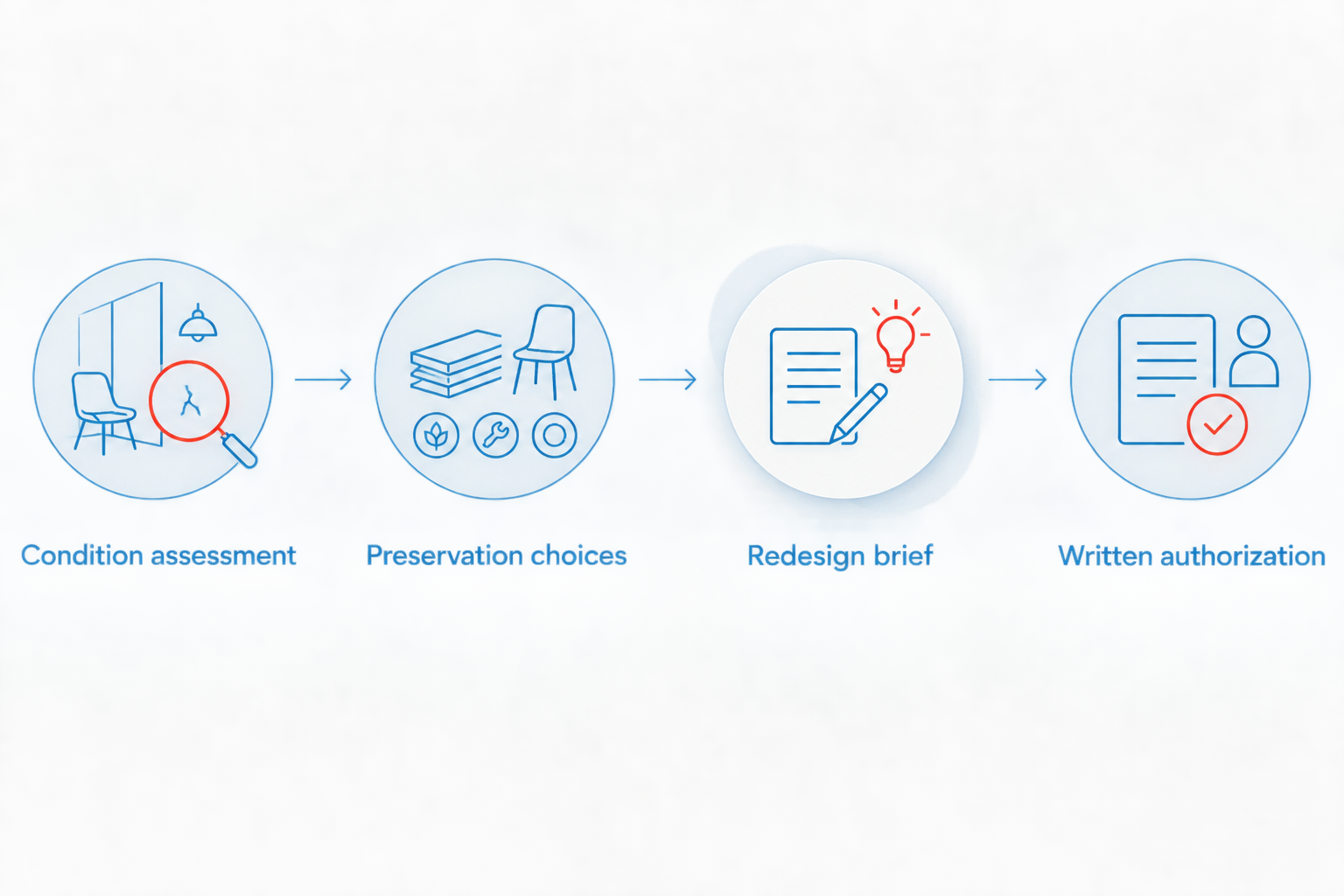
Condition assessment and preservation choices
Request findings before design decisions
- Ask for a condition assessment. Discuss loose stones, worn settings, cracks, previous solder joints, and other visible concerns. Ask which observations are confirmed and which require further examination.
- Clarify material identification. Ask what supports the stated metal content and gemstone identity. A stamp is useful evidence, but it does not describe every component or establish a gemstone’s treatment history.
- Discuss handling risks. Before authorizing stone removal, ask about chips, fractures, fragile settings, and any uncertainty affecting the proposed work. Request an explanation you understand rather than accepting technical terms without context.
- Flag potentially significant details. Ask whether signatures, unusual workmanship, or documented history warrant specialist review before alteration. Do not assume that material value captures the significance of an intact piece.
- Define the evaluation’s purpose. A repair assessment, a purchase offer, and a written insurance appraisal serve different purposes. Ask which service you are receiving and what documentation it includes.
Expected result: You understand what is known about the heirloom, what remains unresolved, and which actions would permanently change it. Stop here if those answers are unclear.
Choose the least change that meets your goal
Compare the routes before discussing a finished design. Each solves a different problem, and each has a limitation.
| Route | Best for | Main advantage | Main limitation |
|---|---|---|---|
| Preserve intact | Owners who prioritize the original object | Keeps the existing design and family details together | Does not resolve a style you dislike or every wearability concern |
| Repair | Owners who like the design but need a functional fix | Addresses a specific defect without requiring a full redesign | The original construction still limits the result |
| Limited modification | Owners seeking a focused change | Can address fit or function while retaining much of the piece | Even a small alteration can affect original details |
| Full redesign | Owners who want a different form or wearing style | Starts the design around your present needs | Can permanently change or eliminate the original setting |
Choose repair when the problem is a defect, not the design. Choose redesign when a different form is the goal and you accept the loss of original features identified during evaluation.
Uptownbullion provides jewelry repair and custom-made jewelry services. The practical benefit is having both routes to discuss; the limitation is that neither service description establishes whether your particular stones, metal, or original setting can be reused. Review the jewelry services before asking about your piece.
Your redesign brief
Turn the findings into instructions
- Name the intended piece. Specify the form you want to wear and the activities it must suit. Describe concerns such as snagging, a top-heavy ring, or a pendant that turns over.
- List what stays. Identify each stone, engraving, or component you want retained. Distinguish keeping the actual original metal from choosing a new piece with a similar appearance.
- Ask what can be reused. Discuss stone dimensions, condition, setting requirements, and the suitability of existing metal. Do not treat an old gold band as automatically suitable for direct reuse in a new casting.
- Define what can change. State your preferences for shape, setting height, finish, and the relationship between the original elements and new components. Bring reference images as explanations, not as proof that a design fits your materials.
- Record unresolved decisions. Ask for alternatives where feasibility is uncertain. Keep those choices open until the relevant assessment is complete.
Expected result: Your brief describes a wearable goal, preservation priorities, and material questions. It does not authorize the jeweler to solve every uncertainty without checking with you.
Keep the initial brief to 1 page. A short document makes conflicts visible: for example, keeping an entire engraved band while asking for a completely different ring shape needs discussion before approval.
Compare the proposal against your priorities
Ask the jeweler to explain how the proposed design addresses your original wearing problem. If the concern was snagging, discuss the setting profile; if it was an unworn brooch, discuss how a proposed conversion changes its balance and attachment.
For your 2026 redesign brief, mark each original feature as keep, change, or discuss. Do not let an attractive drawing stand in for a material-reuse decision. A drawing can show an intended appearance without confirming that every inherited component is suitable for it.
Written authorization and handoff
Confirm the scope before leaving the piece
- Request an itemized intake record. Ask for a description of the jewelry and components accepted, along with recorded condition observations. Compare that description with your photographs.
- Separate evaluation from alteration. Specify whether you are authorizing inspection only, a particular repair, stone removal, or construction. Avoid an open-ended instruction to do whatever is needed.
- Confirm the design approval method. Ask how you will review the proposed design and how later changes will be documented. Do not assume a sketch, model, or digital preview is included.
- Address removed materials. Ask how unused stones, old settings, and other remaining components will be handled. Put your agreed instructions in the work record.
- Define the next decision point. Agree on what happens if examination reveals damage or makes the proposed design unsuitable. Require further approval before work expands beyond the agreed scope.
Expected result: Both parties have the same description of the item, the authorized work, the preservation instructions, and the next approval point. Keep a copy before leaving the jewelry.
Date the final authorization in 2026 and identify the approved design version. If you change direction later, update the written scope instead of relying on a conversation alone.
Discuss your heirloom jewelry
Ask about jewelry repair and custom-made jewelry services before authorizing changes.
When repair replaces redesign
A repair-first workflow fits an heirloom you already like but cannot comfortably or safely wear. A broken clasp does not, by itself, create a reason to replace an entire necklace.
Start with the same photographs, ownership check, and condition assessment. Then narrow the brief to the defect: restore the fastening, address a worn setting, or discuss fit while preserving the existing design.
Ask whether the proposed repair addresses only the immediate problem or whether other worn components need attention. Record what remains unchanged and ask how the repair will affect nearby details.
Expected result: You authorize a defined repair rather than a redesign you did not need. The trade-off is straightforward: repair retains the design, but it does not turn that design into something different.
Troubleshooting
The jeweler cannot confirm a stone’s identity
Pause design decisions that depend on gemstone identity or treatment. Ask what further examination is needed and whether a qualified gemologist or laboratory should be involved before removal or resetting.
Family members disagree about changing the piece
Stop before irreversible work. Resolve ownership and permission separately from design preferences, then document the agreed preservation priorities before returning to the consultation.
The original metal is unsuitable for the proposed design
Separate preserving the heirloom’s meaning from reusing every material. Ask about retaining an intact component or revising the design; do not assume that using new metal requires discarding the original setting.
A newly discovered crack changes the plan
Return to the condition findings and request a revised scope. Ask what changed, which choices remain, and what additional work requires your approval before construction continues.
The proposal removes a detail you wanted kept
Return the proposal for revision before approval. Point to the specific engraving, arrangement, or component in your preservation list rather than asking for a generally more sentimental design.
Customize your workflow
Build your next step around the unresolved question, not around the most dramatic transformation. An insurance-documentation need calls for a different conversation from a broken fastening or a request for a new ring.
For Uptownbullion jewelry repair and custom-made jewelry inquiries, explain your intended outcome and ask what assessment is needed first. Keep sentimental decisions with you and technical feasibility questions with the person examining the piece.
Use one project record throughout 2026: original photographs, condition findings, approved design, authorization, and later changes. That record gives you a consistent reference when comparing the finished piece with what you approved.
FAQ
What happens during an heirloom jewelry evaluation to redesign consultation?
The consultation should establish condition, preservation priorities, and design feasibility before you authorize alterations. Ask which findings are confirmed and which need further examination.
Should I get an appraisal before redesigning inherited jewelry?
Clarify whether you need a formal appraisal before authorizing changes. Insurance, estate documentation, and design feasibility are different purposes, so ask which professional service addresses yours.
Can a jeweler reuse my heirloom’s original gold?
Reuse depends on the metal’s condition and suitability for the proposed work. Ask whether the plan preserves an existing component or involves making a new one; those are different outcomes.
Can my inherited gemstones go into a new setting?
A jeweler needs to assess the gemstones before confirming suitability for resetting. Condition, dimensions, and the proposed setting affect the decision, and removal risks need discussion before authorization.
Is repair better than redesign for heirloom jewelry?
Repair is the better starting point when you like the original design and need a specific defect addressed. Redesign fits a change in form or wearing style, with the trade-off of altering the original object.
What should I bring to a jewelry redesign consultation?
Bring the jewelry, available records, clear photographs, and a written list of details you want preserved. Reference images help explain your preferences but do not establish what your materials can support.
Does Uptownbullion offer custom jewelry and repairs?
Uptownbullion provides custom-made jewelry and watch and jewelry repair services in Dallas. Ask directly about assessment, documentation, and the proposed work for your heirloom before leaving it or authorizing alterations.
One last thing
Choose one feature you would regret losing before you choose the new design. An underside engraving or familiar arrangement of stones is easy to overlook when attention moves to the finished appearance. Put that feature in writing and make its treatment an explicit approval decision.