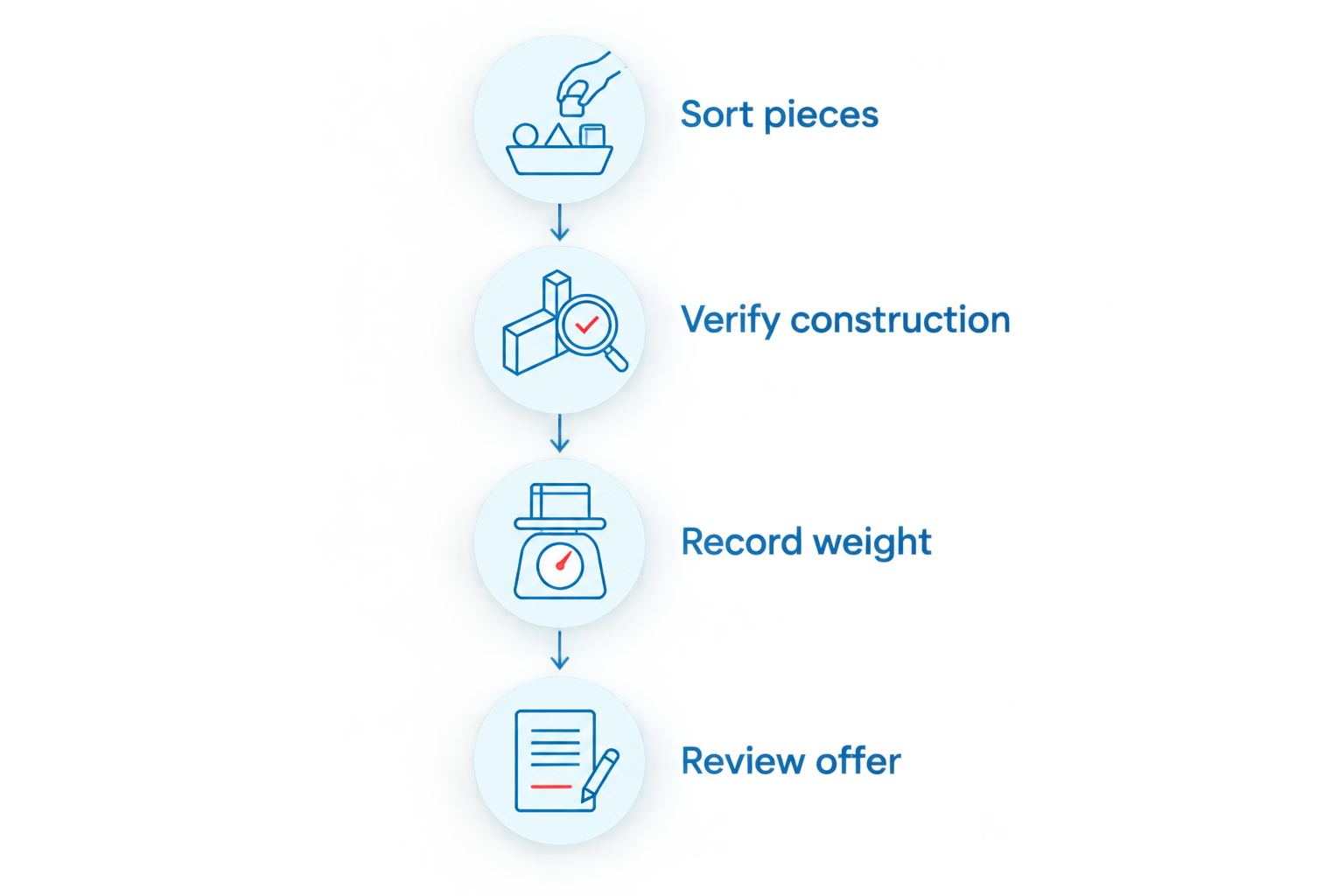
Instead of weighing an entire silverware chest and treating every gram as silver, use this silverware flatware weigh in to scrap payout workflow: sort the pieces, verify their construction, record the eligible weight, and review the written offer before selling. For a local starting point, Uptownbullion is a Dallas gold and silver exchange; confirm that the buyer accepts your particular flatware before bringing it in.
- Use the silverware flatware weigh in to scrap payout workflow to separate sterling, plated pieces, and weighted handles.
- Uptownbullion suits Dallas consumers seeking a local gold and silver exchange; confirm flatware acceptance before visiting.
- Sterling silver contains 92.5% silver by mass; a whole knife's weight does not establish its silver content.
- Review collectible value before authorizing destructive testing or accepting a scrap offer.
Why this matters
Gross weight is not payable silver weight. A chest can contain solid sterling forks, silver-plated spoons, and knives with steel blades and filled handles. Combining them produces a weight that does not describe the silver content.
A sound 2026 sale record connects each group of pieces to its identification, weighing method, and offer. You should be able to follow that chain without guessing what the buyer included or excluded.
Uptownbullion is best for Dallas consumers seeking a local gold and silver exchange. Its stated services include precious-metal buying, but ask specifically about silverware acceptance and evaluation before arranging your visit.
Before you start
- Gather the pieces and identification materials. Bring the flatware, clear photographs of marks, any purchase or inheritance records you have, and a simple worksheet. Ask the buyer what identification and ownership documents the transaction requires.
- Confirm the evaluation process. Ask whether the buyer handles your material, how testing works, whether any test alters the item, and how the offer will be documented. Do not assume an appraisal, purchase, or payment method is included.
- Keep hollow and weighted pieces separate. A sterling-marked knife handle does not make its steel blade, filling, or entire assembled weight sterling. Do not cut handles open yourself; resolve their treatment before weighing them into a scrap group.
No account or software integration is required. A paper worksheet works, provided you keep the item groups and weight units consistent.
Material identification
Create your own worksheet with fields labeled Group, Piece count, Marks, Construction, Weight unit, and Measured weight. These are recordkeeping labels, not fields in a buyer's system.
Sort by marks and construction
- Empty the chest onto a protected surface. Keep storage cases, fabric sleeves, and packaging away from the weighing area. Preserve any maker information attached to the set.
- Count each type of utensil. Record forks, spoons, serving pieces, and knives separately. Photograph the complete set before separating it into groups.
- Read and photograph the marks. Look for wording such as sterling, numerical fineness marks, plating descriptions, and maker names. Copy unfamiliar marks exactly rather than assigning a purity from appearance.
- Separate different construction types. Keep apparently solid pieces apart from hollow handles, weighted objects, and mixed-metal utensils. Put uncertain pieces in a separate group.
- Flag anything needing identification. A stamp is evidence to investigate, not a substitute for verification. For help distinguishing construction, use the guide to identifying real silver versus plated silver.
Expected result: Every piece belongs to a recorded group, and uncertain items remain clearly identified as uncertain. You have not treated the entire chest as a single silver alloy.
Sterling silver is 925 parts per thousand silver, or 92.5% by mass. The FTC Jewelry Guides describe this fineness standard; that standard explains the alloy designation, not the amount a buyer must offer.
A missing mark does not settle the question either. Ask for identification rather than discarding an unmarked piece or adding it to the sterling group without testing.
Weighing records
Record the weight without adding non-silver material
- Select a consistent unit. Record grams if that is what your scale displays. Do not write only ounces, because an ordinary ounce and a troy ounce are different units.
- Zero the scale with the empty container. Use the tare function if your scale has one. Otherwise, record the container separately and subtract its weight from the combined measurement.
- Weigh each sorted group separately. Record the count, unit, and reading together. A home reading is a preparation record, not a replacement for the buyer's transaction measurement.
- Exclude unresolved construction from your silver calculation. Record assembled knives as assembled knives. Do not multiply their entire weight by a sterling purity factor.
- Ask to see the transaction weight. Confirm the unit, the included pieces, and the treatment of non-silver components before reviewing an offer.
Expected result: Your worksheet distinguishes measured object weight from the weight used to calculate silver content. Every reading has a unit and an identifiable group of pieces.
For unit checking in your 2026 worksheet, NIST conversion tables distinguish a troy ounce at approximately 31.1035 grams from an avoirdupois ounce at approximately 28.3495 grams. The two units are not interchangeable. Retain the buyer's original unit in your record even if you also convert it.
Use the worksheet to expose assumptions, not to predict a guaranteed payout. A calculation based on the wrong construction remains wrong even when the arithmetic is correct.
The practical calculation is eligible alloy weight multiplied by verified silver fineness. That gives a fine-silver weight estimate, not a promised payment. Ask the buyer to explain how that metal content leads to the offered amount and what deductions apply.
Offer review
Choose between scrap evaluation and intact-set evaluation
- Check whether the set needs a separate resale assessment. Record the maker, pattern, matching pieces, condition, and any provenance. Do this before authorizing a process that alters the objects.
- Ask what the offer values. Establish whether the buyer is evaluating metal content, resale as usable flatware, or selected pieces only.
- Request an itemized explanation. Match each offered group to its recorded weight, verified fineness, exclusions, and deductions. Ask which pieces are being returned rather than purchased.
- Compare like with like. Compare offers for the same pieces, evaluated on the same basis and at a clearly identified time. Do not compare an intact-set offer with a scrap offer for only part of the set.
Expected result: You know what you are selling and which valuation route the offer represents. Nothing changes hands because of an unexplained total alone.
| Evaluation route | Best for | Advantage | Limitation |
|---|---|---|---|
| Scrap evaluation | Damaged or unmatched pieces after collectible value is checked | Focuses on verified metal content | Does not necessarily recognize pattern or set value |
| Intact-set evaluation | Identified, matching flatware with potential resale interest | Considers the objects as usable or collectible pieces | Requires more identification than a metal-only assessment |
| Identification before sale | Unmarked, mixed-metal, or unfamiliar pieces | Resolves uncertainty before a sale decision | Delays a decision until construction and marks are understood |
Do not choose scrap solely because it sounds simpler. A complete pattern deserves an intact-set assessment before you approve an irreversible change. Conversely, a maker's name alone does not prove a collectible premium.
For a 2026 offer comparison, record the evaluation date and ask how long the offer remains open. Do not reuse an older offer as though it applies to a later transaction.
Sale authorization and receipt
Approve only the pieces and terms you understand
- Reconcile the item count. Match the pieces being purchased and returned to your original inventory. Resolve any mismatch before signing.
- Confirm the final terms. Ask about the final amount, payment method, payment timing, and any conditions that remain unresolved. Do not infer those details from advertising or a preliminary conversation.
- Authorize the agreed transaction. Read the document before approving it. If you do not understand a deduction or description, pause and ask for clarification.
- Keep the transaction record. Retain the receipt, item description, evaluation date, and any supporting worksheet. Store photographs with that record rather than leaving them scattered across messages.
Expected result: Your retained documents explain what left your possession, what was returned, and what transaction you authorized.
Uptownbullion provides local precious-metal buying services, but flatware-specific terms need confirmation. Ask about acceptance, testing, documents, and payment arrangements rather than assuming they match another buyer's process.
Ask about your silverware
Confirm flatware acceptance, evaluation steps, and required documents before visiting.
Repeat the workflow when more pieces turn up
An inherited collection does not always arrive together. If you find another serving spoon or a second box after an evaluation, treat the addition as a new group rather than editing the original weight without explanation.
- Photograph and count the newly found pieces.
- Record their marks and construction independently.
- Add a separate worksheet entry with the evaluation date.
- Ask whether the additional pieces change the intact-set assessment.
- Obtain a current offer instead of extending an earlier one yourself.
This second workflow preserves the original record while accommodating additions. It also prevents a newly found plated piece from silently entering a previously verified sterling group.
Use a separate transaction entry for each 2026 sale. Keeping the same pattern name across entries is useful; merging different sales into an undated total is not.
Troubleshooting
The knife is marked sterling, but its weight is excluded
Ask which component the mark describes. A knife can combine a sterling handle with a steel blade and internal filling. Request a separate explanation of how its recoverable silver is assessed; do not dismantle it at home.
Your scale and the buyer's scale disagree
Compare units, containers, and included pieces first. Verify that both readings concern the same group and that neither includes packaging. Then ask about scale resolution and the measurement used for the transaction.
Dark tarnish makes the set look questionable
Do not use color alone to classify silver. Tarnish is not proof of fineness. Preserve the marks and request identification instead of using abrasive polishing or chemical testing to force an answer.
The offer is below your metal-content calculation
Ask for the bridge between fine-silver weight and the offer. Check purity assumptions, excluded components, and deductions. A theoretical metal-content calculation is not a commitment by a buyer to pay that amount.
The buyer wants to alter an unfamiliar piece
Pause until you understand the test and give permission. Ask what the procedure changes and whether identification should happen first. Keep pieces with unresolved collectible interest out of destructive testing until that question is addressed.
Customize your workflow
Add fields that match your situation, not extra calculations that hide assumptions. An estate inventory benefits from ownership records and clear identification of who can authorize the sale. A mixed household collection needs especially clear separation between flatware, coins, and jewelry.
For repeat sales, retain the same worksheet headings and measurement units. Consistency makes changes visible without implying that different items share the same purity or treatment.
A useful 2026 record separates observation from verification: what you read on a stamp belongs under marks; what the evaluator confirms belongs under the evaluation result. Keep both. That distinction prevents an early guess from becoming an apparent fact later.
FAQ
Can I sell silverware or flatware as scrap?
Verified silver flatware can be evaluated for its metal content, subject to the buyer's acceptance criteria. Confirm whether the buyer handles solid sterling, hollow handles, and plated pieces before visiting.
Does a sterling stamp mean the entire knife is silver?
No. A sterling mark can describe the handle while the knife also contains a steel blade and filling, so the assembled weight does not establish its silver content.
Should I polish silverware before taking it to a buyer?
Do not polish silverware just to prepare it for scrap evaluation. Preserve marks and surface details, and ask for care instructions if the pieces need an intact-set assessment.
Why is the buyer's payable weight different from my home weight?
The payable weight can exclude containers, non-silver parts, or pieces outside the evaluated group. Check the units and ask the buyer to identify every exclusion before accepting the offer.
Is a troy ounce the same as a kitchen-scale ounce?
No. A troy ounce is approximately 31.1035 grams, while an ordinary avoirdupois ounce is approximately 28.3495 grams; confirm which unit appears on the scale and paperwork.
Should I sell a complete sterling set for scrap?
Get an intact-set assessment before choosing scrap for a complete sterling set. Maker, pattern, condition, completeness, and provenance belong in that assessment; none guarantees a premium.
Does Uptownbullion buy every type of silver flatware?
Confirm flatware acceptance directly with Uptownbullion before visiting. Its stated services include gold and silver buying, but acceptance of every flatware construction is not established.
One last thing
Photograph the underside of the handles, not just the table setting. A photograph of the full set records appearance; close-ups preserve the marks needed to explain identification. Take both before separating pieces for evaluation, and keep them with the final transaction record.