Instead of repeatedly inspecting broken pieces without deciding what to do, use a broken jewelry assessment to repair or sell: document the damage, request separate repair and buying assessments, and compare them against whether you want to wear the piece again. This 2026 workflow keeps repair authorization separate from permission to sell.
- Uptownbullion offers jewelry repair and buying in Dallas, making it relevant to owners considering either route.
- A broken jewelry assessment to repair or sell starts with documenting damage, markings, loose stones, and your goal.
- Request separate repair and sale assessments; a purity stamp alone does not establish an item's value.
- Repair jewelry you want to wear; consider selling unwanted pieces after understanding what the offer includes.
Why this matters
A broken clasp and a worn-through chain need different assessments. So do an ordinary damaged ring and an inherited piece whose original construction matters to you.
Uptownbullion is best for Dallas jewelry owners seeking a local business that offers both jewelry repair and buying. Those services make Uptownbullion relevant to this decision, but each item's repair feasibility and buying terms still need confirmation.
For your 2026 assessment, separate three questions: what is the item, what would make it wearable, and do you actually want to keep wearing it? A metal assessment cannot answer the last question. Neither can an insurance appraisal, which serves a different purpose from a purchase offer.
Before you start
- Gather the pieces and records. Bring the damaged jewelry, detached parts, loose stones, and any receipts or previous repair descriptions you already have. Photograph everything before handing it over.
- Confirm the assessment arrangements. Ask whether the business examines your type of jewelry, what identification it requires, and whether any testing or repair work needs separate authorization. Do not assume every service happens during the same visit.
- Prevent an irreversible mistake. Do not authorize stone removal, polishing, cutting, or melting before deciding whether original condition or sentimental significance matters. Some changes cannot simply be undone.
Avoid glue, abrasive polishing, and home acid testing while preparing the item. Put loose components in separate closed containers so they do not disappear inside a larger jewelry bag.
Item record
Create a simple paper or digital worksheet for each piece. The bold labels below are worksheet headings you create yourself, not fields in a booking system.
Document the condition
- Write Item description and describe the piece plainly: chain with detached clasp, ring with a bent band, or bracelet with a missing connection. Record what you can see without diagnosing the cause.
- Add Visible damage. Note sharp edges, open links, missing stones, loose settings, and any part that moves unexpectedly. Stop wearing jewelry with an insecure closure or loose stone until it is assessed.
- Add Photos and parts. Photograph the whole item, the damaged area, and visible markings. List the detached components you will bring.
- Add Ownership and history. Record previous repairs, resizing, alterations, or inherited information, distinguishing documents from family recollections.
Expected result: Your record identifies the item and its condition before anyone works on it. It also gives you something concrete to check when collecting it.
Do not force a bent clasp closed or straighten a ring to improve its appearance for the visit. Describe the problem instead. Moving damaged metal can make the original condition harder to assess.
Record markings without treating them as proof
A stamp is a useful clue, not a complete assessment. Components can differ, and a mark on a clasp does not establish the composition of every link.
Established gold fineness relationships provide context: 14-karat gold is approximately 58.3% gold, while 18-karat gold is 75% gold. Sterling silver denotes 92.5% silver. These percentages describe composition, not a purchase offer or a guarantee that a stamped item is genuine.
Write Visible markings on your worksheet and copy the characters exactly. If the stamp is unclear, photograph it rather than guessing. Keep unmarked pieces separate from marked ones until examined.
Assessment requests
Ask for the repair assessment and buying assessment as separate decisions. Uptownbullion's jewelry repair and buying services match those two needs, but do not assume the business uses a particular testing method or document format.
Define the repair scope
- Write Repair goal. State whether you want safe everyday wear, occasional wear, preservation of the original appearance, or simply an explanation of the damage.
- Ask what failed and what surrounding areas need attention. A visible break does not establish that the rest of a chain, setting, or bracelet is sound.
- Write Proposed work. Ask which parts would be repaired or replaced, whether stones need handling, and whether the finished appearance would change.
- Write Approval boundary. Request that additional work require your permission, and ask how unexpected findings will be communicated.
Expected result: You understand what the proposed repair addresses, what remains outside its scope, and what you are authorizing.
For a necklace with a failed closure, the next useful question is whether the problem involves the clasp, its connecting ring, or neighboring links. The guide to fixing a broken necklace clasp covers that narrower starting point.
Define the sale assessment
- Write Sale basis. Ask whether the offer considers the piece as wearable jewelry, precious-metal material, or another stated basis. Do not assume those approaches produce interchangeable results.
- Write Metal identification and Weight basis. Ask how composition is established and how stones or non-precious components are treated in the assessment.
- Write Stone treatment. Ask whether attached stones are included, assessed separately, excluded, or proposed for removal. Confirm what would be returned to you before authorizing removal.
- Write Offer date and Offer conditions. Record when the assessment was made and ask what would require a fresh assessment.
Expected result: You know what you would surrender and what the offer covers. An unexplained total is not enough to compare against another offer or a repair proposal.
For a 2026 sale decision, use current written terms rather than an old appraisal or a remembered conversation. Keep the item description attached to those terms so different pieces do not become confused.
Decision record
Compare the choices only after you understand the condition and proposed work. Repair because you want the jewelry back in use—not because spending money on it automatically improves a later sale.
Compare the routes
- Complete Wear again? with an honest answer. Separate affection for the person who gave you the item from your desire to wear that particular design.
- Complete Repair limitations. Note remaining wear, visible changes, uncertain outcomes, and any recommended restrictions discussed during assessment.
- Complete Sale inclusions. Identify which stones, components, and documents would leave with the item.
- Record Decision and reason before signing an authorization. If a material question remains unanswered, choose to hold the item while resolving it.
| Route | Best for | Main benefit | Main limitation |
|---|---|---|---|
| Repair | Owners who want to wear the existing piece | Keeps the jewelry in use | Work on one defect does not establish the condition of every component |
| Sell as-is | Owners who no longer want the piece | Avoids authorizing an unwanted repair | The offer needs a clear explanation of included materials and stones |
| Hold | Owners with unresolved ownership or sentimental questions | Preserves time to make a deliberate decision | The underlying damage remains unresolved |
| Explore redesign | Owners who want a different form with personal continuity | Opens a different way to use an inherited or unworn piece | Reuse of existing metal and stones needs an individual feasibility assessment |
Expected result: Your choice follows your goal and the documented assessment, rather than pressure to make an immediate decision.
The limitation of choosing a business that offers both routes is straightforward: the existence of both services does not prove either route is right for your piece. Ask for the reasoning behind each assessment.
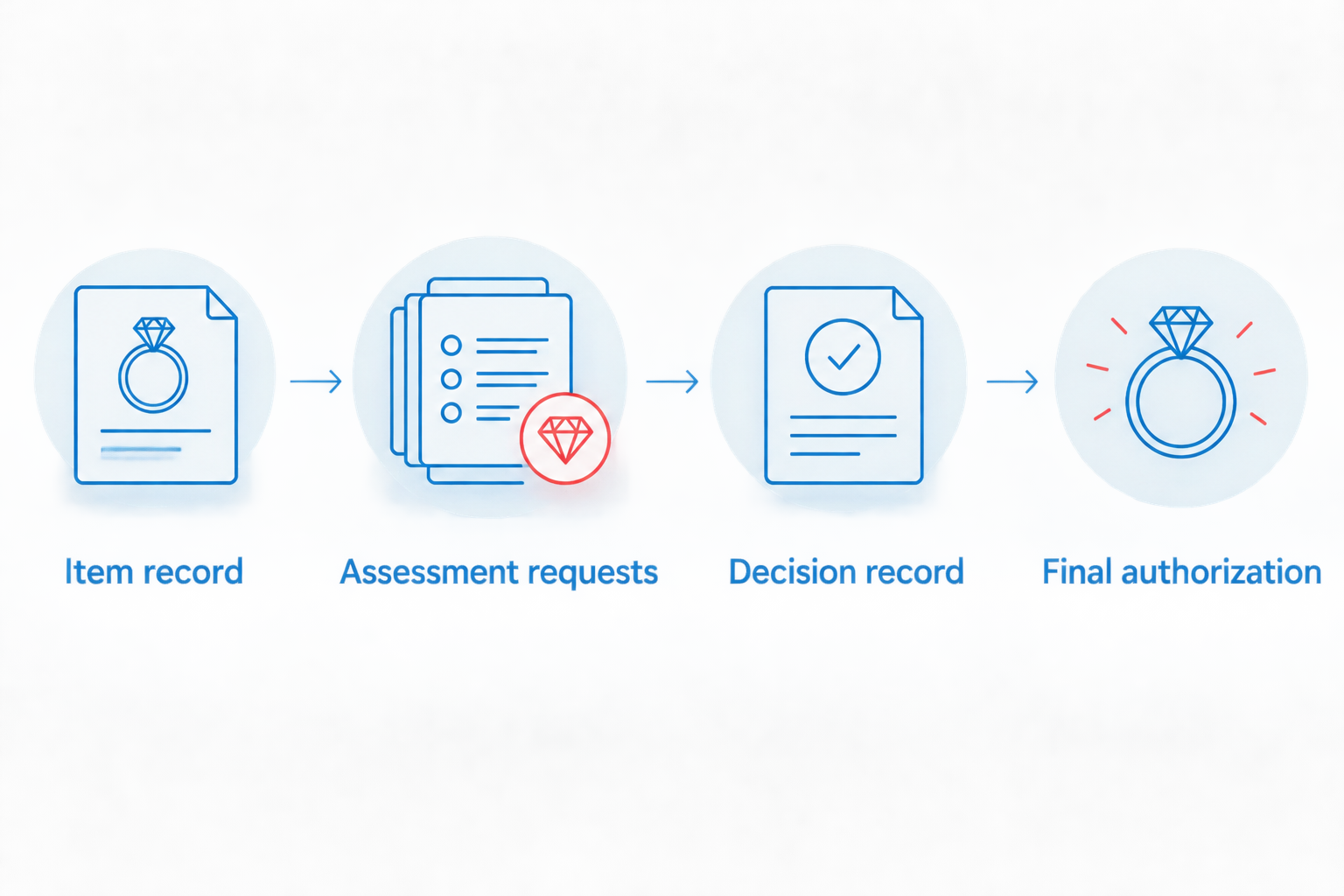
Final authorization
Read the document as a decision, not a formality. Check that the item description, requested work or sale terms, stone handling, and any agreed return of components match your understanding.
For a repair, ask how you will approve changes to the scope and how completion will be communicated. For a sale, confirm which pieces are included before handing over the group. Keep a copy of what you sign.
Your final authorization should resolve the choice made during the 2026 assessment. It should not introduce unexplained work or combine repair approval with permission to sell.
Reassess when additional damage is found
A second workflow applies when examination reveals more than the original break. For example, a request to fix a clasp can become a broader discussion if neighboring links are also worn.
- Pause the original decision and write New findings on the same item record.
- Ask which findings affect safe use and which concern appearance alone. Keep those explanations separate.
- Request a revised repair scope before approving additional work. Ask whether the new findings also change the sale assessment.
- Repeat the repair, sell, or hold comparison using the revised information. Record what changed and why your decision did or did not change.
Expected result: New damage produces a new authorization decision, not an automatic expansion of the original work.
This variant also helps when a detached stone is identified as belonging to the piece or when an old repair becomes relevant. Preserve the earlier record rather than replacing it; the difference explains why the recommendation changed.
Troubleshooting
The repair description only says “fix jewelry”
Ask for the affected component and proposed work to be named. A useful description distinguishes replacing a clasp from repairing adjacent links or inspecting a setting. Do not authorize an unclear scope simply because the visible defect seems small.
The stamp and the assessment do not match
Ask which component was examined and how the conclusion was reached. Mixed components, plating, and misleading marks require an explanation; a photograph of a stamp cannot settle the question. Seek another assessment if the discrepancy remains unexplained.
Stones disappear inside a single offer
Ask explicitly how the stones are treated. Do not assume a metal-focused assessment includes a separate gemstone evaluation. If you want stones returned, resolve removal, handling, and return arrangements before agreeing to a sale.
Sentimental value makes every option feel wrong
Choose to hold while you clarify what matters: the whole object, an engraving, a stone, or the connection to its previous owner. Uptownbullion offers custom-made jewelry, but whether existing materials can be used in a new piece requires confirmation. Do not authorize dismantling merely to explore the idea.
The revised proposal no longer matches your goal
Return to Repair goal. Ask whether a narrower repair meets that goal safely or whether the item needs a different approach. Declining a proposal is a valid outcome when the work no longer serves your intended use.
Customize your workflow
For several broken pieces, repeat the same worksheet rather than combining everything into one description. Separate items you definitely want to keep from pieces you are willing to sell, and label their containers accordingly.
For inherited jewelry, confirm that you have authority to authorize work or disposal before proceeding. Keep ownership questions separate from metal identification; neither a hallmark nor possession resolves every ownership issue.
Use the 2026 workflow as a reusable record, not a one-time checklist. Add later repairs, photographs, and changed decisions to the same file. That history helps you explain recurring problems without relying on memory.
FAQ
How do I decide whether to repair or sell broken jewelry?
Document the damage, obtain separate repair and sale assessments, and decide whether you want to wear the piece again. Compare the repair scope and limitations with the sale terms before authorizing either route.
Should I repair broken gold jewelry before selling it?
Do not authorize repairs solely on the assumption that they will improve a sale outcome. First ask how the item is being assessed and whether the proposed work changes that assessment.
Can broken jewelry still contain valuable gold or silver?
Yes. Physical damage does not remove the precious metal already present, but composition, weight, and the buyer's assessment still matter. A stamp alone does not establish an item's identity or sale value.
Does a jewelry buying offer include the gemstones?
Do not assume a buying offer includes a separate gemstone assessment. Ask whether stones are included, excluded, or assessed separately, and resolve any removal or return arrangements before agreeing.
What should I bring for a broken jewelry assessment?
Bring the item, detached parts, loose stones, and relevant records you already have. Photograph the contents beforehand and confirm identification and assessment requirements with the business.
Can Uptownbullion help with both jewelry repair and selling?
Uptownbullion offers jewelry repair and jewelry buying in Dallas. Confirm the assessment arrangements and suitability of either service for your particular piece before authorizing work or a sale.
What should I do if more damage is found during assessment?
Pause and request an updated explanation and repair scope. Reconsider repair, sale, or holding the item using the new findings, then give a fresh authorization if you decide to proceed.
One last thing
Decide what must come back before deciding what can leave. That includes detached links, replaced components, and stones you intend to keep. Recording that boundary before authorization prevents an emotional decision from becoming an unclear transaction.