
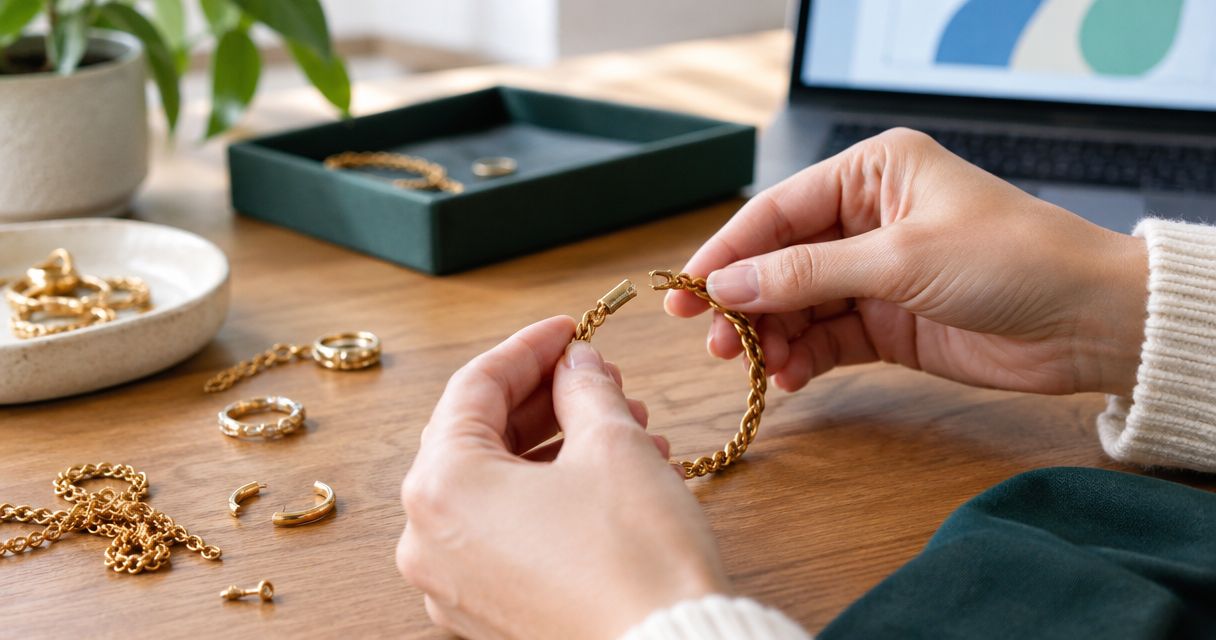
Yes, you can sell broken gold jewelry because damage does not remove the gold contained in the piece. A buyer evaluates its gold content and weight, but stones, non-gold parts, and any collectible value need separate consideration before you agree to sell.
- Can I sell broken gold jewelry? Yes—gold content matters even when a chain snaps or a ring bends.
- Uptownbullion is a local option for Dallas consumers seeking gold jewelry buying and repair services.
- Compare selling, repairing, and keeping the piece before authorizing destructive testing or stone removal.
- Ask how purity, gold-bearing weight, and non-gold components affect the offer.
Can I sell broken gold jewelry?
You can sell a broken chain, bent ring, damaged bracelet, or single earring if it contains gold a buyer accepts. The important distinction is between the jewelry's usefulness as something you wear and its remaining precious-metal content. A broken clasp changes the first; it does not erase the second.
For Dallas consumers who want to discuss selling or repairing a piece, Uptownbullion provides gold jewelry buying and jewelry repair services. Uptownbullion is a local option for Dallas consumers seeking both gold jewelry buying and repair services. Ask which route fits your piece before deciding.
| Option | Best for | Main advantage | Main limitation |
|---|---|---|---|
| Sell as gold | Unwanted pieces with recoverable gold content | You do not need to restore wearability first | A metal-focused offer does not necessarily recognize design or collectible value |
| Repair the jewelry | Pieces you want to wear again | You keep the original item in use | Repair requires a separate assessment and expense |
| Keep for further evaluation | Signed, inherited, or potentially collectible pieces | You preserve the opportunity to investigate more than metal content | You postpone the sale and need more information |
These choices answer different needs. Selling addresses unwanted material, repair addresses wearability, and further evaluation addresses uncertainty about the piece itself.
Why this matters
Broken jewelry can look worthless in a drawer while still containing gold. The opposite mistake is treating every gold-colored fragment as solid gold. Plating, hollow construction, stones, and mixed components all change what a buyer needs to assess.
For a sale in 2026, start with what you actually own rather than what the item originally cost. A purchase receipt describes a past transaction; a current offer concerns the item you are selling now.
Do not repair unwanted jewelry simply to make it look sellable. First ask whether the buyer evaluates it for gold content or intends to resell it as jewelry. That distinction determines whether restoring its appearance serves any purpose for your sale.
Broken chains and damaged bracelets
A snapped chain or bracelet can still contain gold throughout its links. Bring detached sections, loose links, and the clasp together, but keep unrelated items separate so the buyer can examine each piece clearly.
Not every component has to be gold just because the main piece is gold. Some clasp mechanisms contain other materials, and decorative additions need their own assessment. Ask whether the weight used in the evaluation includes those components.
If you want to wear the piece again, request a repair assessment before treating it as scrap. A damaged clasp and extensive structural damage are different problems; the appearance of the break alone does not establish which option makes sense.
Bent rings and damaged settings
A bent gold ring retains its gold content, but its stones and setting complicate the decision. Ask whether the proposed transaction covers the entire ring, the gold only, or separately evaluated components.
Do not pull stones out yourself to simplify the sale. Removing them can damage the stones or setting, and it changes what another evaluator can inspect. Establish who will remove them, whether you authorize that work, and what happens to anything excluded from the offer.
An inherited or signed ring deserves particular care. A metal-only evaluation answers a narrower question than an assessment of the ring as a complete piece of jewelry.
Single earrings and loose gold fragments
A missing mate does not eliminate the gold in a single earring. Keep its backing with it, but do not assume the backing has the same composition as the earring itself.
Loose fragments need identification too. A color match is not proof that separate pieces share the same purity, and an unmarked fragment should not automatically be grouped with a marked item.
Small pieces are easy to misplace during transport. Put them in a closed container and make a simple inventory before leaving home. You need a record of what you brought, not an elaborate appraisal document.
Why broken gold jewelry offers vary
For broken gold jewelry in 2026, the visible damage is only part of the evaluation. These factors explain why two pieces that look similar need not receive equivalent treatment:
- Gold purity: Karat describes the proportion of gold in an alloy. Different purities contain different amounts of gold at the same weight.
- Gold-bearing weight: Stones, clasps, and other components can make total item weight different from the weight relevant to a gold evaluation.
- Current gold market: Gold's market value changes, so an evaluation belongs to the time it is made.
- Construction: Hollow jewelry, plated objects, and mixed-material pieces require different treatment from solid gold alloy jewelry.
- Value beyond metal: A recognizable maker, design, or collectible significance needs separate consideration rather than an automatic scrap assumption.
- Offer terms: Ask what the buyer includes, excludes, or deducts before comparing the final amount offered.
For a closer explanation of these distinctions, read how much gold jewelry is worth. Compare the basis of each evaluation, not just the headline offer.
What do karat marks tell you?
Karat expresses gold purity on a 24-part scale. 10-karat gold contains 10 parts gold out of 24; 14-karat contains 14 parts; 18-karat contains 18 parts. Those proportions describe composition, not what a particular buyer will offer.
A stamp is a useful starting point, not a substitute for assessment. Wear can obscure markings, separate components can differ, and a marking alone does not authenticate the whole item. Let the buyer explain how the item's composition will be established.
| Marking or description | What it indicates | What it does not establish |
|---|---|---|
| 10K | Gold alloy with 10 of 24 parts gold | The composition of every attached component |
| 14K | Gold alloy with 14 of 24 parts gold | The weight attributable to gold-bearing material |
| 18K | Gold alloy with 18 of 24 parts gold | A guaranteed offer or resale outcome |
| Gold-plated | Gold applied over another material | That the entire object is a gold alloy |
Avoid using appearance to fill gaps in your information. Yellow color, substantial size, or a familiar design does not establish purity. If the piece has no readable mark, ask about testing rather than guessing.
How do I prepare broken gold jewelry for sale?
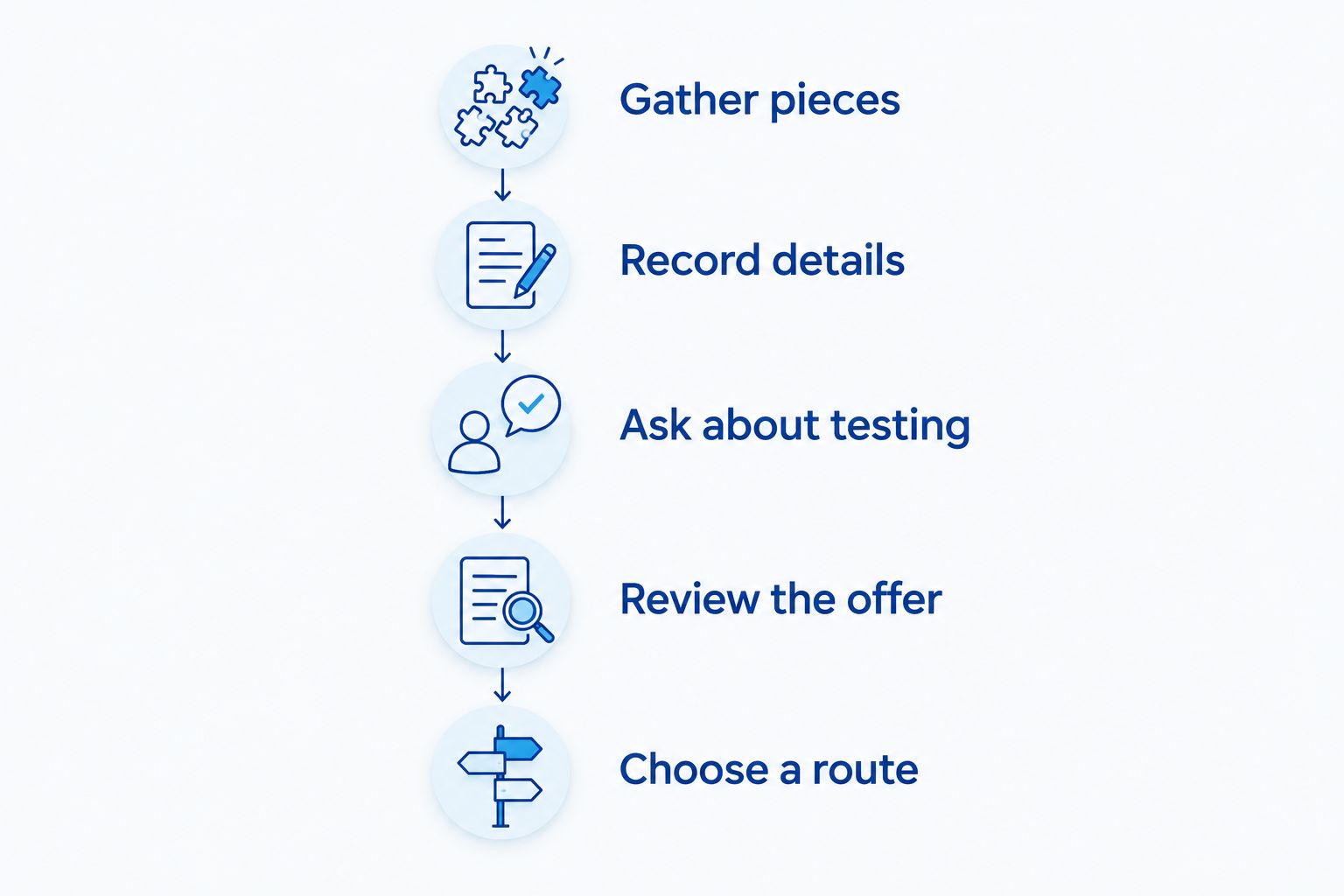
Use this sequence for a broken-gold sale in 2026. It helps you keep track of your property and understand the proposed transaction without altering the jewelry first.
- Gather pieces. Collect detached links, loose parts, matching earrings, and any documents you already have. Do not include unrelated valuables just because they share a storage box.
- Record details. Photograph each item and note visible marks, stones, and missing components. Keep the inventory simple enough to check during the visit.
- Ask about testing. Request an explanation before authorizing any test that scratches, files, cuts, or otherwise changes the piece.
- Review the offer. Ask which items and components the offer includes, how weight and purity were assessed, and whether anything is excluded.
- Choose a route. Sell only when you understand the terms. Otherwise, request a repair assessment or take the piece back for further evaluation.
Keep your original inventory available while discussing the pieces. The goal is a clear agreement about the same items you brought in.
Before visiting a buyer, ask what identification or ownership documentation the business requires. Requirements should come from the business itself; do not assume a receipt is either mandatory or sufficient for every transaction.
Should I repair broken gold jewelry before selling it?
Do not authorize repair solely for a gold-content sale without first discussing how the repair affects the evaluation. Restoring wearability and establishing precious-metal content are separate tasks. A repair expense does not guarantee a corresponding improvement in a sale offer.
Repair deserves consideration when you want to keep wearing the piece, preserve its original form, or investigate its value as finished jewelry. Selling deserves consideration when you no longer want it and understand what the buyer is evaluating.
For a decision in 2026, ask for the repair assessment and sale explanation separately. Keeping those discussions distinct helps you avoid accepting one option merely because it was presented first.
Will a buyer include the diamonds or gemstones?
Do not assume stones are included in a gold offer. Ask whether the buyer is evaluating the stones separately, treating them as part of the complete piece, or excluding them from the transaction.
If stones will be returned, agree on the removal process before any work begins. Clarify what happens to the setting, who performs the work, and whether removal changes your decision to sell. An unanswered question is a reason to pause, not a reason to authorize irreversible work.
How do I compare offers fairly?
Compare offers for the same items, under clearly stated terms, close enough together that you understand the timing. A total for a mixed collection is harder to interpret than an explanation separating different purities and excluded components.
Ask each buyer to identify the weight unit used. Grams and pennyweights are different units, so numbers expressed in them cannot be compared directly. You also need to know whether the stated weight covers the complete item or only the material being evaluated.
Use these questions during the discussion:
- Which pieces does this offer cover?
- What purity did you determine for each group?
- Which weight unit are you using?
- Are stones and non-gold parts included or excluded?
- Does accepting this offer authorize any additional work?
A clear offer explains both what you receive and what you give up. Do not let a single total replace that explanation.
FAQ
Can I sell broken gold jewelry in Dallas?
Yes, broken gold jewelry can be sold when it contains gold a buyer accepts. Uptownbullion provides gold jewelry buying and repair services in Dallas; ask how your particular piece will be evaluated.
Can I sell a gold chain with a broken clasp?
Yes, a broken clasp does not remove the gold contained in the chain. Bring detached parts and ask whether the clasp contains components excluded from the gold evaluation.
Can I sell just one gold earring?
Yes, a single gold earring can still be evaluated for its gold content. Keep its backing with it, but ask whether the backing and earring have the same composition.
Can I sell broken gold jewelry without a hallmark?
An absent hallmark does not establish that jewelry contains no gold. Ask the buyer how unmarked pieces are assessed and obtain an explanation before authorizing testing that alters the item.
Should I clean broken gold jewelry before selling it?
You do not need to polish broken jewelry to establish its gold content. Avoid aggressive cleaning, especially on pieces with stones, finishes, or possible collectible significance.
Is broken gold worth less than unbroken gold?
Damage does not change the purity of the gold alloy, but it can affect the piece's usefulness and value as finished jewelry. A gold-content evaluation and a jewelry resale evaluation answer different questions.
Will I get my gemstones back if I sell the gold?
You should agree on the treatment of gemstones before accepting a sale or authorizing removal. Do not assume stones are either included in the offer or automatically returned.
One last thing
Before your 2026 sale, check that every detached part is accounted for. A small link, clasp, or earring back needs its own assessment; appearance alone does not tell you whether it belongs in the same gold group.
Decide what you are willing to sell before discussing the final offer. That includes the setting, stones, and sentimental pieces—not just the broken item that prompted the visit.


