
Your gold jewelry’s estimated metal value equals its gold-alloy weight multiplied by its gold purity and the current gold value per gram. Your cash offer is a separate figure: it reflects the buyer’s terms, while gemstones, workmanship, and collectible appeal require their own assessment. For a 2026 valuation, separate the value of the gold from the value of the finished piece before deciding to sell.
- How much is my gold jewelry worth? Start with gold-alloy weight, karat purity, and the current gold reference.
- Melt value estimates gold content; a buyer’s cash offer and an insurance appraisal measure different things.
- 14-karat gold contains approximately 58.3% gold; stones and other non-gold components need separate treatment.
- Uptownbullion is best suited to Dallas consumers seeking a local gold-jewelry buyer.
Why this matters
A replacement appraisal, an online calculator, and a purchase offer answer different questions. Comparing them as though they measure the same thing creates confusion, especially when you are selling an inherited ring or a chain bought years ago.
Choose the valuation that matches your decision. If you want to sell, ask what you will receive for the item, not what a similar new piece would cost. Uptownbullion buys gold and jewelry in Dallas; ask how a proposed purchase offer treats the metal and any stones separately.
How much is my gold jewelry worth?
Use this calculation to estimate the gold-content value:
Gold-alloy weight in grams × gold purity as a decimal × current fine-gold value per gram = estimated gold-content value.
The weight must represent the gold alloy, not automatically the entire item. A ring’s total weight includes its stone; a watch can include a movement, crystal, and steel components. Applying the gold percentage to everything overstates the amount of gold.
For your 2026 worksheet, record the gold reference’s date, time, and unit. Gold quoted per troy ounce must be converted before you use a weight measured in grams. One troy ounce equals approximately 31.1035 grams; an ordinary household ounce is a different unit.
| Valuation | Best for | What it tells you | Main limitation |
|---|---|---|---|
| Gold-content or melt estimate | Checking the metal calculation | The reference value of the gold contained in the alloy | Does not establish the cash offer or finished-jewelry value |
| Purchase offer | Deciding whether to sell | What a particular buyer offers for the item | Depends on that buyer’s assessment and terms |
| Resale valuation | Assessing a wearable or collectible piece | The item’s value as jewelry rather than only metal | Requires attention to condition, identity, stones, and demand |
| Insurance replacement appraisal | Documenting replacement needs | An opinion of replacement value for the stated purpose | Is not a promise of sale proceeds |
A correct melt calculation is a reference point, not a guaranteed payout. Keep that distinction visible when comparing figures.
10-karat gold: approximately 41.7% gold
Ten-karat gold contains 10 parts gold out of 24 parts of alloy. Its theoretical gold fraction is approximately 0.4167, so only that share of the gold-alloy weight belongs in the fine-gold calculation.
For equal alloy weights, 10-karat jewelry contains less gold than 14-karat or 18-karat jewelry. That makes the metal-content calculation lower, but it does not tell you whether the finished piece has value beyond its gold.
Look for a karat mark as a starting clue, not final proof. A worn mark, repaired section, or mixed-metal construction needs closer examination before you rely on the stamp.
14-karat gold: approximately 58.3% gold
Fourteen-karat gold contains 14 parts gold out of 24, or approximately 58.3% gold. Use 14 divided by 24 when calculating rather than rounding the purity too early.
A 14-karat ring’s gold content is not 58.3% of its total weight if that total includes a gemstone. You first need an appropriate gold-alloy weight, with non-gold components accounted for.
Best for checking a 14-karat offer: ask for the assessed purity and the weight used. A total offer without those details is harder to compare against a separate buyer’s assessment.
18-karat gold: 75% gold
Eighteen-karat gold contains 18 parts gold out of 24, which equals 75% gold. Its gold fraction is 0.75.
At equal gold-alloy weights and the same gold reference, 18-karat jewelry contains more gold than either 10-karat or 14-karat jewelry. A heavier lower-karat piece can still contain more gold overall than a lighter higher-karat piece.
Do not rank pieces by karat alone. Weight and purity work together, and a finished piece’s identity, condition, and stones require a separate judgment.
Why gold jewelry value varies
Two pieces that look similar can produce different valuations. These factors explain the differences without assuming that appearance or original purchase cost determines today’s offer.
- Gold purity: Karat changes the proportion of gold in the alloy. Testing and construction details matter when a hallmark does not tell the whole story.
- Gold-alloy weight: Stones, steel springs, watch movements, and other non-gold parts do not belong in the gold-content calculation.
- Gold reference: The market reference and its timestamp affect the calculation. Keep the reference unit consistent with the measured weight.
- Finished-piece characteristics: Maker identification, condition, craftsmanship, and documented provenance can matter when jewelry is assessed for resale.
- Gemstones: Stone identity, quality, and condition need their own assessment. A gold-content estimate does not assign them a value.
- Buyer terms: Ask what deductions apply and what the final proceeds will be. Compare the amount you receive, not just a headline description of the offer.
For a useful 2026 comparison, keep these inputs consistent wherever possible. A quote for metal alone is not directly comparable with an offer that also assigns value to a diamond or to the piece as wearable jewelry.
How to check a gold jewelry offer before selling
You do not need to identify every technical feature yourself. You do need a clear record of what is being assessed and how the offer relates to it.
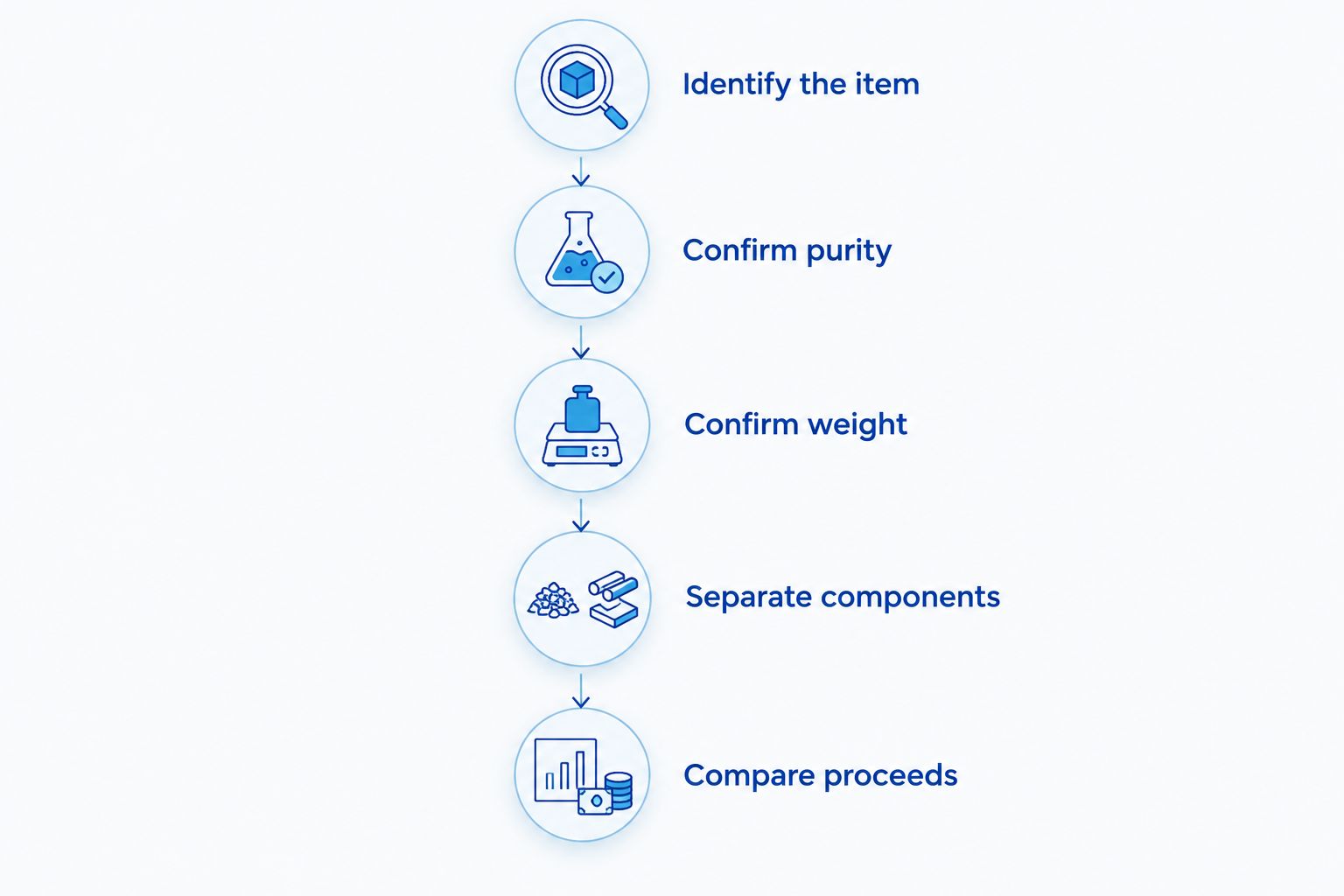
- Identify the item. Photograph the piece and any visible marks. Gather an existing appraisal, receipt, or maker documentation if you have it, but do not treat those documents as a current cash offer.
- Confirm purity. Ask how the buyer established the gold content. Make sure the explanation addresses mixed metals, repairs, or uncertainty about a stamp.
- Confirm weight. Ask which unit is being used and how stones or other components are handled. Keep different karats separate in your notes.
- Separate components. Ask whether the offer values only the gold, the gold and stones, or the finished piece. Do not assume that a gemstone has been included.
- Compare proceeds. Request the final amount you would receive and an explanation of any deductions. Decide only after you understand what you are transferring.
Keep the item descriptions attached to the figures. If you take several pieces together, an itemized record helps you understand why one piece receives a different assessment from another.
The scrap gold weigh-in to cash payout guide covers the sale process in more detail. Use it to prepare questions before handing over jewelry for assessment.
Should you sell for gold content or as finished jewelry?
Best for broken, unremarkable pieces: check the gold-content calculation first. A broken clasp or missing link does not remove the gold from the remaining alloy, although missing parts reduce the weight available to assess.
The advantage of a metal-focused assessment is clarity: weight and purity provide a defined starting point. The drawback is that this approach does not, by itself, recognize any value associated with design, maker, or gemstones.
Best for identifiable, wearable, or unusual pieces: investigate finished-jewelry value before accepting a metal-only offer. Preserve marks, documentation, and the item’s condition while you seek that assessment.
A resale assessment considers more than metal, but it also requires more information. Do not assume that age, a recognizable style, or an original receipt automatically creates additional resale value.
Avoid polishing, altering, or removing stones simply to prepare for a quote. First ask whether the proposed work is necessary and whether it would change the assessment or your options.
Is my jewelry appraisal the same as its cash value?
An insurance replacement appraisal is not a cash purchase offer. Its purpose is to estimate replacement value under the appraisal’s stated assumptions, not to establish what a buyer will pay you.
Read the document’s purpose and date before using it. For a 2026 sale, an older appraisal can help identify a piece, but it does not replace a current assessment of its condition, gold content, and sale prospects.
Is broken gold jewelry still worth anything?
Broken gold jewelry still contains gold if the material is a gold alloy. Damage changes the condition of the piece; it does not automatically eliminate its metal value.
Ask whether repair would serve your goal before paying for it. Repairing something you want to wear is a different decision from preparing something for a metal-focused sale.
Does white gold have the same value as yellow gold?
White gold and yellow gold of the same karat contain the same nominal proportion of gold. If their gold-alloy weights are also equal, their theoretical gold-content values match under the same gold reference.
Color alone does not establish a finished-jewelry resale value. Assess stones, condition, maker identification, and other relevant features separately.
What to ask a local jewelry buyer
Bring questions rather than a target based only on your original receipt. Ask the buyer to identify the assessed karat, explain the weight, and state whether the offer includes any value for gemstones or finished-jewelry characteristics.
Uptownbullion offers gold and jewelry buying in Dallas, along with custom jewelry and watch and jewelry repair services. Those services address different needs; a sale assessment does not automatically provide an insurance appraisal or establish a collectible value.
For a 2026 sale, request a current explanation of the offer and its terms. If an answer remains unclear, pause before agreeing. You should understand what is included, what is excluded, and what you will receive.
Ask about selling your gold jewelry
Contact Uptownbullion in Dallas to discuss gold and jewelry buying.
FAQ
How much is my gold jewelry worth if I only know the karat?
Karat alone does not establish your gold jewelry’s value. You also need the gold-alloy weight and a current gold reference; stones and finished-jewelry characteristics require separate assessment.
What percentage of a 14-karat ring is gold?
14-karat gold is approximately 58.3% gold by alloy weight. That percentage applies to the gold alloy, not automatically to the weight of the entire ring with its stones.
Can I weigh my gold jewelry on a kitchen scale?
A kitchen scale can provide a rough starting weight, but it does not separate stones from metal or establish purity. Ask the buyer to explain the measured weight and unit used in the offer.
Does a gold stamp prove my jewelry is solid gold?
A gold stamp is a clue, not conclusive proof of the item’s composition. Plated construction, worn marks, repairs, and mixed-metal parts require closer assessment.
Will a gold buyer pay me for the diamonds too?
Do not assume a gold offer includes payment for diamonds. Ask whether the stones are being valued separately and whether they are included in the proposed transfer.
Is 18-karat gold worth more than 14-karat gold?
18-karat gold contains 75% gold, compared with approximately 58.3% for 14-karat gold. At equal gold-alloy weights and the same gold reference, its gold-content value is higher.
Should I use an online gold calculator before visiting a buyer?
Use an online gold calculator as a metal-content reference, not a guaranteed payout. Check its purity setting, weight unit, gold reference, and treatment of non-gold components.
One last thing
A hollow chain can look substantial while containing less gold-alloy weight than a smaller solid piece. Appearance is not a substitute for weighing, and karat is not a substitute for accounting for stones and other components.
Before accepting an offer, ask the buyer to connect the item in your hand to the weight, purity, and final proceeds on the page. That explanation is more useful than a single unexplained figure.


