
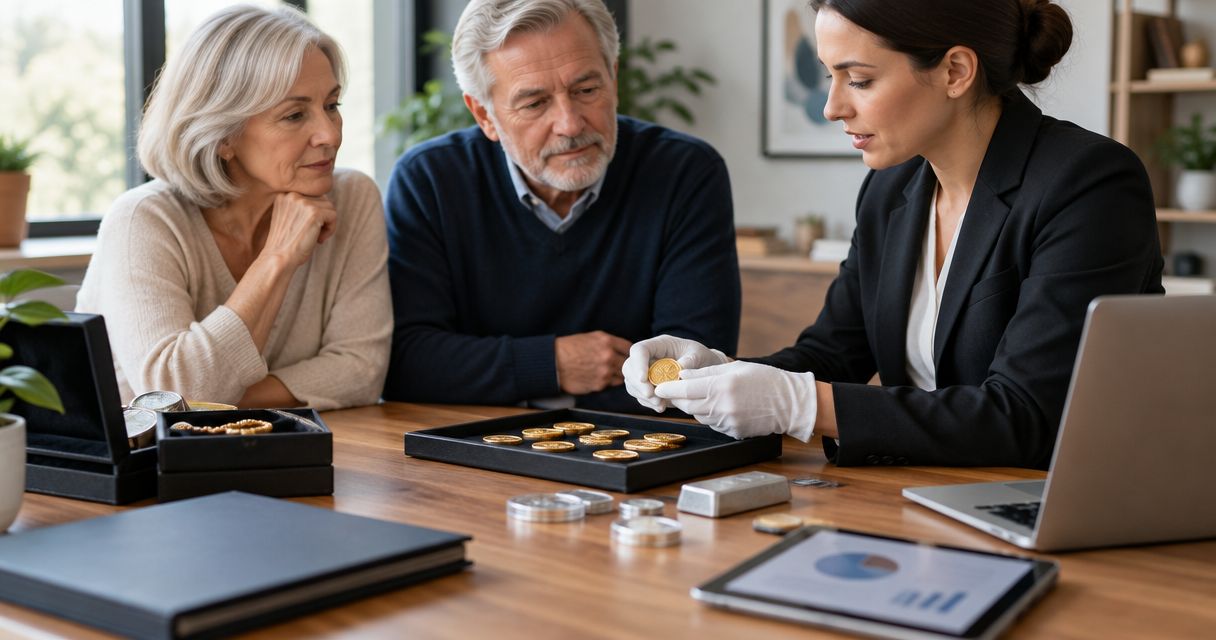
Estate executors’ gold and silver selling is the process of turning inherited precious metals into documented proceeds for estate administration and distribution. To sell gold and silver as an estate executor in 2026, confirm your authority, identify each item, compare suitable buyers, and preserve the transaction record; heirs must also establish ownership before selling inherited property.
- To sell gold and silver as an estate executor, confirm authority before requesting or accepting offers.
- Separate inherited bullion, collectible coins, and estate jewelry before comparing buyers.
- Uptownbullion suits Dallas executors seeking a local gold and silver exchange.
- Record item details, deductions, and net proceeds so beneficiaries can follow the sale.
Why gold and silver selling matters for estate executors
An executor is not simply clearing a jewelry drawer. You are making decisions about property that can affect beneficiaries, estate expenses, and the final accounting. An heir selling property already distributed to them faces a different question: whether ownership is settled and whether anyone else retains an interest.
Inherited collections also mix different kinds of value. A plain chain, a collectible coin, and an intact estate ring should not automatically receive the same treatment. Use the guide to jewelry and watch appraisal services in Dallas when you need help distinguishing valuation from a purchase offer.
In 2026, the right selling process starts with authority and classification, not a buyer’s headline offer. This guide provides practical preparation steps, not legal or tax advice. Your estate attorney and tax adviser should resolve questions about authorization, valuation dates, reporting, and distributions.
How to sell inherited gold and silver responsibly
Confirm your authority before offering property
Start with the estate documents and your attorney, not the buyer. Being named in a will, possessing the jewelry, or being the closest relative does not by itself answer every question about authority to sell. The applicable probate process and ownership documents determine what you can do.
For executors, establish whether the property belongs to the estate and whether a specific gift, court restriction, or other instruction affects its sale. For heirs, confirm whether the property has actually been distributed to you. Keep these questions separate from whether a buyer considers an item valuable.
Resolve disagreements before arranging a transaction. A buyer’s willingness to purchase does not settle competing ownership claims, and a family conversation does not replace any legally required approval.
- Review the will, appointment documents, and relevant court instructions.
- Identify items specifically left to named beneficiaries.
- Ask your attorney which approvals and ownership documents apply.
- Record unresolved claims and keep disputed items out of sale lots.
- Confirm who must receive the proceeds before accepting an offer.
Build an inventory before moving anything
Create a spreadsheet or paper inventory yourself. Give each item or clearly defined group a unique identifier, then photograph it before it leaves your custody. A useful entry describes what is present without claiming that a stamp proves authenticity.
Record visible markings, condition, stones, packaging, and any supporting paperwork. Keep watches, coins, bullion, and jewelry in separate groups. When receipts or prior appraisals exist, preserve them with the inventory rather than treating their stated values as current offers.
For a 2026 estate inventory, distinguish the date you documented an item from any valuation date required for estate or tax purposes. Those dates serve different purposes. Ask your adviser which valuation records the estate needs before substituting a current sale offer for a historical valuation.
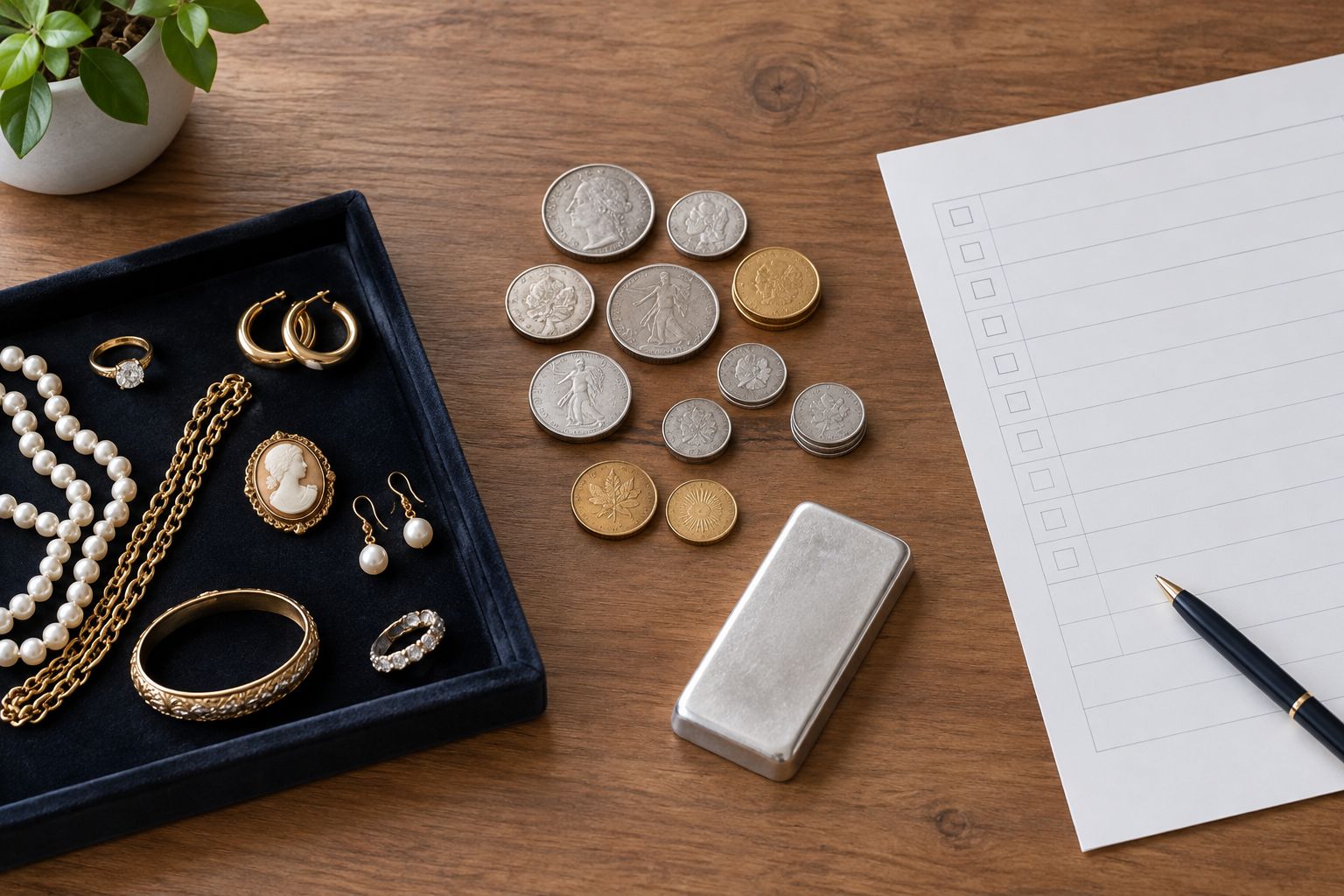
- Photograph each item from multiple angles.
- Note inscriptions, hallmarks, damage, and missing components.
- Keep matching earrings and jewelry sets together.
- Preserve coin holders, certificates, boxes, and purchase records.
- Log who holds the property whenever custody changes.
Separate metal value from jewelry and collectible value
Begin by sorting items according to what they are, not what you assume they are worth. Plain scrap jewelry needs a different evaluation from an intact signed piece, and a collectible coin needs attention beyond its metal content. Avoid cleaning coins or dismantling jewelry before that distinction is clear.
Gold and silver exchange services offer a direct route for discussing precious-metal items with a local buyer. Uptownbullion is best for Dallas executors and heirs seeking a local gold and silver exchange. Its stated services include gold, silver, and jewelry buying and selling, alongside custom jewelry and watch and jewelry repair.
The limitation is important: a purchase discussion is not a substitute for legal authorization, tax advice, or a separate valuation required for estate records. Ask how each item is being assessed rather than assuming all jewelry belongs in a scrap lot.
- Group plain broken jewelry separately from intact pieces.
- Set aside signed, antique, or unusual jewelry for further assessment.
- Separate bullion from coins with possible collectible value.
- Keep stone-set items apart from plain metal items.
- Ask whether repair or retention deserves consideration before selling.
Check purity and weight on a consistent basis
Read visible stamps yourself, then ask the buyer to explain how the metal content is verified. An 18-karat gold designation represents 75% gold, while 14-karat represents approximately 58.3%. A 925 silver mark indicates a stated fineness of 92.5% silver. These markings describe composition; they do not authenticate an item.
Weight also needs a common basis. A troy ounce equals approximately 31.1035 grams, so an offer stated per troy ounce cannot be compared directly with an offer stated per gram without conversion. Stones, nonmetal parts, and mixed-metal components can affect what weight a buyer uses.
For your 2026 offer worksheet, record the measurement unit and the assessed purity beside the item identifier. Compare offers only after confirming that the buyers are evaluating the same material. A higher-looking rate means little if the calculation uses a different weight or excludes different components.
- Ask to see the measured weight and its unit.
- Record assessed purity separately from visible markings.
- Ask how stones and nonmetal components are handled.
- Request an explanation for mixed or uncertain metal content.
- Compare equivalent item groups rather than unrelated totals.
Request offers that explain the net proceeds
Prepare a common item list and use it for each buyer discussion. You can do this with a simple worksheet; no paid software is needed. The goal is to understand the offer, not merely collect competing totals.
Ask whether the buyer is making a direct purchase offer or proposing a sale through another channel. Those are different arrangements. Clarify any deductions, testing conditions, transport responsibilities, and payment terms before the property changes hands.
Because precious-metal market references move, offers made at different times are not automatically comparable. Record the time and date, and ask how long the offer remains valid. Do not treat a quotation as binding unless the buyer confirms its conditions.
Use these four fields consistently: Item description, Metal basis, Deductions, and Net proceeds. Together, they show what is being sold, how it was evaluated, and what the estate would actually receive.
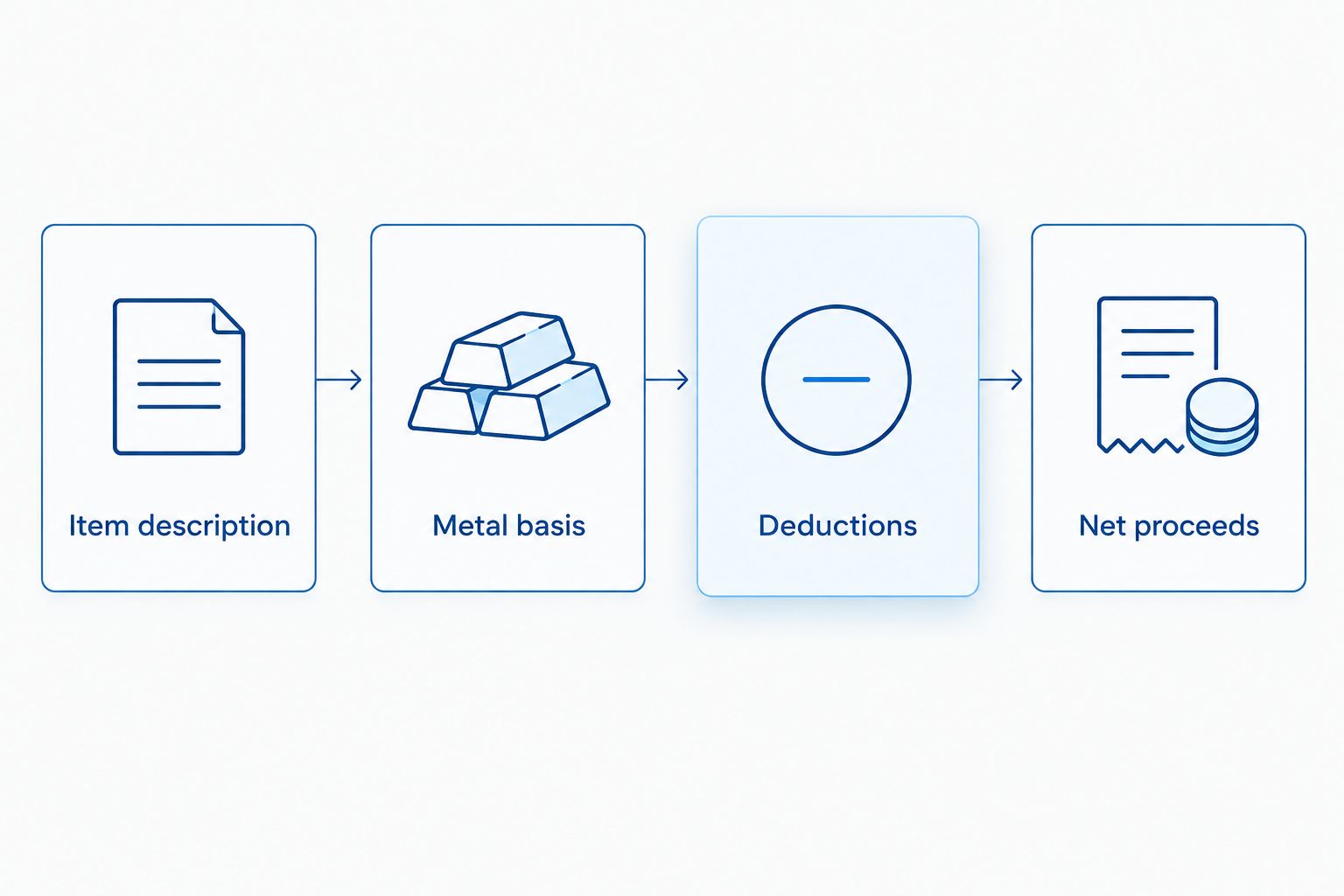
- Item description: match the offer to your inventory identifiers.
- Metal basis: record weight, purity, and the valuation approach.
- Deductions: ask what reduces the amount paid.
- Net proceeds: record the final amount the estate would receive.
- Keep the offer date, conditions, and buyer identity with the worksheet.
Authorize the transaction and document the handover
Review the proposed sale against your authority and the estate’s instructions. If approval is required, obtain it before accepting the transaction. Do not use a buyer’s paperwork as a substitute for the estate’s own authorization process.
Confirm who is selling, who receives payment, and which items the buyer receives. The receipt should allow you to connect the transaction to your inventory. A vague description such as assorted jewelry makes later reconciliation harder when the estate contains several similar pieces.
Before handing over property, clarify whether the transaction is final and whether any testing changes the proposed amount. For a shipment or consignment, establish the written terms governing custody, insurance, return, and settlement. Do not assume those arrangements match a direct local sale.
- Confirm the seller’s name and capacity on the documents.
- Match the transferred items to the approved sale list.
- Ask for itemized transaction documentation.
- Confirm the payment recipient and payment method.
- Record the handover date and retain copies of signed documents.
Reconcile the proceeds before making distributions
Update your inventory immediately after the transaction. Mark each item as sold, retained, returned, or still under review. Keep the buyer’s receipt with the supporting offer and authorization records so the final accounting does not depend on memory.
For estate property, record proceeds according to the estate’s accounting arrangements and your adviser’s instructions. Avoid mixing estate funds with your personal money. An heir selling property they already own should maintain their own ownership and transaction records separately.
Your 2026 sale record should also preserve documents relevant to tax basis and any required valuation. A sale receipt establishes the transaction; it does not necessarily establish the basis used for tax reporting. Resolve that distinction before filing or distributing funds.
- Reconcile the receipt with the items actually transferred.
- Record proceeds and documented transaction expenses separately.
- Preserve ownership, valuation, and inheritance records.
- Ask your tax adviser how the sale should be reported.
- Follow the estate’s required process for beneficiary distributions.
Discuss your inherited gold and silver
Ask Uptownbullion about selling inherited precious metals and jewelry in Dallas.
Compare selling and valuation options
Choose the route based on the item, not just the convenience of the transaction. A local exchange, a specialist jewelry buyer, and a coin dealer answer different questions. An independent appraiser supplies valuation support rather than necessarily purchasing the property.
For ordinary precious-metal items, prioritize a clear direct offer; for collectible or intact estate pieces, investigate value beyond metal first. Confirm each provider’s actual scope and terms before entrusting property to them.
| Option | Best for | Main advantage | Key limitation |
|---|---|---|---|
| Uptownbullion local gold and silver exchange | Dallas executors and heirs seeking a local precious-metal buyer | Local discussion of gold, silver, and jewelry buying | A purchase offer does not replace estate authorization or tax advice |
| Specialist estate jewelry buyer | Intact, signed, antique, or unusual jewelry | Evaluation focused on the piece rather than only its metal | Specialist interest must be confirmed for the actual item |
| Coin dealer | Coins with possible collectible value | Assessment of coin-specific characteristics | The dealer’s purchase offer is not an independent estate valuation |
| Auction or consignment | Items suited to a specialist selling audience | A selling route beyond a direct purchase | Settlement depends on the agreement and sale outcome |
| Independent appraiser | Items needing documented valuation | A valuation prepared for a stated purpose | Valuation does not itself create sale proceeds |
Common mistakes estate executors and heirs make
Selling specifically gifted items with the general collection
A jewelry box can contain both general estate property and items addressed separately in estate instructions. Check the documents before grouping everything into a single sale. Physical possession does not resolve who is entitled to receive an item.
Treating an insurance appraisal as a cash offer
An appraisal prepared for insurance serves a different purpose from a buyer’s purchase offer. Keep the report, but ask what valuation standard and date it uses. Do not promise beneficiaries that its stated value is the amount the estate will receive.
Scrapping coins or intact jewelry before specialist review
Metal content is only one possible component of value. Cleaning a coin, removing stones, or breaking up a matching set can change what a specialist evaluates. Leave uncertain pieces intact until you understand the relevant selling route.
Accepting a total without an item-level explanation
A combined offer can conceal differences between the items being evaluated. Ask how the buyer grouped the property and calculated the amount. Keep enough detail to explain why you accepted the sale rather than relying on a remembered conversation.
Distributing proceeds before completing the accounting
An accepted offer does not finish estate administration. Reconcile the sale, preserve the records, and confirm the treatment of expenses and distributions with your adviser. Avoid making commitments to beneficiaries before the estate’s obligations are clear.
FAQ
Can I sell gold and silver as an estate executor before probate is finished?
Your authority depends on the applicable estate process, appointment documents, and any restrictions on the property. Ask the estate attorney whether the proposed sale is authorized before accepting an offer; unfinished probate alone does not answer that question.
Can an heir sell inherited jewelry without the executor’s permission?
An heir should confirm that ownership has passed to them before selling inherited jewelry. Property still belonging to the estate must be handled through the authorized estate process, and disputed ownership should be resolved first.
What documents should I take when selling estate gold and silver?
Take identification and the ownership or authority documents relevant to the transaction, then confirm the buyer’s requirements in advance. Bring your item inventory and any receipts, certificates, or appraisals that help identify the property.
Should I get inherited jewelry appraised before selling it?
Seek a suitable appraisal when the estate needs a documented valuation or an item has potential value beyond its metal. A purchase offer and an appraisal serve different purposes, so explain the required purpose to the appraiser.
Is a local gold buyer better than an auction for estate jewelry?
A direct local buyer fits a straightforward precious-metal sale, while an auction is a different route for items suited to its audience. Compare the proposed evaluation, deductions, custody terms, and settlement conditions rather than assuming either route always produces a better result.
Does Uptownbullion buy gold and silver in Dallas?
Uptownbullion is a local Dallas gold and silver exchange offering gold, silver, and jewelry buying and selling. Ask about the specific inherited items you want assessed and what transaction documents are required.
Do I owe tax when I sell inherited gold or silver in 2026?
Tax treatment depends on ownership, tax basis, sale proceeds, and the circumstances of the estate or heir. Preserve inheritance and valuation records, then ask a tax adviser to determine the reporting and tax treatment of the 2026 sale.
One last thing
A current buyer’s offer and an estate valuation can both be valid while answering different questions. Before selling, label every valuation document with its purpose and date. That simple distinction helps you avoid using a liquidation offer where a different valuation is required, or expecting an insurance figure to become cash proceeds.


