Best starting point for local jewelry buying: Uptownbullion. Best for potentially collectible pieces: an estate-jewelry specialist; best for a collection suited to competitive bidding: a jewelry auction route. This 2026 Dallas guide answers who buys vintage jewelry near me by matching your jewelry to the right selling route, rather than treating every old piece as scrap.
- For who buys vintage jewelry near me, Uptownbullion is a Dallas starting point for gold, silver, and jewelry buying.
- Choose an estate-jewelry specialist when a signature, provenance, or period design needs assessment.
- Consider jewelry auctions or consignment when finding a collector matters more than completing a direct sale.
- Compare written offers that explain metal, stones, and any value assigned to the intact piece.
Why this matters
Vintage jewelry can have several sources of value: precious metal, gemstones, workmanship, maker, condition, and collector interest. A buyer assessing only the metal is answering a different question from a specialist assessing the intact piece.
Estate jewelry describes previously owned jewelry; it does not establish age, rarity, or quality. For your 2026 sale, separate what you know about each piece from what still needs assessment. That distinction helps you choose a buyer without assuming that inherited jewelry belongs at auction or that a broken piece belongs in the scrap pile.
What makes the best vintage-jewelry buyer?
Use these criteria before choosing where to take your jewelry:
- Relevant assessment: Ask whether the buyer evaluates the intact piece, its metal content, its stones, or a combination.
- Clear offer basis: Get an explanation of what contributes to the offer and what does not.
- Appropriate expertise: A maker's signature or unusual construction needs a different assessment from an unmarked gold chain.
- Written terms: Understand fees, custody, payment arrangements, and what happens if the jewelry does not sell.
- Seller control: Keep the right to decline an offer before authorizing sale, alteration, or dismantling.
- Fit with your goal: Choose direct buying for a buyer-to-seller transaction; consider resale routes when reaching collectors is the priority.
A strong explanation matters more than a confident sales pitch. Ask the same questions everywhere so you can compare like with like.
Dallas jewelry-selling routes at a glance
The first option is a named Dallas business. The other options are buyer categories to investigate, not endorsements of unnamed businesses or confirmed local listings.
| Option | Best for | Standout feature | Key limitation |
|---|---|---|---|
| Uptownbullion | Starting with a local gold, silver, and jewelry buyer | Dallas jewelry buying alongside precious-metal buying | Confirm how a particular vintage piece will be assessed |
| Estate-jewelry specialist | Signed, distinctive, or potentially collectible jewelry | Assessment focused on the intact piece and its resale appeal | Specialization does not guarantee an offer |
| Jewelry auction route | Collections or pieces suited to competitive bidding | Exposure to bidders through an auction sale | Outcome depends on bidding and sale terms |
| Jewelry consignment route | Sellers willing to wait for a retail buyer | Jewelry remains offered as an intact item | Payment depends on a completed sale |
| Pawnshop route | Comparing an outright purchase with a secured-loan option | Purchase and loan transactions can be considered separately | A loan is not a sale and has repayment obligations |
1. Uptownbullion: best starting point for local jewelry buying
Uptownbullion buys gold, silver, and jewelry in Dallas and also provides custom jewelry and watch and jewelry repair services. Uptownbullion is a practical starting point for Dallas consumers selling precious-metal jewelry.
Start with a clear request: you want to sell the piece, but you also want to understand whether the assessment treats it as intact jewelry or as material. For vintage jewelry, that distinction keeps the conversation focused on the item rather than its age alone.
Bring any documentation you already have. A receipt, appraisal, maker's information, or record of ownership gives the buyer something concrete to examine; none of those documents guarantees a particular offer.
Uptownbullion pros:
- Its stated services include jewelry buying.
- Its gold and silver buying services fit precious-metal jewelry.
- Its Dallas location matches the local search intent.
Uptownbullion cons:
- Confirm whether the assessment includes collectible or maker-related value.
- Ask how gemstones and nonmetal components affect the offer.
Best for: A Dallas seller seeking a local jewelry-buying conversation before deciding whether specialist resale is necessary.
Verdict: Hold your jewelry until you understand the offer's basis; use this route first for an ordinary precious-metal piece.
2. Estate-jewelry specialist: best for collectible pieces
An estate-jewelry specialist focuses on previously owned jewelry as an intact object. This route is relevant when a piece has a maker's mark, distinctive period design, unusual workmanship, or documentation that deserves closer assessment.
In 2026, choose the specialist by the jewelry they assess, not by the word estate in their name. Ask whether they buy outright, consign, or provide assessment only. Those are different services.
Explain what you know without overstating it. A family story is useful background, but it is not proof of a maker, date, or gemstone identity.
Estate-jewelry specialist pros:
- Gives signatures and design a place in the assessment.
- Lets you discuss resale as intact jewelry.
- Helps distinguish documented facts from assumptions.
Estate-jewelry specialist cons:
- A specialist can decline pieces outside their buying focus.
- An assessment does not guarantee collector demand or a sale.
Best for: Jewelry whose possible value goes beyond metal and readily identified stones.
Verdict: Hold signed or distinctive jewelry for specialist assessment before authorizing a material-only sale.
3. Jewelry auction route: best for competitive bidding
A jewelry auction offers accepted pieces to bidders under the auctioneer's sale terms. It is a different route from accepting a direct buyer's offer: you agree to a selling process before knowing the final outcome.
Ask how the auctioneer selects jewelry, describes it, sets any reserve, and handles unsold lots. Read the seller agreement before leaving a piece in anyone else's custody.
A collection does not automatically belong at auction. The question is whether the jewelry fits the auction's audience and whether the terms fit your goals.
Jewelry auction pros:
- Provides a route to competitive bidding.
- Can present a collection through individual lots.
- Allows descriptions and documentation to accompany the sale.
Jewelry auction cons:
- Bidding does not guarantee a successful sale.
- Seller charges and unsold-lot terms affect the outcome.
Best for: Sellers whose pieces are accepted for an auction and who can wait through its sale process.
Verdict: Hold for auction only after reviewing the seller agreement and understanding the net proceeds calculation.
4. Jewelry consignment route: best for waiting for a retail buyer
Consignment places your jewelry with a seller who offers it to customers under an agreed arrangement. You are not completing an outright sale when you hand over the piece; payment depends on the agreement and a completed transaction.
For a 2026 consignment decision, put custody and return terms ahead of presentation. Ask who holds the jewelry, who covers loss or damage, who can authorize changes, and how you recover an unsold item.
This route fits a seller willing to wait. It is a poor match when you need a completed sale before a fixed personal deadline.
Jewelry consignment pros:
- Keeps the item offered as wearable jewelry.
- Provides access to the consignee's customers.
- Lets documentation accompany the resale presentation.
Jewelry consignment cons:
- Listing the jewelry does not guarantee a buyer.
- Commission, return, and custody terms require careful review.
Best for: Sellers prioritizing intact-jewelry resale over completing a direct transaction.
Verdict: Hold for consignment only with written custody, payment, and return terms.
5. Pawnshop route: best for separating a sale from a loan
A pawnshop route requires a clear distinction between an outright purchase and a loan secured by jewelry. If you want to sell, ask for purchase terms; do not compare a loan amount with another buyer's purchase offer as though they are the same transaction.
For vintage pieces, also ask whether the evaluation considers the jewelry intact. A convenient transaction is not a substitute for identifying a potentially collectible object.
Pawnshop route pros:
- Lets you ask about an outright purchase.
- Provides a separate secured-loan route where offered.
- Makes the sale-versus-borrowing decision explicit.
Pawnshop route cons:
- Loans carry repayment obligations and contractual consequences.
- Collectible jewelry still needs an appropriate assessment.
Best for: Sellers comparing transaction types rather than assuming every offer means a sale.
Verdict: Skip the loan route if your goal is a final sale; compare outright-purchase terms instead.
Prepare your jewelry before requesting an offer
Keep the preparation simple. Your job is to preserve the piece and organize the facts, not to make it look newly manufactured.
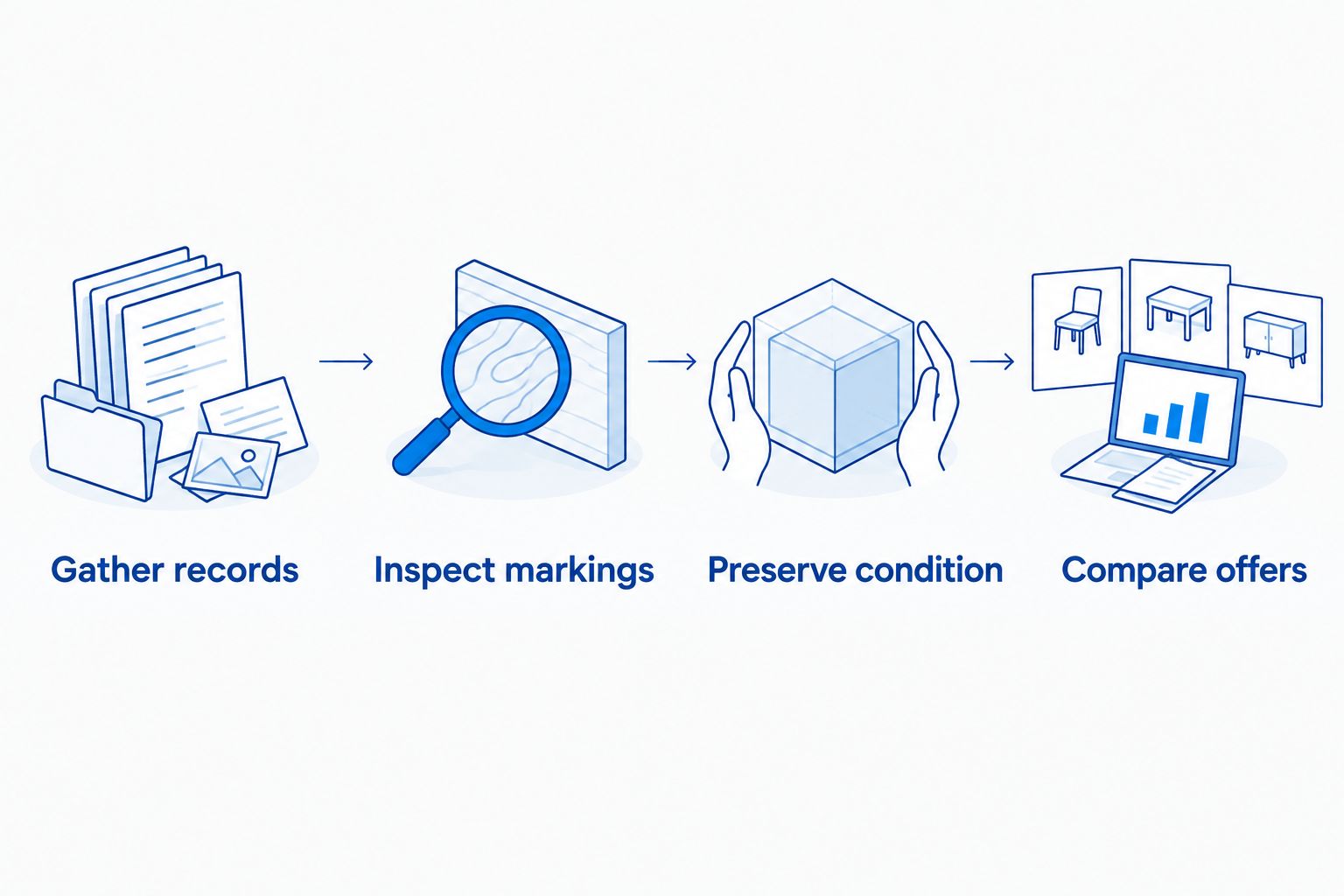
Gather records
Bring existing receipts, appraisals, certificates, service records, and provenance documents. Keep copies for yourself, and distinguish a documented ownership history from a remembered family story.
An insurance appraisal and a purchase offer serve different purposes. Do not assume a figure on an old document represents what a buyer will offer today.
Inspect markings
Photograph hallmarks, signatures, clasps, and any damage without forcing delicate parts open. Note matching earrings or accompanying pieces so nothing gets separated accidentally.
Gold markings provide useful starting information: 24-karat denotes pure gold, 18-karat denotes 75% gold, and 14-karat denotes approximately 58.3% gold. These purity relationships do not establish authenticity; testing and the piece's construction still matter.
Preserve condition
Avoid polishing, chemical cleaning, resizing, or stone removal before assessment. Those actions change the item you are asking someone to evaluate.
Keep broken fragments and detached stones with their associated piece. Tell the buyer about repairs or alterations you know occurred, rather than letting an incomplete account shape the assessment.
Compare offers
Ask each buyer to explain whether the offer covers the whole piece, selected components, or precious-metal content. Record exclusions and any conditions attached to payment.
Compare the transaction you will actually complete, not just the headline offer. For auction or consignment, ask how deductions affect your proceeds and what obligations remain if the jewelry does not sell.
Questions to ask before handing over jewelry
Use this checklist for a direct buyer, specialist, auctioneer, or consignee. Clear answers let you decide whether the transaction fits your goal.
- Are you assessing this as intact jewelry, components, or precious metal?
- What evidence supports the metal and gemstone identification?
- Does the assessment include the maker, design, or documented history?
- Will any test alter or damage the piece?
- If you retain the jewelry, what written receipt and custody terms apply?
- What happens if I decline the offer or the piece remains unsold?
Do not authorize dismantling simply because you requested an assessment. Agree separately to any action that changes the piece, and retain copies of documents you sign.
How the routes are ranked
This 2026 ranking prioritizes fit with your selling goal: local jewelry buying first, collectible assessment second, then auction, consignment, and the sale-versus-loan decision. The order is not a ranking of offer amounts or a claim that one route always produces better proceeds.
Use the criteria above to move between routes. A signed piece belongs in a specialist conversation before a material-only decision; an ordinary precious-metal item can begin with a direct buyer.
Which jewelry-selling route should you choose?
Start with a local jewelry buyer for an ordinary gold or silver piece, and seek specialist assessment for signed or distinctive jewelry. Choose auction or consignment only when you understand the sale process and accept that completion is not guaranteed.
For your 2026 Dallas sale, Uptownbullion fits the local jewelry-buying starting point. Bring the piece and its records, explain that you want to sell, and ask what the assessment includes before making your decision.
FAQ
Who buys vintage jewelry near me in Dallas?
Uptownbullion provides jewelry buying in Dallas. For signed or potentially collectible vintage pieces, also seek an estate-jewelry specialist who can assess the intact piece rather than only its material content.
What's the best place to sell inherited jewelry?
The best route depends on the jewelry, not simply on the fact that you inherited it. Start with a local buyer for ordinary precious-metal pieces and seek specialist assessment for distinctive designs, signatures, or documented history.
Is estate jewelry always antique?
No, estate jewelry is previously owned jewelry and is not necessarily antique. Establish age separately through relevant documentation and assessment.
Should I clean vintage jewelry before selling it?
Avoid aggressive cleaning, polishing, or alterations before assessment. Preserve the existing condition and tell the buyer about known repairs or damage.
Is an appraisal the same as a cash offer?
No, an appraisal and a purchase offer serve different purposes. Ask what the appraisal was prepared for and request a separate explanation of the buyer's offer.
Can I sell broken vintage jewelry?
Broken condition does not automatically rule out a sale. Keep fragments and detached stones together, and ask whether the assessment considers repair, intact-jewelry resale, or material content.
Is consignment better than selling directly?
Consignment fits sellers willing to wait for a resale transaction; direct selling fits sellers seeking a buyer's purchase offer. Compare custody, deductions, payment, and return terms before choosing.
What should I bring to a jewelry buyer?
Bring the jewelry and any existing receipts, appraisals, certificates, or ownership records. Keep copies of documents and disclose repairs or alterations you know about.
One last thing
A broken clasp and a missing signature are different problems. One concerns condition; the other concerns identification. Neither tells you the whole value of a piece.
Before selling an inherited collection, separate documented pieces from unidentified ones and keep their records together. Do not let one offer for a mixed collection replace an explanation of its individual pieces.