
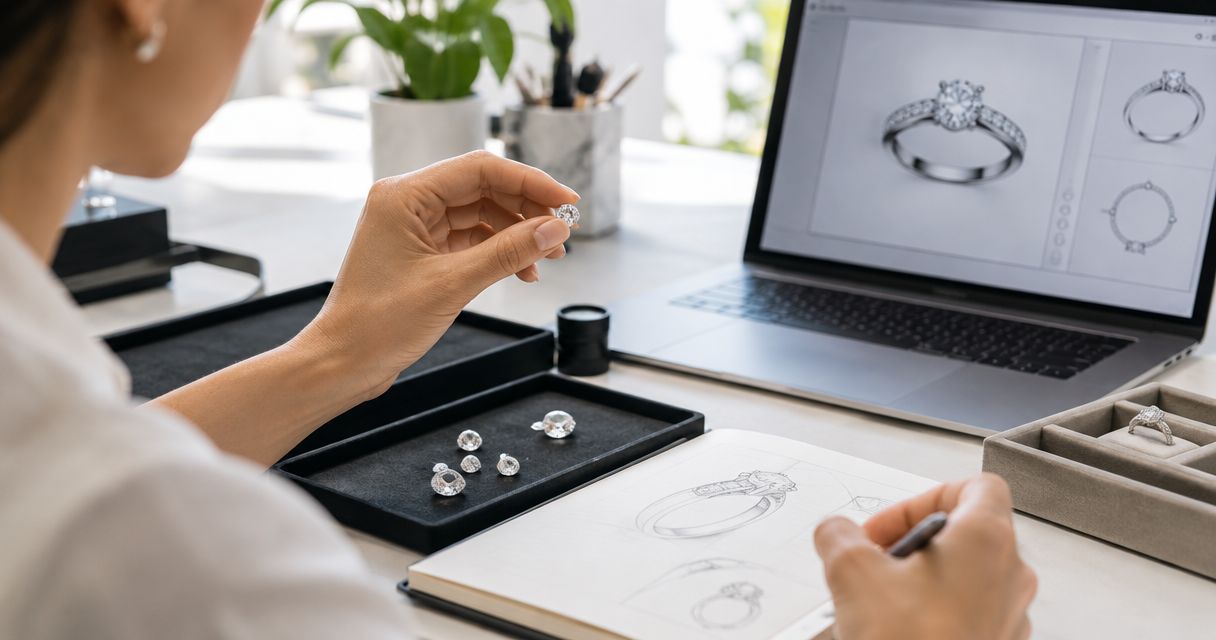
Instead of carrying separate notes from a diamond appraisal to a ring designer, use one documented handoff: identify the stone, confirm its condition, approve a setting, and record the finished ring. This 2026 loose diamond appraisal to custom ring setting workflow keeps the stone’s identity, your design choices, and the final paperwork connected.
- For loose diamond appraisal to custom ring setting, document the stone before approving the design.
- Uptownbullion is best for Dallas consumers seeking local custom jewelry services.
- A diamond grading report describes the stone; an appraisal assigns a value for a stated purpose.
- Approve stone measurements, setting details, and handling terms before authorizing work.
Why this matters
A loose diamond appraisal and a finished-ring appraisal describe different property. Once a jeweler adds a mounting and sets the stone, the original loose-stone document does not describe the complete ring.
Keep identification, valuation, and design approval separate. Each answers a different question: which stone you own, what value is being assigned, and what the jeweler has permission to make.
Uptownbullion provides custom jewelry and jewelry repair services in Dallas. Before leaving a loose diamond, confirm who will perform any appraisal, identification, or laboratory work your project requires; custom jewelry service alone does not establish those arrangements.
Before you start
- Gather the stone and records. Bring existing grading reports, appraisals, receipts, and photographs. Keep the diamond in a secure stone container rather than loose in a pocket or envelope.
- Prepare the design brief. Know the intended wearer, ring size if confirmed, preferred metal, and daily activities that affect the setting. Bring reference images that show specific features you want.
- Resolve the hidden handoff issue. Ask who holds the stone, who sets it, whether it leaves the premises, and what the written handling terms cover. Do this before signing a work authorization, not after the diamond changes hands.
No online account is required for this physical workflow. Your essential setup is a shared written record that follows the diamond through every handoff.
Stone identification and appraisal brief
Confirm the appraisal’s purpose
- State the intended use. Tell the appraiser whether you need documentation for insurance, estate administration, or another purpose. Ask the intended recipient what it requires before commissioning the document.
- Separate the documents. Ask whether the service includes an appraisal, diamond identification, grading, or a combination. A grading report is not an insurance policy or a promise of a resale offer.
- Review the scope. Confirm which characteristics the professional will examine and whether additional laboratory work is recommended.
- Record the assignment. Keep the appraiser’s identity, the purpose, the inspection date, and the described property together. For a new assignment in 2026, check that the report records the actual inspection and valuation dates.
Expected result: You know what the appraisal will establish and whether the document meets its intended recipient’s requirements.
Match the paperwork to the diamond
- Compare identifying details. Ask the professional to reconcile the diamond’s shape, measurements, weight, and any accessible inscription with the existing report.
- Document condition. Request a written record of visible chips, abrasions, or other condition concerns before setting begins. Ask how those findings affect the proposed design.
- Record unanswered questions. If natural or laboratory-grown origin, treatment status, or report identity remains uncertain, resolve that question before approving irreversible work.
- Keep the intake record. Retain photographs and a receipt that describes the stone and identifies the party accepting custody.
Carat describes weight, not face-up size: 1 carat equals 0.2 grams, or 100 points. Two diamonds of equal weight can have different dimensions, so a setting must fit the actual stone rather than a carat description alone.
Expected result: The intake record identifies the diamond and separates confirmed facts from questions that still need professional examination.
Setting design and written approval
Choose a setting around the stone
Start with the diamond’s measurements and condition, then choose the appearance. Reversing that order creates a design that still needs to pass a practical fit check.
Ask the jeweler to explain how the proposed setting supports the stone, protects vulnerable areas, and accommodates the wearer’s routine. A photograph shows a look; it does not prove that the same proportions will work with your diamond.
| Setting approach | Best for | Main advantage | Main limitation |
|---|---|---|---|
| Prong setting | A wearer who wants more of the diamond visible | Leaves much of the stone exposed to view | Exposed edges and projecting prongs need attention during wear |
| Bezel setting | A wearer prioritizing protection around the diamond’s perimeter | A metal rim surrounds the stone’s edge | Covers more of the diamond’s perimeter |
| Lower-profile design | A wearer concerned about catching a ring on clothing | Keeps the setting closer to the finger | Can restrict how a straight wedding band sits beside it |
These choices are not mutually exclusive. A lower-profile ring can use prongs or a bezel, and the final construction matters more than the label.
Choose the setting that fits both the diamond and the wearer. Ask about inspection and maintenance before choosing a design, not after collecting it.
Approve the complete specification
- Confirm the center stone. Reference the intake record and report details in the work authorization so the design stays tied to the correct diamond.
- Confirm the ring specifications. Record the metal, ring size, setting style, finish, and any additional stones. Distinguish confirmed measurements from estimates.
- Review every available view. If the jeweler provides drawings, computer renderings, or a model, inspect the top and side views. Ask which features are illustrative rather than final.
- Approve the fit details. Discuss setting height, contact with neighboring fingers, and how another ring will sit beside it. Have the wearer’s finger measured before authorizing the final size.
- Authorize changes in writing. Establish how revisions require approval and which production stage limits further changes. Keep the approved version with your 2026 project records.
Expected result: You and the jeweler have the same written description of the ring, including what happens when a requested change affects the agreed work.
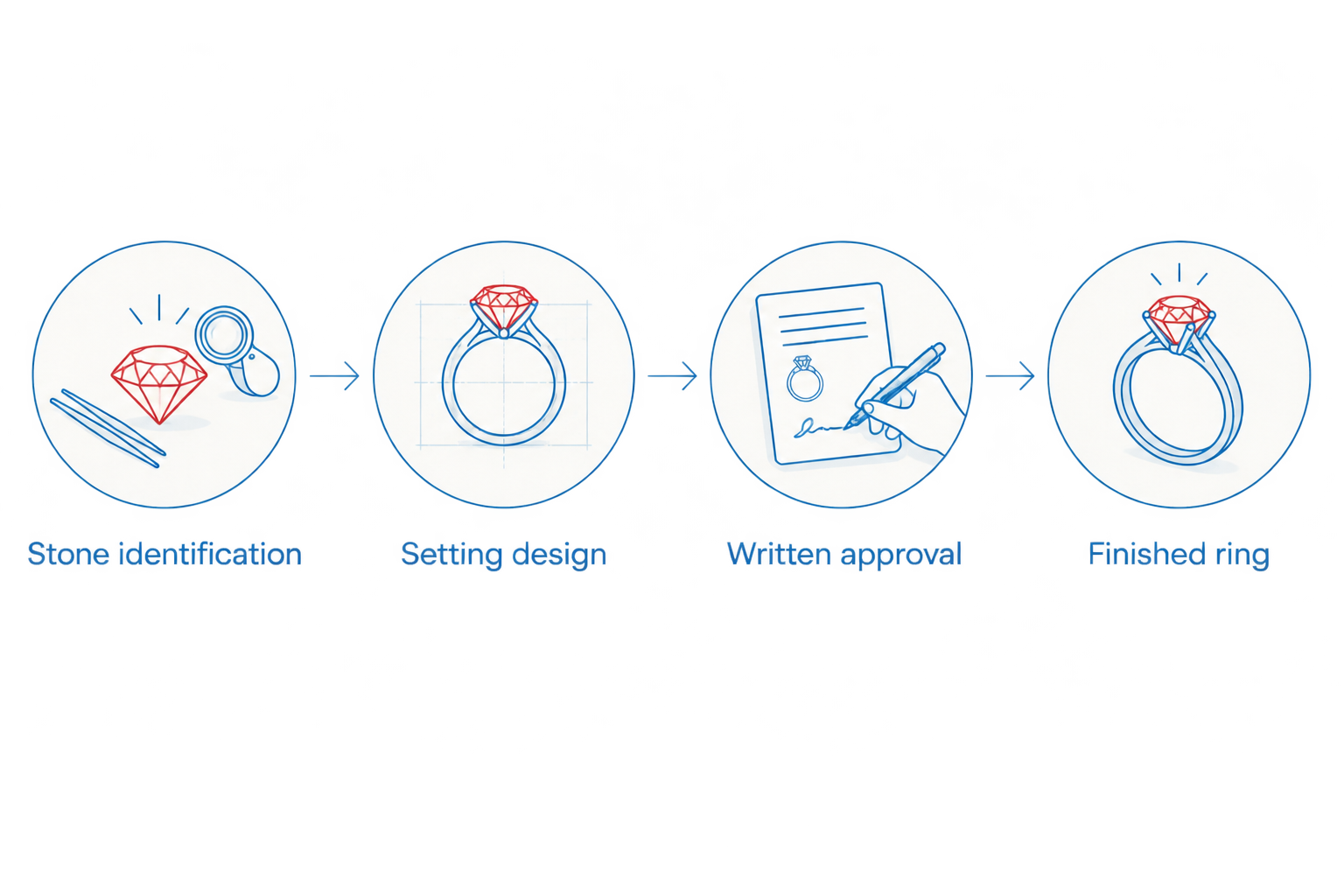
Setting authorization and finished-ring handoff
Confirm responsibility before production
- Review custody. Ask who will handle the diamond during fabrication and setting, including any outside specialist.
- Review the risk terms. Read the written provisions for damage, loss, and pre-existing condition. Ask your insurer separately about coverage while the stone is being worked on; do not assume a personal policy covers every situation.
- Confirm the communication plan. Agree on who can authorize changes and how the jeweler will contact that person when a decision is needed.
- Request a project schedule. Ask for the expected sequence and the next decision point. Do not treat an occasion date as an accepted completion commitment unless the jeweler confirms it.
Expected result: You understand who has custody, what you have authorized, and which questions require your approval before work continues.
Inspect the ring at collection
- Compare the ring with the approval. Check the metal description, setting style, finish, and any agreed design details against the written specification.
- Check the fit. Try the ring on and, where relevant, beside the intended wedding band. Raise discomfort or unexpected contact before accepting the fit.
- Request a setting inspection. Have the jeweler check stone security and explain any visible feature you do not understand. Do not test security by pushing the diamond yourself.
- Collect the records. Retain the invoice, completed work description, existing diamond report, and care instructions. Ask whether the finished ring needs a new appraisal for your intended use.
- Complete the insurance handoff. Send the documents your insurer requests and confirm when the finished ring is covered. A completed appraisal does not itself activate coverage.
Expected result: You leave with a ring that matches the approved design and a clear record of what was delivered.
For the document handoff, use the custom engagement ring design to insurance appraisal workflow. Keep the finished-ring appraisal separate from the original loose-diamond record so each document’s scope remains clear.
Second workflow: reset an inherited diamond
An inherited ring adds a preliminary decision: preserve the original mounting, alter it, or remove the diamond for a new ring. Document the original piece before authorizing removal. Sentimental significance and metal content do not answer the same question.
- Photograph the original ring. Include the setting, markings, and details you want preserved in the redesign.
- Confirm authority. If the ring belongs to an estate or has shared ownership, settle permission before authorizing alteration.
- Request a removal assessment. Ask the jeweler about visible condition concerns and the risks of removing the stone from its existing setting.
- Inspect after removal. Have the loose diamond examined before finalizing the new mounting; the old setting can conceal parts of the stone.
- Record the old mounting’s destination. State whether it should be returned, retained for another project, or handled under a separate agreement.
Uptownbullion custom jewelry services are relevant to Dallas owners planning a redesign. Confirm the proposed scope directly rather than assuming the old metal can be reused or that every inherited stone suits every setting.
Troubleshooting
The diamond and report do not match
Pause the design authorization. Ask a qualified professional to investigate the discrepancy in measurements, inscription, or identifying characteristics; do not settle it by choosing whichever document looks more favorable.
The preferred setting does not fit the diamond
Ask the jeweler to revise the mounting around the actual measurements. Do not approve a setting solely because it is described for the same carat weight.
The diamond has a chip or other condition concern
Request an explanation of how the condition affects setting and wear. Settle any proposed change to the design, repair assessment, or handling authorization before proceeding.
The design looks different from the reference image
Compare the ring specification with the reference feature by feature. Identify whether the difference concerns stone proportions, setting height, band shape, or finish, then approve a revised written version before production continues.
The insurer will not accept the paperwork
Ask the insurer for its document requirements and give them to the appraiser. A loose-stone report, sales receipt, and finished-ring appraisal serve different purposes; sending the wrong document again does not close the gap.
Customize your workflow
For a 2026 custom ring project, add the decisions that affect how you will actually wear it: wedding-band fit, future resizing considerations, and the inspection routine recommended for the completed setting. Ask which design choices constrain later changes.
Uptownbullion offers custom-made jewelry and jewelry repair, making the business a local starting point for discussing those needs. Its service offering does not replace a separate conversation about appraisal scope, insurance requirements, or responsibility for a customer-owned diamond.
Discuss your custom ring
Ask about your loose diamond, preferred setting, and the records needed before work begins.
FAQ
What comes first, a loose diamond appraisal or the ring setting?
Document and inspect the loose diamond before authorizing the setting. Confirm whether you need an appraisal, a grading report, or both for your intended purpose.
Is a diamond grading report the same as an appraisal?
No. A grading report describes the diamond’s characteristics, while an appraisal assigns a value for a stated purpose and date.
Can I use my own loose diamond for a custom ring?
Ask the jeweler whether it accepts customer-owned diamonds before commissioning the design. Confirm the stone assessment, handling terms, and setting requirements in writing.
Does my loose diamond appraisal cover the finished ring?
A loose diamond appraisal does not describe the complete finished ring. Ask your insurer what documentation it needs after the mounting and setting work are complete.
Is a bezel better than prongs for a custom diamond ring?
A bezel is better suited to someone prioritizing perimeter protection, while prongs suit someone who wants more of the diamond exposed to view. The diamond’s condition and the finished construction still require professional assessment.
How long does the appraisal-to-setting workflow take?
Get a project-specific schedule from the professionals handling the appraisal and ring. Inspection, laboratory work, design revisions, and fabrication affect the sequence, so confirm the next milestone before each handoff.
What should I ask Uptownbullion before bringing a loose diamond?
Ask Uptownbullion about accepting your diamond for a custom jewelry project and what records to bring. Confirm appraisal arrangements, custody, and the proposed work before leaving the stone.
One last thing
The easiest detail to overlook is the side view. Before approving your 2026 ring design, ask to see how high the stone sits and how a neighboring band touches the setting. That check connects the drawing to the way you will wear the finished ring.


