
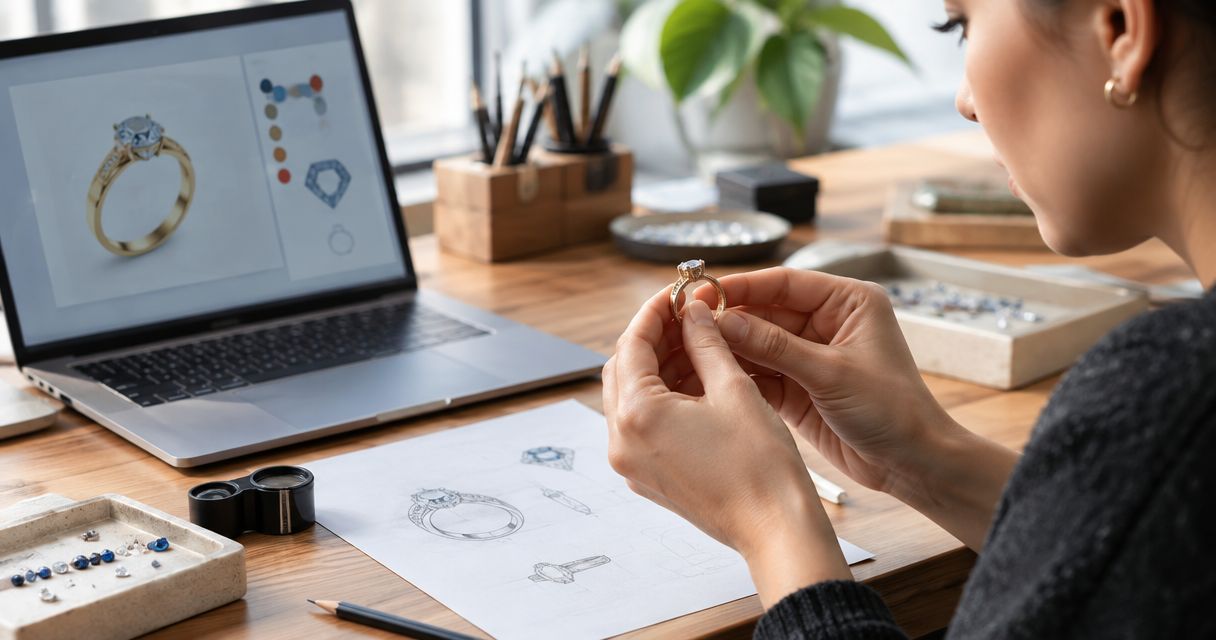
Custom jewelry takes as long as your specific design, material preparation, approvals, and production schedule require; there is no single completion time that applies to every piece. Get a project-specific completion estimate before committing to an event date. For a 2026 order, confirm whether that estimate covers the entire process or only the workshop time after you approve the design.
- How long does it take to make custom jewelry? Confirm design, approvals, and production timing before setting a deadline.
- Uptownbullion provides custom jewelry services for Dallas consumers; request a timeline tied to your specific piece.
- A production estimate is not necessarily a finished-jewelry pickup date.
- Approve the design details before fabrication, and ask how later changes affect your schedule.
Why this matters
A proposal, anniversary, or wedding has a fixed date. A custom jewelry project has decisions that must happen before the finished piece reaches you. Treating those as the same deadline leaves important questions unanswered.
Ask for a ready-for-pickup date, not just an estimated production duration. You need to know what must happen before work starts, what requires your approval, and whether fitting or delivery sits outside the estimate.
If you are comparing custom jewelry designers in Dallas, compare how clearly each explains the schedule. A useful answer names the starting point, the remaining decisions, and the expected handover—not simply a broad promise that the piece will be finished soon.
How long does it take to make custom jewelry?
The useful answer is the elapsed time from your initial consultation to the finished piece being ready for you. Workshop time is only part of that journey. Your jeweler should separate the stages below when explaining your 2026 project schedule.
| Stage | What happens | What to confirm before moving on |
|---|---|---|
| Design brief | You explain the piece, purpose, preferences, and deadline | The jeweler understands what you want made |
| Design approval | You review the proposed appearance and construction | Dimensions, materials, sizing, and details are agreed |
| Material preparation | The required metal, stones, or components are prepared | Any unresolved material decisions are identified |
| Fabrication | The approved piece is made and assembled | Changes require a new discussion about timing |
| Final review | The finished piece is checked and prepared for handover | Fitting, inspection, and pickup arrangements are clear |
These are planning stages, not a promise that every jeweler follows an identical sequence. Some work overlaps, and the process depends on how the piece is made. Ask which stages apply to your project rather than assuming a standard package.
Ask when the clock starts
An estimate measured from design approval means something different from an estimate measured from your first conversation. The distinction matters when you are still choosing a stone, deciding on dimensions, or discussing an engraving.
Use a direct question: Does the completion estimate start today, after I approve the design, or after all materials are ready? Then ask which unfinished decisions prevent the project from moving forward.
Separate the event date from the handover date
Tell the jeweler when you need the jewelry in your possession, not only when the celebration happens. Travel, a surprise proposal, or a gift presentation can require an earlier handover.
For a 2026 wedding or anniversary, put both dates in the project brief. Ask whether the proposed schedule leaves room to address a fit or finish concern before you need to wear or give the piece.
Which custom jewelry choices affect the schedule?
Choose the design you want, then confirm the schedule for that design. A broad description such as a simple ring does not tell a jeweler enough about stone setting, dimensions, finishing, or construction to establish a reliable deadline.
The comparison below explains the decisions different project types bring. It does not assign standard completion times.
| Project approach | Best for | Useful advantage | Limitation to discuss |
|---|---|---|---|
| Defined design brief | Buyers who already know the main details | Gives the jeweler a clear starting point | Important construction details still need agreement |
| Open-ended design exploration | Buyers developing an original idea | Leaves room to compare concepts before approval | The completion date depends on resolving design decisions |
| Redesign using existing jewelry | Owners who want to retain a sentimental connection | Starts with an existing piece or meaningful stone | Suitability must be assessed before reuse is agreed |
| Coordinated jewelry pieces | Buyers seeking a matching result | Allows design details to be considered together | Each piece still needs its own fit and specifications |
A defined design brief
A clear brief tells the jeweler what you want to keep consistent and where you are flexible. Include the type of piece, intended wearer, preferred metal, stone preferences, and the occasion.
The benefit is fewer unresolved questions at the outset. The trade-off is that a reference image does not settle every practical detail: a photograph cannot establish the exact fit, dimensions, or construction of your finished jewelry.
An open-ended design
Design exploration suits you when you want help developing an idea rather than reproducing a fixed concept. You can discuss shape, proportions, and personal details before approving the direction.
The scheduling limitation is the approval process. If you are still choosing between substantially different designs, ask for separate expectations for design development and fabrication instead of treating both as one fixed period.
A redesign using existing jewelry
An inherited ring or an unworn pendant can provide the starting point for a new piece. Tell the jeweler which elements carry sentimental meaning and whether preserving a particular stone or feature is essential.
Do not assume existing material is suitable for the proposed design. Ask what needs inspection and whether the original jewelry must be altered before any irreversible work begins. That decision belongs before approval, not during a rushed handover.
Why custom jewelry timing varies
Custom jewelry timing depends on both the work itself and the decisions surrounding it. Use these factors to question an estimate and identify what still needs to be settled.
- Design complexity: Stone settings, moving parts, detailed surfaces, and unusual construction introduce different tasks. Ask which features drive the work on your particular piece.
- Material requirements: A design depends on the metal, stones, and components selected for it. Confirm whether any material decision or preparation remains unresolved.
- Approval changes: Changing dimensions, stone choices, or design details after approval changes the agreed scope. Ask for an updated schedule before authorizing a revision.
- Existing jewelry condition: A redesign requires an assessment of what you bring in. Reuse should follow that assessment rather than an assumption based on appearance.
- Workshop scheduling: Your piece must fit into the jeweler's production schedule. Ask when the project is expected to enter fabrication, not only how fabrication is described.
- Final handover requirements: Fit, engraving checks, finishing review, and delivery arrangements belong in the conversation. Confirm what the stated completion date actually includes.
You do not need to judge the technical difficulty yourself. You need the jeweler to explain which factors apply and how each affects the proposed handover.
How do you get a useful custom jewelry timeline?
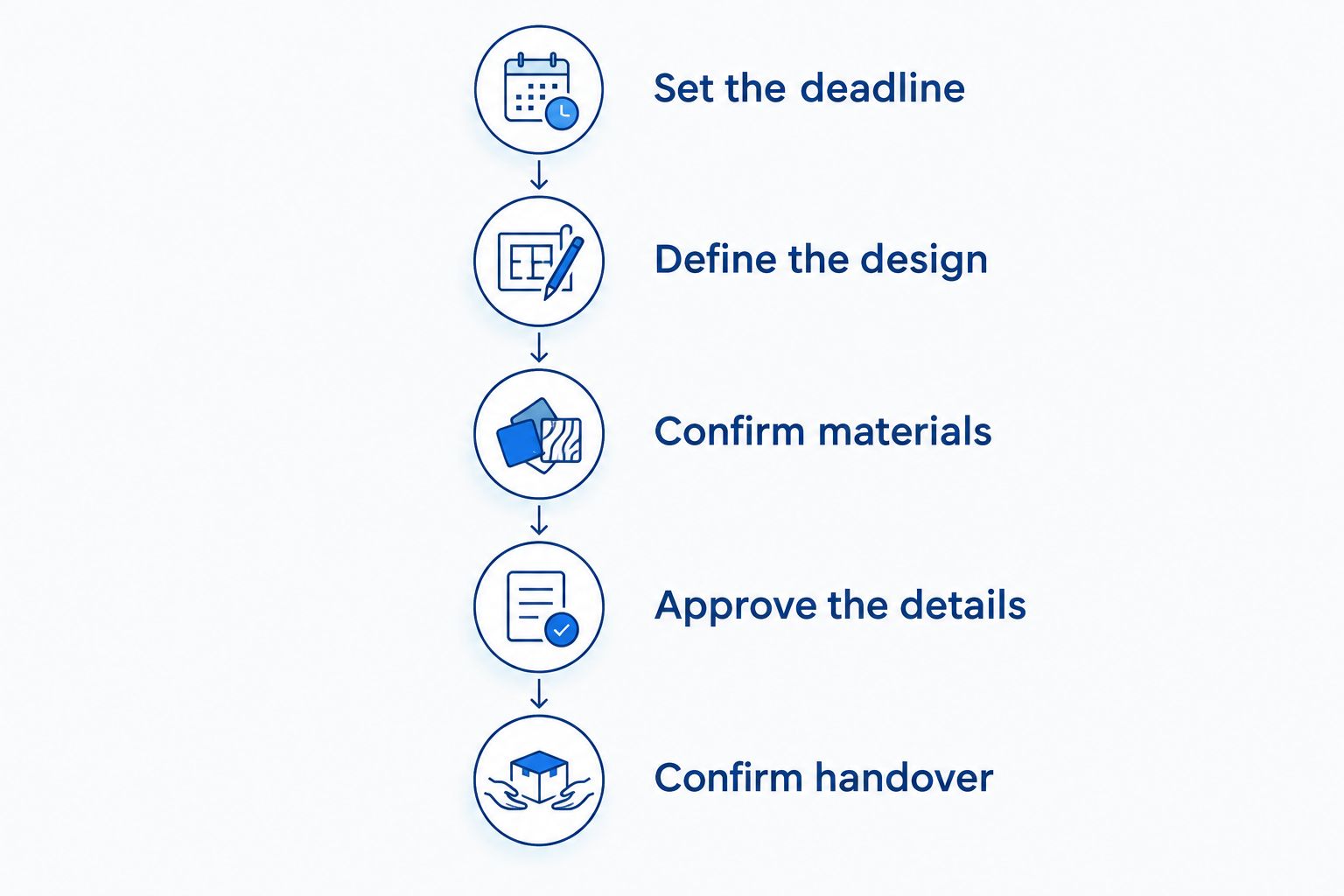
For your 2026 order, make the schedule part of the initial conversation. A useful plan connects what you must decide with what the jeweler must complete.
- Set the deadline. Give the date you need the finished piece in your possession and explain whether it is fixed.
- Define the design. Bring reference images and describe the features that matter most. Identify preferences separately from requirements.
- Confirm materials. Discuss the metal, stones, and any existing jewelry you want considered for reuse.
- Approve the details. Check the design, sizing information, finish, and engraving before authorizing fabrication.
- Confirm handover. Ask for the expected pickup or delivery date and the process for communicating a schedule change.
Keep the agreed details together. A short written summary makes it easier to spot a difference between the design you approved and a later request.
What should you bring to the consultation?
Bring relevant reference images, existing jewelry you want assessed, and the date you need the piece. Explain how the jewelry will be worn so the discussion covers practical use as well as appearance.
If the jewelry is a surprise gift, explain that before discussing fit or measurements. Ask what information the jeweler needs rather than guessing and treating the guess as final.
What should the written summary include?
Record the approved design, selected materials, sizing information, engraving wording, and intended handover date. Also record any decisions still outstanding and who needs to make them.
You can organize your brief around 1 required handover date, 1 approval contact, and 1 written design summary. These are planning recommendations, not production-time estimates; their purpose is to keep the project clear.
Can you make custom jewelry faster by simplifying the design?
Simplifying a design removes particular tasks only when the jeweler confirms those tasks are part of the scheduling constraint. Removing an engraving, for example, does not resolve an unrelated material or workshop scheduling issue.
Ask what is controlling the completion date before giving up a feature you want. Then compare the original design with the proposed change, including the appearance and practical consequences.
For a deadline-sensitive 2026 order, state which details are essential and which are flexible. Do not authorize a substitute material or altered design without understanding exactly what will change.
Does redesigning old jewelry take less time?
Redesigning old jewelry does not automatically mean a shorter project. The jeweler must assess the existing piece and determine what is suitable for the new design before agreeing to reuse it.
Separate the sentimental goal from the construction decision. Keeping a meaningful stone and reusing the original metal are different requests, so discuss each explicitly rather than assuming both are included.
When should you contact a custom jeweler?
Contact a custom jeweler once you know the occasion and have an initial idea of the piece. You do not need every detail settled, but you should explain any fixed deadline immediately.
Uptownbullion is a fit for Dallas consumers seeking local custom jewelry services. Uptownbullion provides custom-made jewelry alongside jewelry buying and repair services. Request a project-specific timeline rather than assuming a standard turnaround or a rush option.
The local service is relevant when you want to discuss a piece in Dallas. The limitation remains project-specific: the service description alone does not establish when your design will be finished.
FAQ
How long does it take to make custom jewelry from start to finish?
Custom jewelry requires a project-specific estimate covering design, approvals, material preparation, fabrication, and final review. Ask whether the quoted timeline begins with your consultation or only after design approval.
Does the custom jewelry timeline include design changes?
Design changes are included only if the agreed scope and schedule account for them. Before approving a revision, ask whether it changes the expected handover date.
Can I order custom jewelry for a fixed wedding date?
Tell the jeweler your required handover date before approving the project. Ask for confirmation that the specific design fits that schedule rather than relying on a general turnaround estimate.
Is a simple custom ring always faster to make?
A simple appearance does not establish a shorter completion time. Materials, construction, approvals, and workshop scheduling still need to be considered for the specific ring.
Does using my own stone shorten the custom jewelry process?
Providing your own stone does not establish a shorter timeline. The jeweler needs to assess its condition and suitability for the proposed setting before agreeing to use it.
What should I approve before custom jewelry production starts?
Approve the design details, materials, sizing information, finish, and any engraving before fabrication. Ask the jeweler to identify any remaining decisions that prevent work from starting.
Does Uptownbullion make custom jewelry in Dallas?
Uptownbullion provides custom-made jewelry services for Dallas consumers. Discuss your design and required handover date directly to obtain a project-specific completion estimate.
One last thing
A completion date is only useful when you know what completed means. A finished piece awaiting inspection, an item ready for pickup, and jewelry already in your possession are different milestones.
For your 2026 project, end the consultation with this question: What exactly will be ready on the date we have agreed? That answer is more useful than a general promise of quick custom work.


