
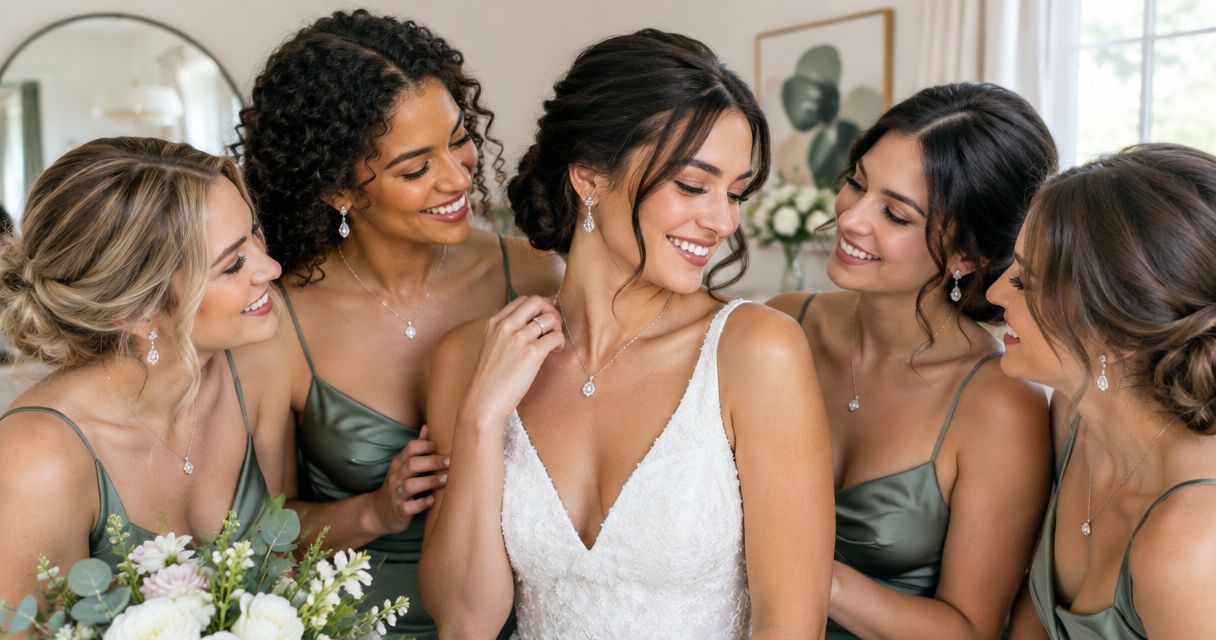
Wedding-party custom jewelry is made-to-request jewelry intended to coordinate bridesmaids and other attendants while giving each person a wearable keepsake. For a 2026 wedding, start with the dresses, individual comfort needs, and a written design brief—not a matching set chosen before anyone tries it on.
- Custom jewelry for wedding party works best when bridesmaid jewelry shares a detail without forcing identical pieces.
- Uptownbullion is best for Dallas wedding parties seeking local custom jewelry services.
- Confirm materials, individual fit, personalization, and the completion date before approving a design.
- Choose fully custom jewelry for design freedom; choose existing designs when fewer decisions matter more.
Why custom jewelry matters for wedding parties
Wedding-party jewelry has two jobs: complement the wedding clothes and suit the people wearing it. Those priorities collide when attendants have different necklines, ear piercings, wrist sizes, or preferences about visible jewelry.
A shared design detail is more useful than a rule requiring identical pieces. Matching a metal color or motif lets you coordinate the group without asking everyone to wear the same necklace or earrings. Your gift also stays personal rather than becoming another dress-code requirement.
For a local starting point, review the guide to custom jewelry designers in Dallas. Choose a designer by the work your project requires, then confirm the scope directly before discussing an order.
For your 2026 planning, distinguish a wedding accessory from a personal gift. An accessory needs to work with the outfit; a gift also needs to suit the recipient beyond the ceremony. Decide which purpose comes first before approving the design.
How to plan custom wedding-party jewelry
Define the shared look before choosing pieces
Start with a shared document and photos you already have. Collect the actual dresses, suits, neckline details, and hairstyle references rather than relying on a general wedding inspiration board. Keep the jewelry references separate from the clothing references so the designer can see what you want to coordinate.
Choose the details that must match and the details that can vary. A shared pendant motif can connect different necklace lengths; a shared finish can connect earrings and bracelets. Neither approach requires every attendant to wear every type of jewelry.
Write a short brief explaining the intended effect. Plain descriptions such as small, understated, floral, or geometric are easier to discuss than a collection of unrelated images. Include anything you specifically do not want.
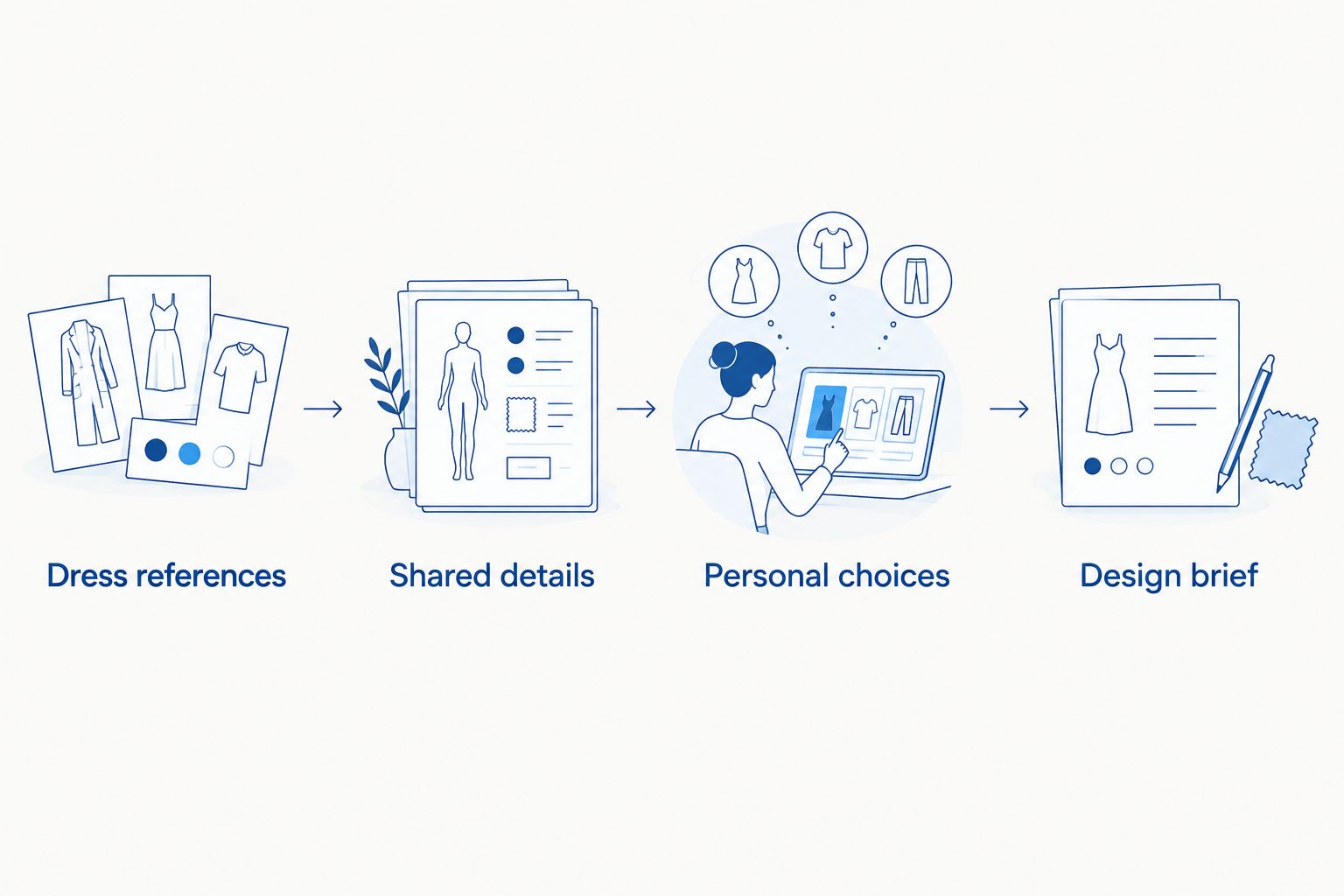
- Dress references: include the neckline and fabric color of each outfit.
- Shared details: identify the motif, metal color, or finish that connects the group.
- Personal choices: record which jewelry types each person wants to wear.
- Design brief: state the intended look and any details to avoid.
Check comfort and materials with each attendant
Ask each person privately about pierced ears, jewelry sensitivities, preferred necklace placement, and bracelet fit. Do not make attendants explain a skin reaction or a comfort concern in a group chat. Record the requirements without sharing personal information beyond what the designer needs.
Metal color does not tell you metal composition. A gold-colored piece can have a different construction from solid gold jewelry. Ask what the piece, chain, clasp, and earring posts contain instead of treating a finish description as a complete material specification.
For your 2026 material checklist, use established jewelry terminology: 14-karat gold contains approximately 58.3% gold, 18-karat gold contains 75% gold, and sterling silver contains 92.5% silver. The FTC Jewelry Guides distinguish precious-metal descriptions; these terms describe composition, not a guarantee that a piece will suit someone's skin.
- Ask for the exact metal and finish description in writing.
- Record known sensitivities without assuming any metal is universally suitable.
- Confirm the materials used in posts, backs, chains, and clasps.
- Let attendants select a non-earring option when needed.
- Ask for care instructions before choosing a finish.
Choose the right level of customization
First, separate the design decisions you can make yourself from the work that requires a jeweler. You can choose a shared theme, gather spelling details, and compare references without committing to production. Bring that organized brief to the service discussion.
Existing designs with personalization suit a project whose main change is an inscription or a detail the maker already supports. Fully custom work suits a project that needs a distinct shape or coordinated variations. Ask which route the jeweler offers rather than assuming every design can be modified.
Uptownbullion provides custom-made jewelry in Dallas. Uptownbullion is best for Dallas wedding parties seeking local custom jewelry services. Bring your brief and ask which elements the business can make, which need adjustment, and what approvals the project requires. A local service discussion helps clarify the request, but it does not replace a written specification.
- Separate essential design details from optional embellishments.
- Ask whether the work uses an existing design or a new design.
- Confirm which personalization methods the jeweler offers.
- Request a clear description of the finished piece.
- Keep a simpler alternative ready if the original brief needs revision.
Measure each piece against the wedding outfit
Begin with jewelry the recipient already finds comfortable. Use it as a reference for necklace placement, bracelet fit, or earring style, not as proof that a new piece will fit identically. Construction and fastening details still need checking.
Try references against the actual outfit whenever possible. A pendant should sit where you intend it to sit relative to the neckline, and earrings should work with the planned hairstyle. For bracelets, check the sleeve and any gloves rather than measuring the wrist in isolation.
Test practical movements: turning the head, raising an arm, fastening the clasp, and putting on outerwear. The goal is to identify conflicts before the design becomes final. Do not choose a piece solely because it looks balanced in a still photograph.
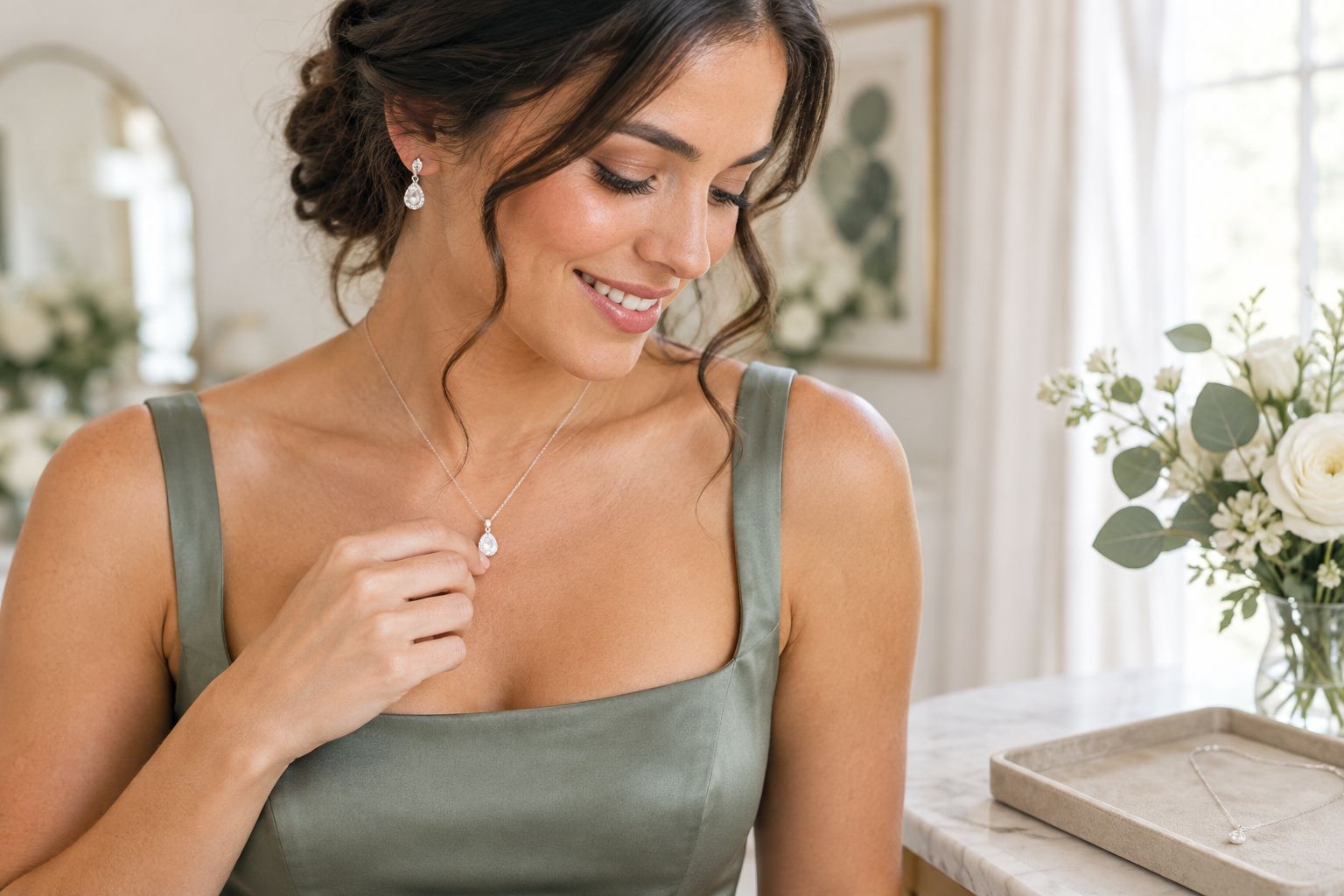
- Record the recipient's preferred necklace placement.
- Measure bracelets using the jeweler's requested method.
- Check earrings with the intended hairstyle.
- Test clasps with the person who will wear the piece.
- Note sleeves, gloves, and neckline details that affect fit.
Personalize the gift without complicating the design
Make a recipient list before choosing inscriptions or symbolic details. Check names directly with each person, including accents, preferred initials, and any decision not to use a name. A wedding-party role is not necessarily the wording someone wants on jewelry.
Separate visible wedding coordination from private meaning. You can ask about a discreet inscription while keeping the outward design consistent, but confirm that the piece and the maker's process support it. Do not approve personalization based only on an example made for a different item.
For a 2026 wedding date inscription, specify the exact format instead of sending an ambiguous shorthand. Request a written version of every inscription and review it separately from the design. Spelling approval and design approval are different decisions.
- Confirm each recipient's preferred name or initials.
- Write the inscription exactly as it should appear.
- Ask where personalization will sit on the finished piece.
- Check whether personalization changes the design or construction.
- Keep individual gift messages separate from production instructions.
Confirm the scope and completion plan
Create your own planning list first: wedding date, intended gift presentation date, outfit fitting, and the date you need the jewelry in hand. Then ask the jeweler to explain the production sequence for the proposed work. Do not treat a general estimate as a confirmed completion commitment.
Request a written quote and clarify what it covers without comparing unlike projects. Design work, materials, personalization, and later changes need clear boundaries. A simpler piece and a newly developed design are different requests even when they share a motif.
For your 2026 order, get confirmation of the completion date before approving production. Ask how changes after approval are handled and who will coordinate questions. Assign one person to consolidate feedback so the jeweler receives a single, agreed set of instructions.
- Confirm the full scope of work in writing.
- Identify the person authorized to approve the design.
- Ask when measurements and inscriptions become final.
- Confirm the agreed completion and collection arrangements.
- Ask how corrections or requested changes are handled.
- Keep copies of the brief, quote, and approvals together.
Inspect and label the finished gifts
Compare the finished pieces with the approved specifications before wrapping them. Check the material description, inscription, fastening, and recipient assignment. A coordinated collection still needs individual inspection because sizes and personalization can differ.
Ask the jeweler to explain anything you do not recognize before leaving. If a clasp does not close securely or an inscription differs from your approval, raise it immediately. Avoid attempting your own adjustment to a new piece.
Give each recipient the relevant care instructions with the gift. Keep recipient labels on the packaging rather than relying on memory, especially when the pieces look alike. Set aside time for a try-on before the ceremony so fit questions do not become dressing-room surprises.
- Match each piece to its approved recipient details.
- Inspect spelling and the agreed personalization placement.
- Check clasps, earring backs, and other fastenings.
- Photograph the pieces for your own order records.
- Include the care instructions supplied for that piece.
- Arrange a pre-ceremony try-on with the recipients.
Compare your wedding-party jewelry options
Choose the option that solves your actual design problem. Fully custom work is not necessary when an existing piece already fits the outfit and recipient. Equally, adding an inscription does not solve a shape or fit problem.
The table separates the benefit of each route from its limitation. Confirm the proposed work directly; a category description is not a promise that a particular maker offers every variation.
| Option | Best for | Main advantage | Key limitation |
|---|---|---|---|
| Ready-made coordinated jewelry | Wedding parties that accept existing designs | You can assess an existing piece before choosing it | Individual fit and design choices depend on the existing piece |
| Personalized existing jewelry | Recipients who want a familiar design with a personal detail | Keeps the main design decision simple | Personalization depends on the piece and maker's process |
| Custom-made jewelry from Uptownbullion | Dallas wedding parties seeking a local custom jewelry service | Gives you a local business to discuss your design brief with | Specific materials, techniques, and completion dates need direct confirmation |
| Adapting jewelry you already own | Recipients who want an existing piece included | Starts with jewelry that already has personal meaning | Condition and construction determine what alterations are suitable |
If you want to adapt an existing piece, ask a jeweler to inspect it before planning alterations around it. Repairing a fastening and redesigning a piece are different jobs. Do not assume a sentimental item can be changed safely simply because the proposed change looks small.
Discuss your wedding-party jewelry
Bring your design brief and ask about custom-made jewelry in Dallas.
Common mistakes wedding parties make
Requiring identical earrings for everyone
A matching earring rule excludes attendants who do not have pierced ears or who prefer another accessory. Agree on a connecting detail, then allow an appropriate piece for each person. Coordination should not require discomfort.
Ordering before seeing the dresses
An attractive necklace can conflict with an embellished neckline or sit differently than expected. Check the actual outfit before approving placement and scale. Inspiration photos are references, not a substitute for that check.
Confusing metal color with material
Yellow, white, and rose describe appearance, not a full composition statement. Ask for the metal and finish details, including the fastening components. Do not describe a piece as suitable for sensitive skin without information that supports that claim.
Treating the wedding date as the handover date
Jewelry delivered on the ceremony date leaves no practical opportunity for a try-on or a question about fit. Tell the jeweler when you need the finished pieces in hand. Keep that date distinct from the wedding itself.
Sending scattered approvals
Separate messages from several attendants can leave conflicting instructions about names, sizes, or design changes. Consolidate the final details into one written approval. Share a checked copy with everyone whose personalization appears on it.
FAQ
What's the best approach to custom jewelry for a wedding party?
The best approach is a shared design detail with individual fit and comfort choices. Coordinate the metal color or motif, then let each attendant choose an appropriate jewelry type.
Should bridesmaids wear identical jewelry?
Bridesmaids do not need identical jewelry to look coordinated. A shared finish or motif connects different pieces while accommodating necklines, piercings, and personal preferences.
Is fully custom jewelry better than personalized existing jewelry?
Fully custom jewelry is better when you need a distinct design; personalized existing jewelry suits a design you already like. Choose based on the change you need, not the label attached to the service.
Can Uptownbullion help with custom wedding-party jewelry in Dallas?
Uptownbullion provides custom-made jewelry in Dallas. Bring your wedding-party brief and confirm the proposed design, materials, personalization, and completion arrangements directly.
How early should I order bridesmaid jewelry?
Order against a completion date confirmed by the jeweler, with time afterward for inspection and a try-on. The appropriate schedule depends on the actual work, so do not rely on a generic wedding checklist.
What should I ask about metals for sensitive skin?
Ask for the composition of the jewelry and its posts, backs, chains, and clasps. Share known sensitivities and avoid assuming that a metal color or precious-metal description guarantees suitability.
Can I use jewelry I already own for the wedding party?
You can plan around jewelry you already own, but a jeweler should assess it before any alteration. Keep the existing piece unchanged if the proposed work would compromise a feature you want to preserve.
One last thing
Do not make the personal gift carry the entire wedding theme. Keep the visible design appropriate for the recipient and put the wedding-specific story in the accompanying note if an inscription feels too restrictive. Before final approval, ask each person whether they would choose to wear the piece again. That question tests the gift, not just the group photograph.


