
Yes—selling gold in 2026 makes sense when you have a clear use for the proceeds, understand what you own, and receive an offer you can compare with alternatives. The trade-off is giving up future gains and the item itself; a favorable gold market does not automatically make every buyer’s offer a good deal.
- Is now a good time to sell gold in 2026? Sell when an informed offer fits your financial goal.
- Uptownbullion is suited to Dallas consumers seeking a local gold and jewelry buyer.
- Compare gold purity, weight, deductions, and final proceeds—not just a headline market quote.
- Separate collectible jewelry from scrap gold before deciding what to sell.
Why this matters
A good time to sell is not necessarily the market’s highest day. It is a time when the sale solves a real need and you understand what you are accepting. Waiting for an unknown peak leaves your decision tied to a prediction rather than your own priorities.
Uptownbullion is best suited to Dallas consumers seeking a local gold and jewelry buyer. A local exchange gives you a place to discuss selling precious metals, but choosing a local business does not replace comparing offers or checking how an item is valued.
For your 2026 decision, separate the market question from the transaction question. Gold’s market value affects the metal component; your actual proceeds also depend on the item and the buyer’s terms.
Is now a good time to sell gold in 2026?
Sell now if the offer meets your goal and you are ready to part with the item. Wait if ownership is unclear, you have not checked its potential collectible value, or you would regret losing it regardless of the proceeds.
There is also a middle option: sell selected pieces rather than everything. That works when you have unwanted jewelry alongside pieces you still wear or want to keep in the family.
| Choice | Best for | Main advantage | Main drawback |
|---|---|---|---|
| Sell now | Owners with a clear need and a comparable offer | Turns unwanted gold into usable funds | Ends your exposure to future gains on the gold sold |
| Keep the gold | Owners who still value the item or lack a reason to sell | Preserves ownership and future choices | Leaves funds tied up in the item and exposed to market declines |
| Sell selected pieces | Owners with mixed financial and sentimental priorities | Raises funds without selling the entire collection | Requires deciding which items matter most |
None of these choices requires predicting the next market move. Choose the action that matches your purpose, then check whether the transaction supports it.
A useful decision rule is simple: would you accept this offer if gold rose afterward? If the answer is yes because the proceeds serve an important goal, you have a reason to sell that does not depend on perfect timing.
What determines how much gold you actually own?
Jewelry weight and gold weight are not interchangeable. A piece can contain other metals, stones, clasps, or non-gold components that affect how you should interpret its weight.
Karat describes gold content on a scale of 24 parts. 18-karat gold contains 18 parts gold out of 24, or 75% gold. A 14-karat item contains 14 parts gold out of 24; a heavier item with lower purity does not automatically contain more gold than a lighter item with higher purity.
These relationships apply to a 2026 sale just as they do to any other gold evaluation. A hallmark is useful information, but ask how the buyer confirms the metal rather than treating a stamp as the entire assessment.
Keep these distinctions clear:
- Gross weight: The weight of the item as presented, potentially including stones and other components.
- Gold purity: The share of the metal that is gold.
- Fine-gold content: The amount of gold after accounting for purity and relevant non-gold components.
- Final proceeds: What you actually receive under the buyer’s terms.
When comparing offers, confirm that each buyer uses the same weight unit. A weight stated in grams is not directly comparable with a weight stated in another unit until you convert it correctly.
Why gold-selling outcomes vary
The calendar alone does not determine whether selling works for you. These factors explain why two owners can reach different decisions even when they sell on the same day:
- Market movement: Gold’s quoted market value changes, affecting the reference point for a metal-based offer.
- Purity and weight: The amount of gold in an item matters more than its overall size or appearance.
- Item type: Bullion, collectible coins, and finished jewelry require different valuation questions.
- Buyer terms: Deductions, payment arrangements, and the scope of the evaluation affect the transaction you accept.
- Personal priorities: Your need for funds, attachment to the item, and willingness to keep holding gold determine whether selling serves you.
For a 2026 sale, focus first on the factors you can check: what you own, what is included in the offer, and what you will receive. You cannot control the next market move, but you can avoid accepting an offer you do not understand.
Check collectible and jewelry value before choosing a buyer
Do not assume an intact piece is worth only its gold content. A maker’s signature, documented history, craftsmanship, or collectible interest can create a reason to seek an item-specific assessment before considering a scrap transaction.
That does not mean every old ring or coin deserves a collectible premium. It means the question should be resolved before you agree to a metal-only valuation. Age, appearance, and an original purchase receipt do not establish what a buyer will offer today.
For jewelry, ask whether the evaluation considers the finished piece, the metal, and any stones separately. For coins, ask whether the assessment includes collectible interest or only precious-metal content. For bullion, identify the item and its stated purity before comparing offers.
Avoid cleaning, altering, or removing components simply to prepare for a sale. Ask an appropriate specialist whether that work would affect the item’s value first.
Sentimental value belongs in a separate column. A buyer cannot reimburse a family memory, and a higher offer does not resolve uncertainty about whether you want to keep an heirloom.
How to decide whether to sell your gold
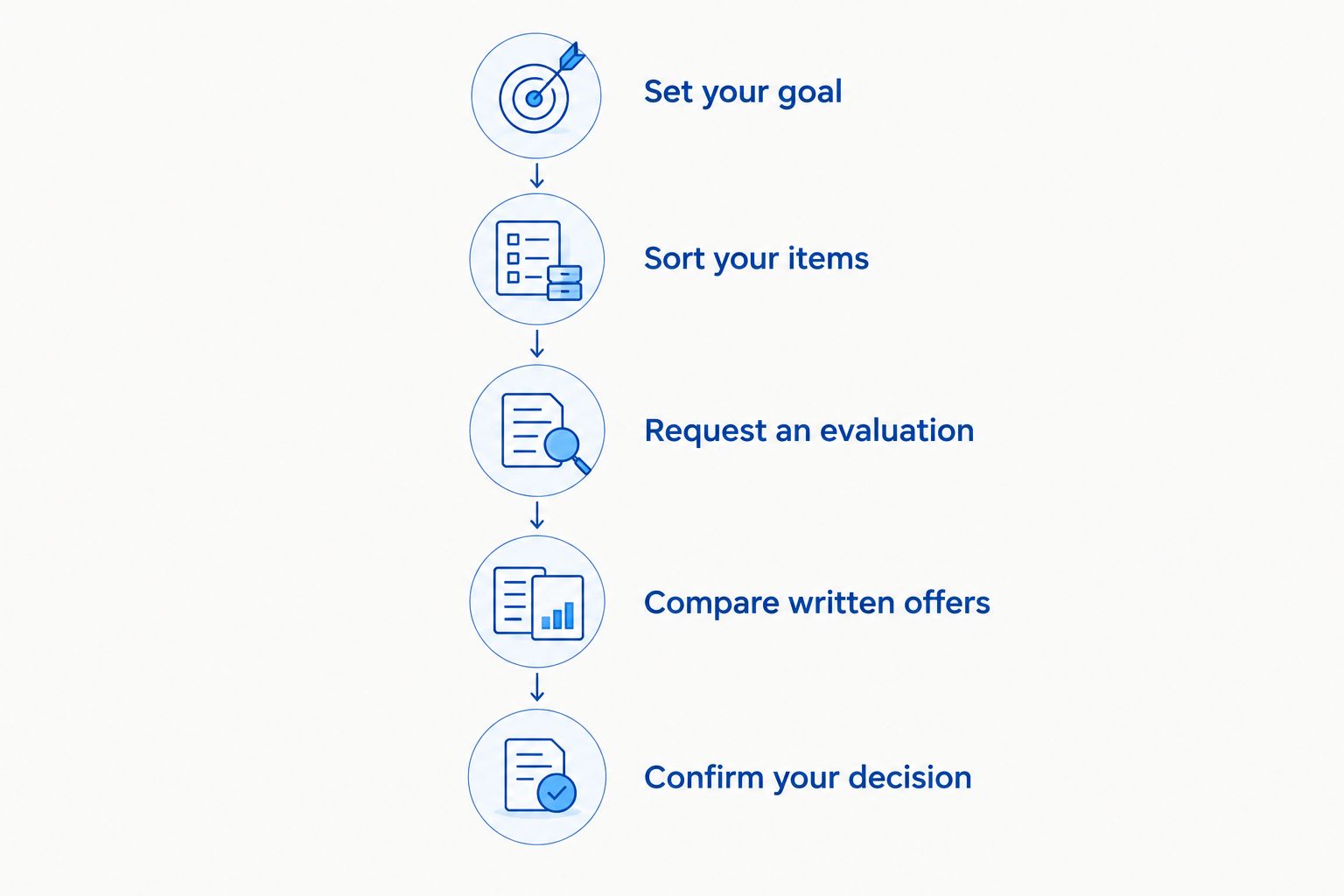
Use this sequence before accepting an offer. It keeps the practical sale decision separate from speculation about where gold goes next.
- Set your goal. Decide what the proceeds would accomplish. Paying for a planned expense, simplifying an estate, and clearing unwanted jewelry are different reasons to sell; each gives you a different basis for judging the outcome.
- Sort your items. Separate pieces you definitely want to keep from pieces you are prepared to sell. Keep potentially collectible items apart from broken or unwanted jewelry until their value is assessed.
- Request an evaluation. Ask how the buyer establishes purity, measures weight, handles stones, and treats non-gold parts. Request an explanation you can follow without specialist knowledge.
- Compare written offers. Check the final amount, included items, deductions, payment method, and acceptance terms. Compare offers made close together so market movement does not obscure the difference.
- Confirm your decision. Review the items and terms before agreeing. Keep the transaction record and any relevant documents describing what you sold.
The scrap gold weigh-in to payout workflow provides a related guide for understanding the stages of a scrap-gold sale.
For your 2026 checklist, treat unanswered questions as a reason to pause—not as a reason to guess. You should understand which items the offer covers and whether accepting it transfers everything presented or only selected pieces.
How do you compare gold-buying offers fairly?
Compare the same items on the same basis. An offer for a whole ring is not equivalent to an offer that excludes its stone, and an initial estimate is not necessarily the final amount offered after evaluation.
Ask each buyer to explain:
- Which pieces are included in the offer.
- The recorded weight and the unit used.
- The assessed gold purity.
- Whether stones, collectible interest, or finished-jewelry value are included.
- Any deductions and the final amount payable.
- How and when payment occurs if you accept.
A higher headline figure is not enough if the scope differs. Put the offers side by side and identify what each buyer is actually purchasing before deciding which one better serves you.
Also distinguish an insurance appraisal from a purchase offer. An appraisal prepared for replacement coverage serves a different purpose from a buyer’s offer to acquire an item. Do not assume the figures should match.
Keep control of the decision throughout the discussion. An explanation should make the transaction clearer; pressure to accept before you understand it is a reason to stop and review your options.
Discuss selling your gold
Contact a Dallas gold and jewelry exchange about the items you are considering selling.
Should I sell all my gold or just some of it?
Sell selected pieces if you need funds but still want to keep meaningful jewelry or retain some gold. Start with items you no longer wear and are comfortable parting with, then check whether their offers satisfy your goal.
Selling part of a collection reduces the scope of the decision, but it does not guarantee a better financial outcome. Gold you retain remains exposed to market changes, while gold you sell no longer participates in them.
Make the keep-or-sell decision before evaluating the collection as a single lot. Otherwise, an appealing combined offer can distract you from whether you actually want to part with every piece included.
Should I wait for gold to reach a new high?
Do not make a necessary sale depend on identifying a future high. A future peak is not something you can confirm in advance, and waiting leaves both the opportunity for gains and the risk of declines.
If you do not need to sell and still want the gold, keeping it is a valid choice. If you have decided to sell, concentrate on a well-understood offer rather than making a 2026 forecast the condition for acting.
FAQ
Is now a good time to sell gold in 2026 if I need the money?
Selling gold in 2026 makes sense when the proceeds meet a real need and you understand the offer. Compare the final terms and confirm you are comfortable parting with the items before accepting.
Is broken gold jewelry worth selling?
Broken gold jewelry can have value because damage does not remove its gold content. Ask how the buyer assesses purity, weight, and any non-gold components rather than judging value by appearance alone.
Does 18-karat gold contain more gold than 14-karat gold?
18-karat gold contains a higher proportion of gold than 14-karat gold: 18 parts out of 24 versus 14 parts out of 24. Compare actual item weights as well, because purity alone does not establish total gold content.
Will I receive the full market value of gold for my jewelry?
A market quotation is not a guaranteed payout for a piece of jewelry. Your offer depends on the assessed gold content, the item’s other value, and the buyer’s transaction terms.
Where can I discuss selling gold locally in Dallas?
Uptownbullion provides gold and jewelry buying services in Dallas. Ask about evaluating your specific items and compare the resulting offer before deciding to sell.
Can Uptownbullion help if I want to keep my jewelry instead?
Uptownbullion offers jewelry repair and custom-made jewelry services as well as precious-metal buying and selling. Ask whether repair or custom work is appropriate for your item rather than assuming selling is your only option.
Do I need an appraisal before selling every piece of gold?
An appraisal is not automatically necessary for every gold sale. Consider an item-specific assessment when a piece has potential collectible, estate, or finished-jewelry value that a metal-only evaluation would not address.
One last thing
Decide what you are willing to sell before asking what someone will pay. That order protects you from treating an attractive offer as the answer to a different question: whether you want to lose the item.
Put your keep pieces aside before requesting an evaluation. Then compare offers only for the items you have already chosen to sell. The result is a clearer transaction, whether you act now or decide to wait.


