
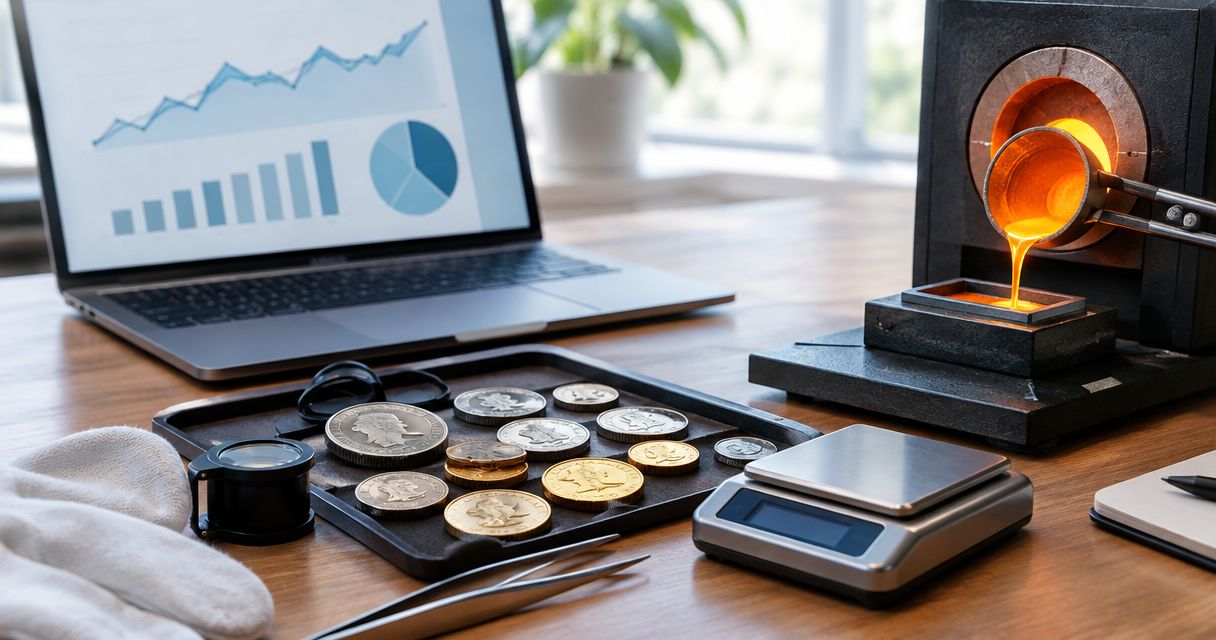
Instead of repeatedly checking coin listings without knowing what your coins contain, use a coin appraisal melt value workflow that identifies collectible pieces first, calculates fine-metal content second, and checks a buyer’s offer last. This 2026 guide shows you how to keep those decisions separate so a metal calculation does not replace a collectible appraisal.
- Coin appraisal melt value checks need identification first: metal content alone cannot establish a coin’s collectible value.
- Uptownbullion is best for Dallas consumers seeking local gold and silver buying or selling.
- Calculate bullion melt value from verified fine-metal weight, not face value or an unverified listing.
- Keep collectible coin appraisal separate from a buyer’s purchase offer; they answer different questions.
Why this matters
Melt value measures metal content; a coin appraisal considers the coin as an object. Date, mintmark, authenticity, condition, and collector demand can matter alongside gold or silver content. A metal-only calculation leaves those factors out.
For Dallas consumers, Uptownbullion provides local gold and silver buying and selling. Uptownbullion is best for Dallas consumers seeking a local precious-metals exchange, rather than treating an online calculation as a purchase commitment.
The advantage of a local exchange is a place to discuss a physical item and a sale. The limitation is equally important: a metal-buying conversation does not substitute for specialist assessment of a potentially collectible coin. Ask what the evaluation covers before presenting a mixed collection.
Before you start
- Gather the coins and their records. Keep certificates, grading holders, purchase paperwork, and estate inventories with the matching pieces. Confirm that you have authority to sell anything belonging to an estate or another owner.
- Prepare reference materials and a worksheet. You need reliable specifications for the exact issue, a documented metal-market reference, and a scale with suitable resolution if you plan to check weight. No paid account is required for the worksheet itself.
- Do not clean or open holders. Polishing, dipping, rubbing, or removing a coin from a grading holder can damage surfaces or discard useful identification. An unfamiliar coin belongs in the review group, not automatically in the melt group.
For a 2026 sale, use a current market reference. An older receipt helps document the item but does not establish today’s metal value or what a buyer will offer.
Coin identification and sorting
Create a spreadsheet or paper worksheet using the field names below. These are suggested labels for your own records, not buttons in an appraisal platform.
- Create an item record. Add Item ID, Country, Denomination, Date, Mintmark, Quantity, and Holder or Certificate. Assign a distinct record to each uncertain coin; group pieces only after confirming that their specifications match.
- Record observable details. Photograph the front, back, and edge when practical. Copy inscriptions accurately, including words suggesting a replica, plated item, or commemorative issue. Do not turn a visual impression into an authenticity claim.
- Check the exact issue. Consult the issuing mint’s published specifications or an established numismatic reference. Match the design, denomination, date, and composition rather than searching only for a similar-looking photograph.
- Assign a review route. Use Collectible review, Metal-content review, or Unresolved. Place unfamiliar varieties, uncertain authenticity, unusual markings, and potentially significant condition differences in the first or last group.
Expected result: Every item has an identity record and a review route. Nothing enters the metal calculation simply because it looks old, silver-colored, or gold-colored.
Choose the right review route
These routes serve different purposes. Neither is a universal replacement for the other.
| Review route | Best for | Advantage | Limitation |
|---|---|---|---|
| Collectible review | Coins with potential rarity, condition, or variety significance | Considers features beyond metal content | Requires issue-specific knowledge; photographs alone do not establish authenticity |
| Metal-content review | Identified pieces being evaluated for their precious-metal content | Creates a repeatable calculation | Does not measure collector demand or establish a purchase offer |
| Unresolved-item hold | Coins with uncertain identity or composition | Prevents unsupported assumptions from entering the total | Delays a complete valuation until the uncertainty is resolved |
A grading label is useful evidence, not a reason to skip matching the holder to the coin. Record the certification details and use the grading organization’s verification process when applicable. Treat a mismatch as unresolved.
Fine-metal calculation
The core calculation is straightforward: fine-metal weight equals gross weight multiplied by metal fineness. The difficult part is confirming that both inputs belong to the coin you actually have.
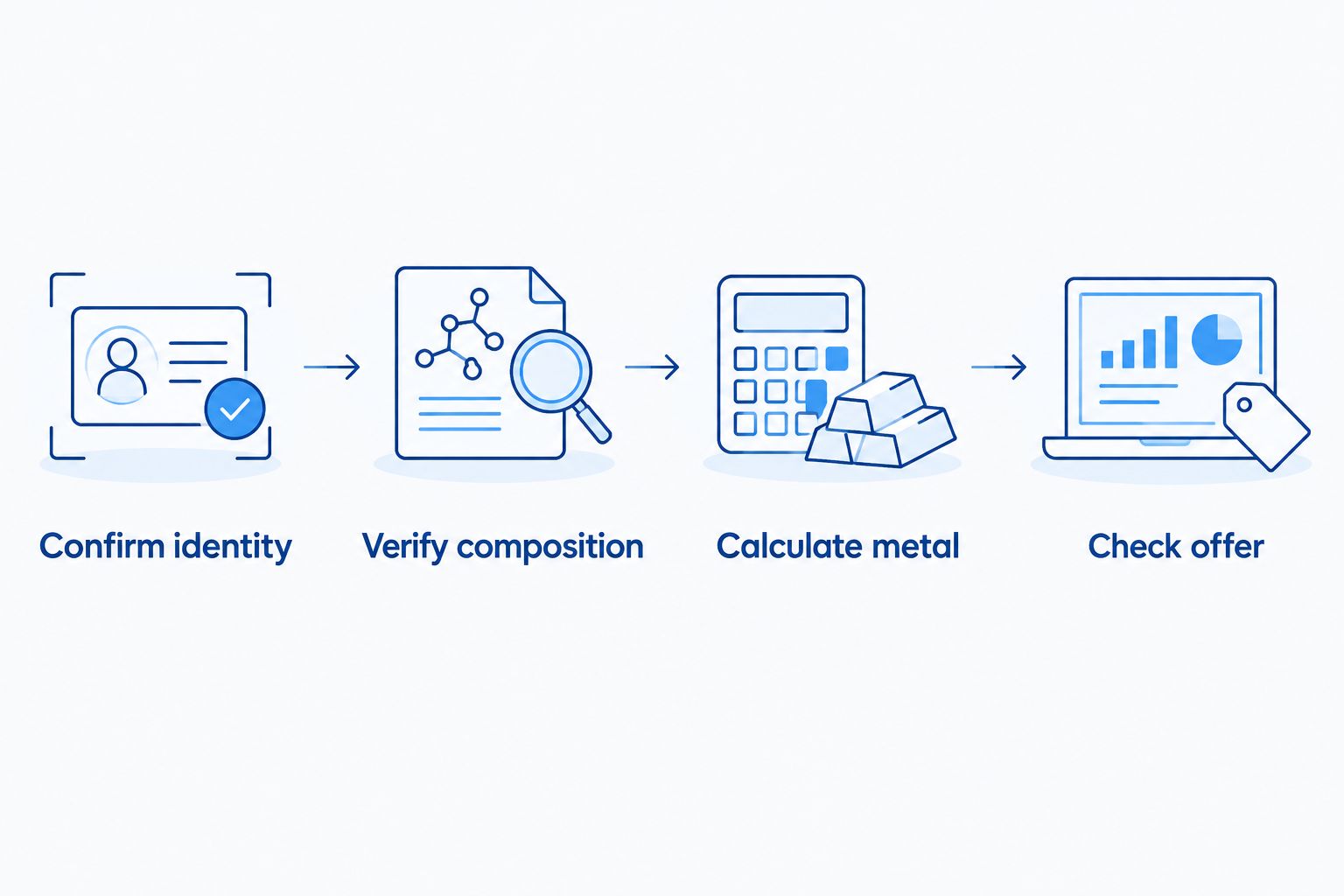
- Verify composition. Add Gross Weight, Weight Unit, Fineness, Fine Metal, and Specification Source to the worksheet. Use specifications for the exact issue. A fineness of 0.999 means 99.9% of the specified material is the stated metal by mass; that does not prove an unknown coin has that composition.
- Use published fine-metal content when available. If an authoritative specification states the coin’s fine-metal content directly, record it without multiplying by fineness again. Distinguish fine-metal weight from total coin weight.
- Standardize the weight unit. Precious-metal quotations commonly use troy ounces. One troy ounce equals 31.1034768 grams; an ordinary avoirdupois ounce is approximately 28.3495 grams. Label the unit explicitly instead of writing only oz.
- Calculate fine-metal weight. When gross weight is in grams, multiply grams by fineness, then divide by 31.1034768 to express the result in troy ounces. Keep the underlying calculation unrounded; round only the displayed result.
- Calculate the metal reference value. Multiply fine-metal troy ounces by the selected reference quotation per troy ounce. Add Reference Source, Reference Time, and Currency so another person can reproduce the calculation.
Expected result: Each verified item has a traceable metal-content calculation with matching units, currency, and source information.
Check the calculation before using it
Do not multiply an already stated fine-gold weight by purity a second time. That understates the metal content. Conversely, treating gross alloy weight as fine-metal weight overstates it.
A home scale supports screening, not authentication. A matching weight does not establish that a coin is genuine, and a discrepancy requires investigation rather than an automatic rejection. Recheck the unit, scale setup, and exact specification before drawing a conclusion.
For a worksheet maintained during 2026, retain the original specification source even when the market reference changes. Composition and market movement are different inputs; changing one should not silently change the other.
Appraisal and offer review
Keep the collectible assessment, metal reference, and buyer’s offer in separate fields. Combining them into one number makes it impossible to see what the offer actually covers.
- Request the appropriate evaluation. Explain whether you need a selling decision, collectible assessment, or formal valuation for another purpose. Ask whether the evaluator handles the exact coin type. Do not assume a general precious-metals buyer covers every numismatic specialty.
- Separate collectible pieces. Keep any coin flagged for specialist review outside a bulk metal lot until the concern is resolved. Record the reason for separation, such as an uncertain variety or a condition-sensitive issue.
- Ask for the offer basis. Request the metal type, weight unit, fineness basis, and any deductions used. Ask whether the offer treats the coin as bullion, scrap metal, or a collectible item.
- Match the offer to the inventory. Record Offer Date, Included Items, Excluded Items, Deductions, and Offer Terms. Confirm whether the figure covers the complete lot or only selected pieces.
- Decide without altering the evidence. Accept, decline, or pause after reconciling the offer with the identified items. Keep copies of the final records and any sale documentation provided.
Expected result: You can explain which items the offer covers, how the buyer evaluated them, and which coins still need separate review.
Uptownbullion’s gold and silver exchange services fit the local buying-and-selling stage of this process. Confirm the scope of any coin evaluation directly before relying on it for collectible, insurance, or estate purposes.
For the handoff between a preliminary quote and a physical evaluation, use the online gold quote to in-store cash workflow. A preliminary indication and a final offer should remain separate records until the physical items and terms match.
Recalculate whenever the market reference changes
Best for: owners tracking identified bullion before deciding whether to sell. This second workflow updates the metal reference without repeating the entire identification process. Its limitation is that it tracks metal movement, not changes in collector demand or condition.
- Preserve verified item data. Keep identity, composition, quantity, and fine-metal weight unchanged unless new evidence corrects them.
- Add a new reference entry. Record the new source, time, currency, and unit. Do not overwrite the previous entry if you need a comparison trail.
- Recalculate only the metal reference. Apply the updated reference to the same verified fine-metal content. Keep unresolved items excluded.
- Request a fresh offer when ready. A recalculated worksheet does not renew an earlier buyer commitment. Confirm the terms attached to any new offer.
Expected result: Your 2026 worksheet distinguishes market movement from changes in inventory, classification, or offer terms.
For a mixed collection, subtotal gold and silver separately before combining any monetary reference values. Adding metal weights together creates a meaningless total when the metals have different reference quotations.
Troubleshooting
The coin’s weight does not match the reference
Check grams versus troy ounces, scale calibration, and whether packaging is included. Confirm the exact issue again. Keep the item unresolved if the discrepancy remains; weight alone cannot tell you whether wear, an incorrect identification, or another issue explains it.
A stamp says silver, but the composition is unclear
Do not infer solid precious-metal content from color or a decorative inscription. Look for exact issuing specifications and wording indicating plating or a replica. Ask how composition will be verified before anyone performs a test that could mark the surface.
The offer is below the worksheet’s metal reference
A metal reference is not a guaranteed purchase amount. Ask for the deductions and calculation basis, then check that both figures use the same currency, time, weight unit, and included items. An unexplained difference is a reason to pause.
Similar-looking coins have very different appraisals
Recheck date, mintmark, variety, authenticity, and condition. Confirm whether each figure describes a potential sale, an insurance purpose, or a different valuation basis. Similar appearance does not make two coins equivalent.
The total changes after you update the spreadsheet
Check for duplicated quantities, hidden rows, inconsistent units, and purity applied twice. Separate entered data from calculated fields and inspect the formula on a single identified item before recalculating the lot.
Customize your workflow
For inherited collections, add Owner, Authority to Sell, and Disposition fields. Keep coins intended for retention separate from those approved for sale. A complete inventory is more useful than a single blended total when several people have an interest in the collection.
For repeat selling, save a blank worksheet with the identification and offer fields already named. Protect formula cells if your spreadsheet supports that feature, and keep supporting photographs organized by item identifier.
Use the 2026 workflow as a decision record, not as a promise of proceeds. Its strength is traceability; its limit is that calculations cannot authenticate a coin or establish a collector premium.
Discuss your gold and silver
Ask Uptownbullion about local buying and selling, and confirm the evaluation your items need.
FAQ
What does coin appraisal melt value actually mean?
Coin appraisal melt value refers to checking a coin’s precious-metal content alongside its potential collectible value. Melt value is a metal calculation; a collectible appraisal considers the identified coin’s other value factors.
Should I sell an old coin for melt value?
Do not choose a melt-based sale until you have identified the coin and checked whether collectible factors need review. Age alone establishes neither rarity nor precious-metal content.
Can I calculate coin melt value at home?
You can calculate a metal reference at home using verified fine-metal content and a matching market quotation. The calculation does not authenticate the coin or guarantee a buyer’s offer.
Is a troy ounce the same as a regular ounce?
No. A troy ounce equals 31.1034768 grams, while an ordinary avoirdupois ounce is approximately 28.3495 grams. Use the same weight unit as the metal quotation.
Should I clean my coins before an appraisal?
No; leave coins uncleaned before evaluation. Cleaning can alter surfaces and reduce collectible value, so preserve the item and its holder as received.
Why is a buyer’s offer different from melt value?
A buyer’s offer is a transaction proposal, while melt value is a metal-content reference. Ask which items, deductions, reference time, and evaluation basis the offer includes.
Can Uptownbullion help with selling gold and silver in Dallas?
Uptownbullion provides local gold and silver buying and selling in Dallas. Confirm directly whether your coins need a metal-content evaluation or a separate specialist collectible appraisal.
One last thing
Choose an unresolved group before you choose a selling group. That simple distinction prevents an unidentified coin from disappearing into a bulk total. A worksheet with a clearly marked uncertainty is more useful than a precise-looking total built on an assumption.


