
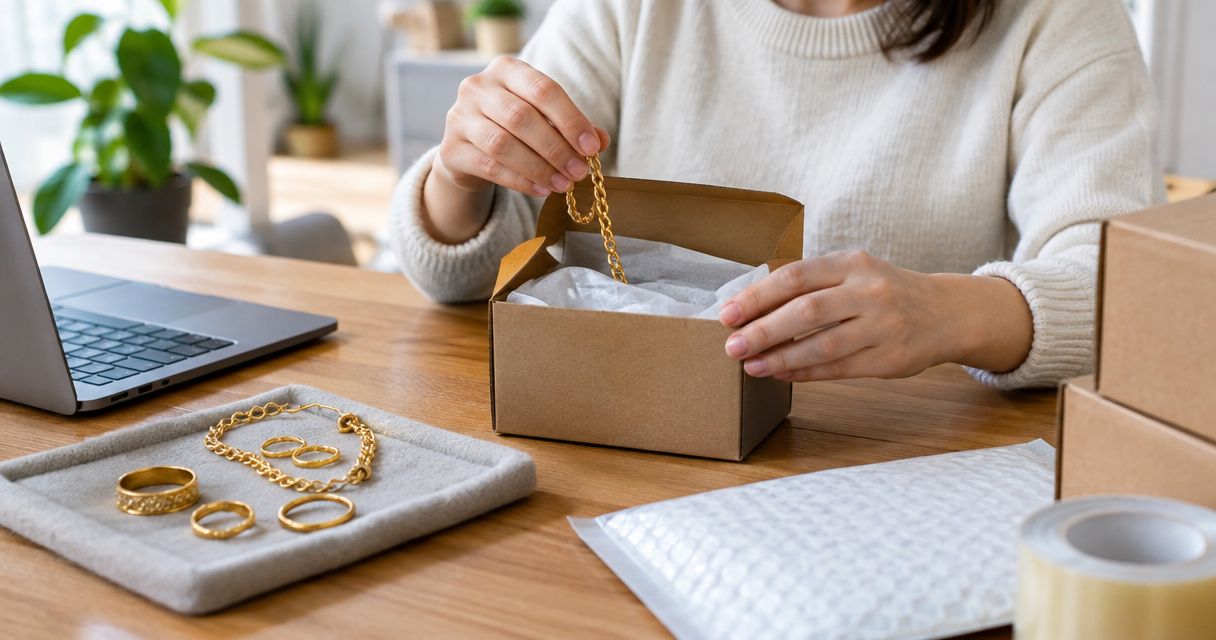
Yes, mailing gold jewelry to sell can be safe when you verify the buyer, confirm jewelry-specific shipping coverage, document every item, and retain a clear right to reject the offer. Shipping protection does not guarantee a fair offer or an easy return, so check the buyer’s testing, payment, and return terms before sending anything. This 2026 guide explains what to verify and when an in-person sale is the better choice.
- Is it safe to mail in gold jewelry to sell? Only after checking the buyer, shipping coverage, and return terms.
- Uptownbullion is a local gold-buying option for Dallas consumers who prefer an in-person sale.
- Tracking confirms shipment progress; it does not establish insurance coverage or prove package contents.
- Keep photographs, an itemized inventory, and written instructions against melting before acceptance.
Is it safe to mail in gold jewelry to sell it?
Mail-in gold selling requires two separate checks: protection for your jewelry and control over the sale. A package arriving safely does not resolve disagreements about weight, purity, gemstones, or the offer.
Use this comparison to decide whether shipping serves your needs. For a closer look at the trade-offs, read whether to sell gold online or in person.
| Selling method | Best for | Practical advantage | Main limitation |
|---|---|---|---|
| Mail-in sale | Sellers comfortable documenting a shipment and reviewing remote terms | Lets you deal with a buyer without visiting | Adds transit risk and dependence on written return procedures |
| In-person sale | Sellers who want to ask questions before handing over jewelry | Lets you discuss testing and the offer directly | Requires travel and still requires buyer verification |
Neither method makes a buyer trustworthy by itself. Choose the process that lets you understand the offer, decline it, and keep an adequate record of what happened.
Why this matters
When you mail jewelry, you surrender physical possession before you know the final offer. Your protection depends on the terms governing that period, not simply the appearance of the shipping kit.
A secure 2026 selling decision therefore starts before packing. Resolve who holds responsibility during transit, what the buyer can do during testing, and how your jewelry comes back if you decline.
Sentimental importance changes the decision, too. Insurance compensation cannot replace a family inscription or the original setting of an inherited ring. Do not ship an irreplaceable piece just because the package has tracking.
How do I check a mail-in gold buyer before shipping?
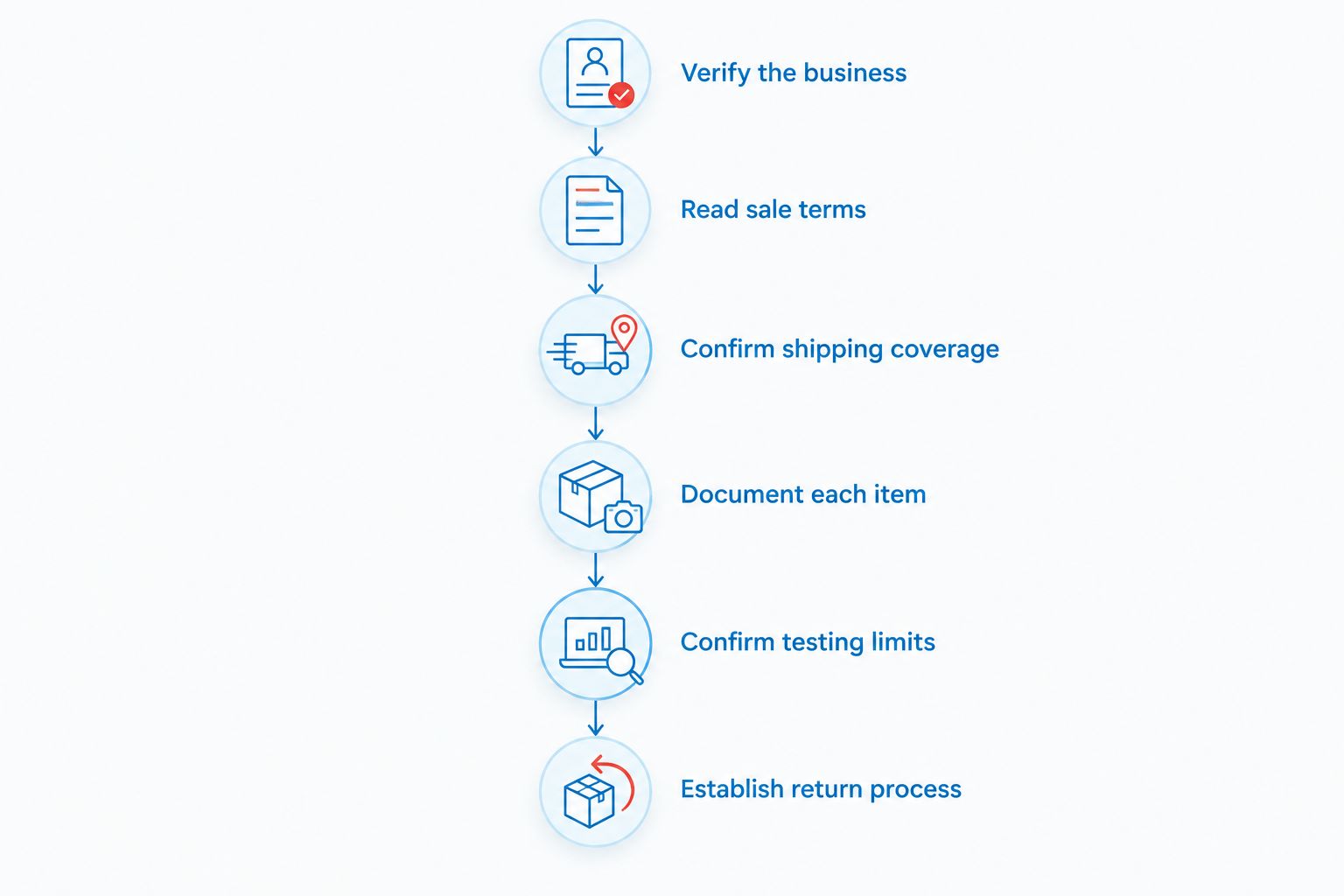
Follow these steps in order. Stop whenever an answer remains unclear rather than treating shipment as a commitment you must complete.
1. Verify the business
Confirm the business’s legal name, physical address, and working contact details. Check that the shipping destination matches the recipient identified in the written agreement, or obtain an explanation of any difference.
Read reviews for specific experiences involving returned jewelry, disputed inventories, and rejected offers. Reviews help identify questions to ask; they do not replace the transaction terms. Avoid sending valuables to a recipient you cannot identify independently.
2. Read the sale terms
Find out whether submitting jewelry authorizes only an evaluation or also authorizes a sale. Ask exactly what action counts as acceptance, including whether silence, a deadline passing, or depositing a payment has consequences under the agreement.
Keep a copy of the terms that apply to your shipment. For a transaction in 2026, save the version you actually accepted rather than relying on a webpage that can change later.
3. Confirm shipping coverage
Ask who provides coverage and request the applicable terms. Verify that the protection expressly includes the type of jewelry you are sending, the shipping method, and the destination.
A declared value is not proof that every loss is covered. Ask about exclusions, coverage limits, required packaging, proof of value, and who must file a claim. Confirm when coverage begins and ends, including any period after delivery but before evaluation.
4. Document each item
Photograph each piece separately, including identifying marks, visible damage, inscriptions, and attached stones. Create an inventory describing the items in ordinary language, then keep that inventory outside the package as well as placing a copy inside.
Record an approximate weight if you have a suitable scale, but do not treat a household measurement as a certified result. Keep any receipts or appraisals as supporting records; do not assume they establish the amount payable under a shipping claim.
5. Confirm testing limits
Ask what testing involves and whether it can scratch, file, cut, or otherwise alter the jewelry. Get explicit agreement about stone removal, disassembly, and any destructive testing before shipping.
State in writing that you do not authorize melting or irreversible alteration before accepting the offer. If the buyer will not accommodate that instruction, decide whether you are genuinely comfortable proceeding. An heirloom deserves particular caution.
6. Establish the return process
Request the rejection deadline, the method for declining, and the process for returning every submitted item. Confirm who arranges the return shipment and what protection applies on the way back.
Ask whether stones, findings, and other components return with the jewelry. Keep the answer with your inventory and shipment receipt. A return promise is useful only when its conditions are clear enough to follow.
Why mail-in gold selling safety varies
The risks depend on the transaction’s details, not on a general promise that mailing valuables is safe. These factors deserve separate attention:
- Buyer identity: You need a verifiable recipient and a workable way to resolve questions after delivery.
- Shipping protection: Jewelry eligibility, exclusions, documentation requirements, and responsibility for claims determine what protection actually applies.
- Item characteristics: Gemstones, inscriptions, fragile settings, and sentimental importance create concerns beyond the gold itself.
- Testing permission: Permission to inspect is different from permission to remove stones or alter a piece permanently.
- Acceptance terms: Your ability to reject the offer depends on the agreement’s deadlines and definition of acceptance.
- Return arrangements: The return journey needs its own packaging, tracking, and coverage checks.
For any shipment in 2026, get answers specific to your package. Do not substitute another customer’s successful transaction for confirmation of your own terms.
How should I pack gold jewelry for shipping?
Pack to prevent movement, conceal the contents, and preserve a clear inventory. Follow the carrier’s and coverage provider’s requirements first; packaging that looks secure is not necessarily compliant with their terms.
Separate pieces so chains cannot tangle and stones cannot strike other jewelry. Protect delicate settings, place the items in a secure inner container, and cushion that container inside a sturdy outer box. Avoid exterior descriptions that advertise valuable contents, while completing any required shipment declarations accurately.
Photograph the items before sealing and retain the shipment receipt. Packing photographs support your records, but they do not conclusively establish what a recipient received. Keep the original image files alongside the inventory and written correspondence.
Use the tracking information to monitor delivery and ask the buyer to acknowledge the inventory after arrival. A delivery scan and an inventory confirmation answer different questions: one concerns the package’s arrival, while the other concerns its contents.
Does insured shipping guarantee I will get my jewelry’s full value?
No. Shipping coverage applies according to its terms, including eligible contents, valuation rules, exclusions, and claim requirements. Do not assume a jewelry appraisal, an advertised coverage amount, and the settlement for a loss are interchangeable.
Ask how value must be established before shipping. Also ask who receives any claim payment when the buyer supplies the label, and how that payment reaches you.
Coverage does not answer whether the buyer’s offer is fair. Separate your shipping decision from your selling decision; you need acceptable terms for both.
How can I check whether the gold offer makes sense?
Ask for the assessed weight, purity, treatment of non-gold components, and explanation of the offer. An itemized evaluation is easier to review than a single total covering several different pieces.
Karat describes the gold proportion in an alloy. On the 24-karat scale, 18-karat gold contains 75% gold, while 14-karat gold contains approximately 58.3% gold by composition. These are purity relationships, not promised payouts or proof that a stamped item is genuine.
Attached stones complicate a simple weight comparison because total jewelry weight is not necessarily gold weight. Ask whether the buyer assigns value to the stones, returns them, or excludes them from the evaluation. Do not authorize removal until you understand its effect on the piece.
An insurance appraisal is not a purchase offer. Before accepting any 2026 evaluation, distinguish the jewelry’s stated replacement value from the amount a buyer offers to acquire it.
What warning signs mean I should not send my gold?
Stop if the buyer cannot explain who receives your jewelry or refuses to provide the terms before shipment. An attractive preliminary estimate does not compensate for unclear ownership, testing, or return rules.
Treat these situations as reasons to pause:
- You cannot identify the business behind the shipping label.
- The agreement does not explain how to reject an offer.
- The buyer will not clarify whether evaluation can alter your jewelry.
- Coverage language does not clearly address jewelry shipments.
- The package destination changes without a verifiable explanation.
- You face pressure to ship before reviewing the agreement.
If you have already shipped, preserve your records and contact the buyer and carrier promptly about the specific issue. Do not send additional valuables while the original shipment remains unresolved.
When is selling gold locally the better choice?
Choose an in-person evaluation when you want to discuss stones, testing, or sentimental details before releasing the jewelry. You avoid the shipping stage, although you still need to understand the buyer’s assessment and acceptance terms.
Uptownbullion is best for Dallas gold sellers who prefer a local exchange to mailing jewelry. The business buys gold, silver, and jewelry; that local service is relevant when shipping is the part of the transaction you want to avoid.
The trade-off is travel. A local visit also does not remove the need to ask about weight, purity, gemstone treatment, and the final offer. Use the same written inventory to prepare for either method, and contact the business to ask about the selling process before visiting.
FAQ
Is it safe to mail in gold jewelry to sell in 2026?
Mailing gold jewelry can be safe when you verify the buyer, confirm applicable shipping coverage, document the contents, and understand the return terms. Do not ship until you know how to reject the offer and recover your items.
Does tracking mean my gold jewelry is insured?
No, tracking does not establish insurance coverage for gold jewelry. Check the coverage terms for eligible contents, exclusions, valuation requirements, and responsibility for filing a claim.
Can I reject an offer after mailing my jewelry?
Your right to reject an offer depends on the agreement you accepted. Confirm the rejection deadline, what counts as acceptance, and how the buyer returns your items before shipping.
Should I send the original jewelry receipt with my gold?
Keep your original jewelry receipt and ask whether a copy is needed. Retain your inventory, photographs, correspondence, and shipment receipt separately from the package.
Is mailing a gold ring with diamonds different from mailing plain gold?
A ring with diamonds requires additional agreement about stone valuation, removal, and return. Confirm whether testing changes the setting and whether every component comes back if you decline the offer.
Does a gold purity stamp prove what my jewelry is worth?
No, a purity stamp alone does not prove authenticity or establish a selling offer. For example, 18-karat describes 75% gold composition, but the buyer still needs to assess the actual item.
Can I sell gold locally instead of mailing it?
Yes, a local gold buyer lets you discuss the transaction without shipping your jewelry. Uptownbullion provides gold and jewelry buying services in Dallas; ask about the process before bringing your items.
One last thing
Check the return journey as carefully as the outbound shipment. Rejecting an offer does not finish the transaction; you still need your original items returned under terms you understand.
Before sealing the box, ask yourself whether you could explain the entire process to someone else using only the documents you saved. If the answer is no, keep the jewelry with you until the unanswered questions are resolved.


