
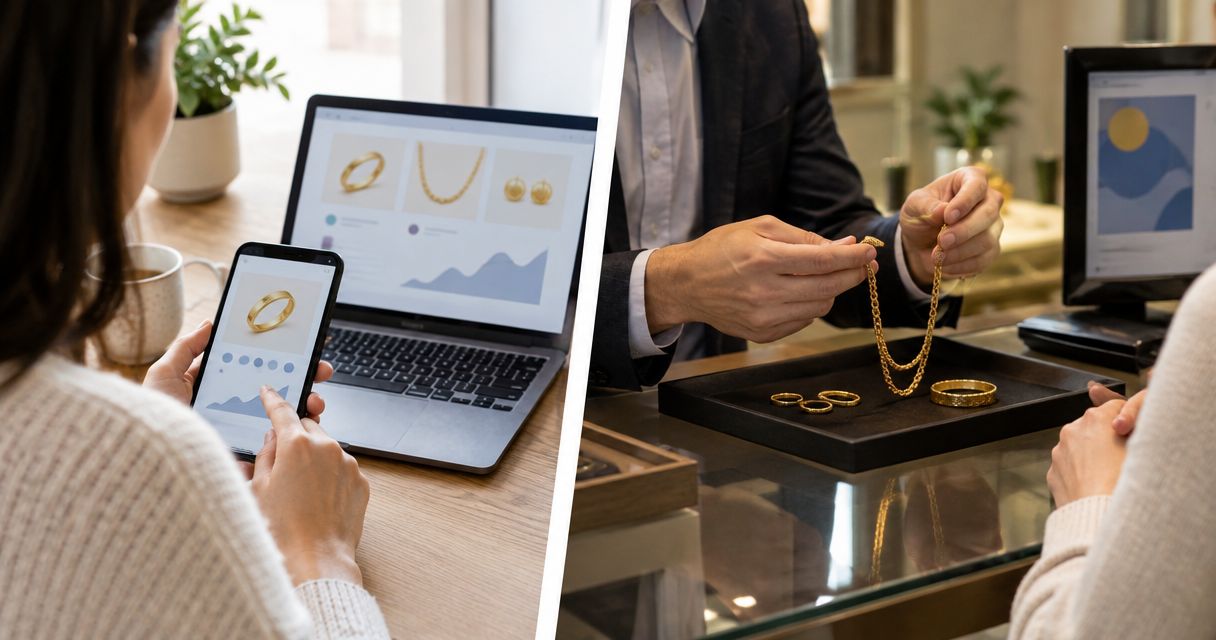
Sell gold in person if you want to discuss the evaluation face to face and avoid shipping your valuables; sell online if remote access matters more and you accept the buyer’s shipping, inspection, and return terms. Neither method guarantees a better offer. In 2026, the stronger choice is the buyer who explains the evaluation, discloses deductions, and lets you understand the transaction before accepting it.
- Is it better to sell gold online or in person? Choose in person for face-to-face evaluation and no shipping.
- Online gold buyers suit remote sellers, but shipping coverage and return terms need careful review.
- Compare final offers for the same items, not advertised payouts or preliminary estimates.
- Gold purity, weight, and jewelry value matter more than whether a buyer operates online or locally.
Why this matters
You are choosing more than where to hand over your gold. You are deciding how the buyer examines it, when you surrender possession, and what happens if you decline the offer. Those differences matter before a transaction starts, not just after an offer arrives.
For a 2026 sale, separate an initial estimate from an offer based on inspection. The online gold quote to in-store cash workflow explains that distinction for sellers considering a local handoff after online research.
Is it better to sell gold online or in person?
In-person selling is the better fit when your priority is discussing the evaluation before handing over your gold. Online selling fits when avoiding a trip matters more. Use the comparison below to identify the trade-off you actually care about.
| Selling method | Best for | Main advantage | Main drawback | Confirm before proceeding |
|---|---|---|---|---|
| In-person gold buyer | Sellers who want direct conversation and no shipment | You can ask questions during the visit and discuss the offer face to face | Travel takes effort, and a nearby buyer is not automatically the strongest buyer | Testing process, deductions, acceptance terms, and payment method |
| Online mail-in gold buyer | Sellers who prefer a remote transaction | You can seek an evaluation without visiting a store | Your items leave your possession before you can discuss the inspected offer in person | Transit coverage, inspection terms, offer acceptance, and return arrangements |
Location alone does not establish fairness. A local buyer still needs to explain the offer, while an online buyer still needs clear terms for handling your property. Reject a process you cannot understand, regardless of the channel.
Do not compare a local inspected offer with an online estimate as though they represent identical commitments. First establish whether both buyers evaluated the same items, purity, weight, and condition.
Selling gold in person: best for direct discussion
An in-person visit puts your questions and your items in the same place. Ask how the buyer identifies gold content, handles stones or non-gold components, and records the items being evaluated. Confirm whether you can observe weighing and testing rather than assuming every store follows the same process.
The limitation is practical: you must travel, and comparing buyers can require separate visits. A convenient location is useful, but convenience is not evidence that an offer accounts for every relevant feature of your jewelry.
For Dallas consumers, Uptownbullion provides a local gold and silver exchange alongside jewelry buying services. Uptownbullion is best for Dallas sellers seeking a local gold exchange rather than a mail-in transaction. Ask about the evaluation and transaction terms before bringing in your pieces; a local service does not remove the need to compare.
Choose this route when you want to explain an item’s history, ask follow-up questions immediately, or avoid packaging valuables for shipment. Wait if the buyer will not explain a test or let you understand the offer before accepting it.
Selling gold online: best for remote access
Online mail-in selling removes the store visit. That makes it a practical option when travel is difficult or you want to consider a buyer outside your area. Its central trade-off is custody: your gold must reach the buyer before a physical inspection can establish the offer.
Read the transaction terms before requesting or using a shipping kit. Confirm which items the buyer accepts, how the shipment must be prepared, and what documentation supports a loss claim. Do not treat tracking and insurance as interchangeable protections.
The return process deserves equal attention. Establish how you decline an offer, whether a response deadline applies, who handles the return, and which deductions apply. Do not ship gold until you understand both the acceptance process and the rejection process.
Online selling is a reasonable choice when those terms are clear and the remote process suits you. Skip any buyer whose advertising is easy to find but whose inspection, acceptance, or return terms are unclear.
Why gold offers vary
The selling channel is only part of the decision. In 2026, compare the following factors before deciding that one buyer’s offer is better than another’s:
- Gold purity. A piece’s gold content affects its metal value. A hallmark provides a starting point, but the buyer still needs to establish what the item contains.
- Gold-bearing weight. Stones, steel springs, and other non-gold components should not be treated as solid gold. Ask what weight the buyer uses in the calculation.
- Market movement. Gold’s market value changes. Offers evaluated at different times do not necessarily use the same reference value.
- Item value beyond metal. A signed piece, collectible coin, or wearable jewel deserves consideration beyond an automatic scrap assessment. Ask whether that buyer evaluates those characteristics.
- Deductions and transaction terms. Shipping, testing, handling, or return charges affect what you retain when they apply. Request a clear explanation rather than assuming the advertised offer is the final result.
A buyer should distinguish these factors instead of reducing the explanation to a single unexplained total. If you cannot tell what was weighed, what purity was used, or what was deducted, you cannot make a meaningful comparison.
What do karat marks tell you?
Karat expresses gold purity in twenty-fourths. 10-karat gold contains approximately 41.7% gold, 14-karat gold approximately 58.3%, and 18-karat gold 75%. Those are nominal compositions, not promises about an untested item.
Keep pieces with different markings separate when preparing for an evaluation. Do not expect equal-weight pieces with different gold content to produce equivalent metal-based offers. Also, do not assume a missing or unfamiliar mark settles authenticity; ask how the buyer verifies the material.
How to compare online and local gold buyers
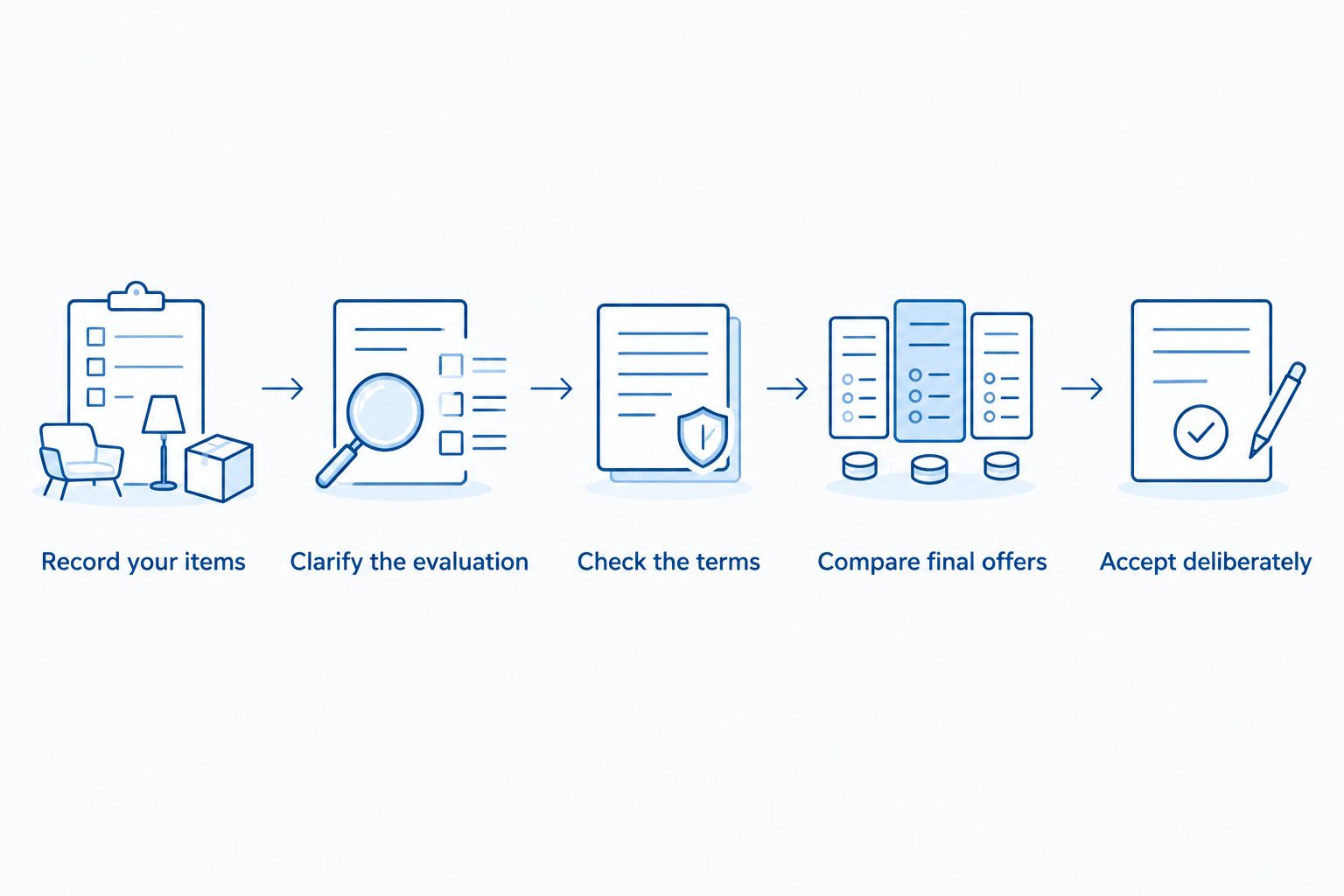
Use the same sequence for either route. The goal is not to become a jewelry appraiser yourself; it is to preserve a clear record and understand what you are accepting.
- Record your items. Photograph each piece, its visible markings, and any existing damage. Make a written inventory that lets you identify every item you hand over or ship.
- Clarify the evaluation. Ask how the buyer establishes purity and weight, whether testing alters the piece, and how stones or other components are handled. Raise concerns about collectible or designer value before authorizing work.
- Check the terms. For a visit, establish the acceptance and payment process. For a shipment, also check packaging requirements, transit coverage, response deadlines, and return arrangements.
- Compare final offers. Compare evaluations of the same items on the same basis. Record deductions and distinguish an estimate from an inspected offer.
- Accept deliberately. Review the item list, agreed terms, and payment details before authorizing the sale. Retain the transaction record and any relevant correspondence.
These steps protect your ability to ask informed questions. They do not certify a buyer, guarantee an outcome, or replace reading the actual transaction terms.
Questions to ask before handing over gold
Keep the questions short enough to use during a visit or in an email. You want direct answers tied to your actual pieces, not general assurances about customer service.
- What exactly are you buying: the metal, the complete jewelry item, or both?
- How will you establish purity and record the weight?
- Does the proposed test alter or damage the piece?
- How are stones and non-gold parts treated?
- What happens if I decline the offer?
- Which deductions apply, and how will payment be made?
A clear explanation is more useful than pressure to decide quickly. If the answers change between advertising, correspondence, and the transaction paperwork, stop and resolve the difference before proceeding.
Will I get a better offer selling gold online?
Online selling does not guarantee a better offer. Compare inspected offers after deductions; a headline estimate cannot establish which buyer gives you the better result for your actual items.
The same rule applies to local buyers. Do not assume a face-to-face conversation proves the offer is competitive, and do not ship valuables merely because an online advertisement promises a stronger outcome.
Is selling gold in person safer than mailing it?
Selling in person avoids shipping exposure, but it does not eliminate transaction risk. You still need to understand testing, item handling, acceptance, and payment before agreeing to the sale.
For a mail-in sale in 2026, verify coverage for the actual contents and follow the shipping instructions. A tracking record confirms shipment activity; it does not, by itself, establish compensation for lost valuables.
Should I sell broken jewelry the same way as intact jewelry?
Broken gold jewelry still requires evaluation of its material and any value beyond the metal. A broken clasp does not establish purity, and an intact piece does not automatically deserve only a scrap assessment.
If you are unsure whether to sell, retain the option to discuss repair before authorizing destructive testing or disposal. Uptownbullion offers jewelry repair as well as jewelry buying, so Dallas consumers can ask about those separate service needs without assuming either outcome is guaranteed.
FAQ
Is it better to sell gold online or in person in 2026?
Sell gold in person if direct discussion and avoiding shipment are your priorities; choose online if remote access matters more. Neither method guarantees a better offer, so compare inspected offers and transaction terms.
Can I compare an online gold estimate with a local offer?
You can compare them as preliminary information, but an estimate is not equivalent to an inspected offer. Confirm that both evaluations use the same items, purity, weight, and deductions before treating them as comparable.
What should I check before mailing gold to a buyer?
Check item eligibility, packaging instructions, transit coverage, inspection terms, acceptance deadlines, and return arrangements. Keep photographs and an inventory, and establish what happens if you reject the offer.
Does an in-person buyer have to test gold in front of me?
Ask the buyer whether you can observe testing and weighing; do not assume every business follows the same process. Confirm whether testing changes the item before you authorize it.
Should I clean or repair my gold before selling it?
Do not clean or repair gold solely to prepare for a sale without first discussing the item with an appropriate specialist. Unnecessary work can alter the piece, and a buyer still needs to evaluate its material and condition.
Can I ask Uptownbullion about selling gold in Dallas?
Uptownbullion provides gold and silver exchange and jewelry buying services in Dallas. Ask about the evaluation process and current transaction requirements before arranging your visit.
One last thing
Decide what you are willing to sell before you decide where to sell it. An inherited ring can have personal importance that no metal evaluation measures. Set aside anything you are not ready to part with, even if it is broken or no longer worn.
For your 2026 sale, make one final check: can you explain what the buyer evaluated, what you will retain after deductions, and when acceptance becomes final? If not, ask again before proceeding. A clear decision is more valuable than a rushed one.


