

To calculate your gold’s spot-based metal value in 2026, divide its net weight in grams by 31.1034768, multiply by its gold purity as a decimal, then multiply by the current spot quote per troy ounce. The result is a melt-value benchmark, not a guaranteed payout; a buyer’s offer also reflects the transaction’s costs and the item’s resale potential. You do not calculate the market’s spot price yourself—you use that quote to calculate the value of your gold content.
- How do you calculate spot price when selling gold? Multiply pure-gold weight in troy ounces by the current spot quote.
- One troy ounce equals 31.1034768 grams; jewelry weight must also be adjusted for purity.
- Melt value is a comparison benchmark, not a guaranteed cash offer.
- Uptownbullion serves Dallas consumers buying or selling gold, silver, and fine jewelry.
Why this matters
A spot quote applies to fine gold, not automatically to the full weight of your jewelry. A ring’s total weight can include other metals, stones, and components that do not belong in the gold calculation. Treating every gram as pure gold overstates the metal value.
Keep three figures separate: the market quote, the calculated metal value, and the buyer’s final offer. The guide to how scrap gold value is calculated explains the metal-content side of that comparison. Keeping these figures separate helps you ask useful questions instead of comparing unlike amounts.
How do you calculate spot price when selling gold?
Use this formula when your gold is weighed in grams and your market quote is expressed per troy ounce:
Spot-based metal value = net metal weight in grams ÷ 31.1034768 × gold purity decimal × spot quote per troy ounce.
The calculation requires a weight, a purity, and a market quote taken at a stated time. Record the unit beside every entry. A correct number paired with the wrong unit still produces the wrong answer.
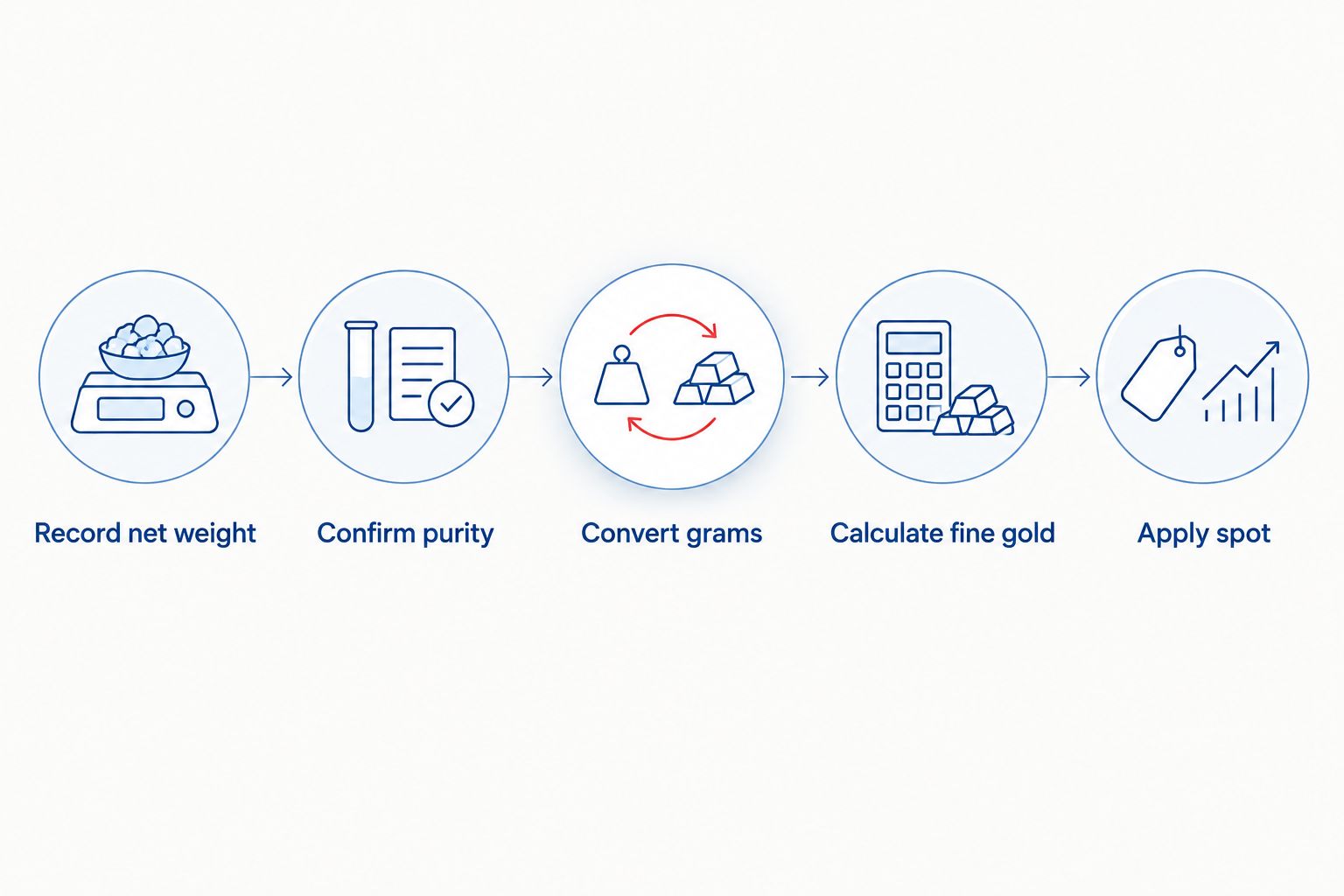
- Record net weight. Use the weight of the gold-bearing metal, excluding stones and other non-gold components where those weights are established.
- Confirm purity. Convert the confirmed gold content to a decimal. A hallmark is a starting point, not a substitute for verification.
- Convert grams. Divide the net gram weight by 31.1034768 to express the alloy’s weight in troy ounces.
- Calculate fine gold. Multiply the troy-ounce weight by the purity decimal.
- Apply spot. Multiply the fine-gold weight by a current spot quote using the same currency as the offer.
- Compare the offer. Ask the buyer to explain the difference between the metal-value benchmark and the final amount offered.
For a 2026 sale, record when you checked the quote rather than treating a saved screenshot as permanently current. Also ask whether the buyer uses the displayed reference quote, a bid quote, or another stated benchmark. Those are different inputs, even when both parties say they are using spot.
Which purity calculation should you use?
Karat describes gold content on a scale of 24 parts. Divide the karat number by 24 to obtain its nominal gold fraction. For a fineness mark expressed in thousandths, divide that mark by 1,000 instead.
The table compares calculation routes, not investment recommendations. Its fractions describe nominal purity; testing establishes what should be used for the specific item you are selling.
| Mark or description | Purity calculation | Useful feature | Limitation |
|---|---|---|---|
| 10-karat gold | 10 ÷ 24 | Converts the karat description directly | Does not verify the item’s actual composition |
| 14-karat gold | 14 ÷ 24 | Gives the nominal fraction without premature rounding | Is not identical to every millesimal fineness mark |
| 18-karat gold | 18 ÷ 24 = 0.75 | Has a straightforward 75% nominal gold content | Still requires the correct net metal weight |
| 22-karat gold | 22 ÷ 24 | Accounts for the non-gold portion of the alloy | Must not be treated as pure gold |
| 585 fineness | 585 ÷ 1,000 = 0.585 | Uses the stated fineness directly | A stamp alone does not prove authenticity |
10-karat gold: 10 parts gold out of 24
For nominal 10-karat gold, multiply the net alloy weight by 10 ÷ 24 before applying the matching spot-per-weight figure. The remaining alloy content is not gold. Applying pure-gold spot to the entire weight therefore overstates the gold-content benchmark.
Use the karat calculation for an initial estimate, then ask which purity the buyer confirmed. Keep items with different karat marks separate so their weights do not become mixed.
14-karat gold: 14 parts gold out of 24
For nominal 14-karat gold, use 14 ÷ 24 rather than rounding the fraction early. A 585 mark expresses 58.5% gold, while the exact fraction 14 ÷ 24 is approximately 58.33%. Those are distinct numerical inputs, even though both markings appear on jewelry described as 14-karat.
Use the confirmed fineness consistently throughout your calculation. Do not start with a karat fraction, switch to a different decimal, and then compare the result as though nothing changed.
18-karat gold: 75% nominal gold content
For nominal 18-karat gold, use 0.75 as the purity decimal. Multiplying the net metal weight by 0.75 gives the corresponding fine-gold weight in the same unit. Convert that weight to troy ounces before applying a per-troy-ounce quote.
You can adjust for purity before or after converting grams to troy ounces. Both routes give the same result when the inputs and rounding are consistent.
22-karat gold: 22 parts gold out of 24
For nominal 22-karat gold, use 22 ÷ 24. High-karat gold still contains an alloy portion, so multiplying its whole weight by a pure-gold quote skips a necessary adjustment.
A coin or bar also needs correct identification. If its specifications state fine-gold content, distinguish that figure from gross weight so you do not apply the purity adjustment twice.
Why your spot-based gold value varies
The formula stays the same in 2026; the inputs and transaction terms change. Before deciding that an offer is wrong, identify which of these factors explains the difference:
- Quote timing. Gold quotations change during trading. Compare offers against a benchmark recorded at the relevant time.
- Quote convention. Bid, ask, and reference quotations are not interchangeable. Ask which quotation the buyer uses.
- Confirmed purity. A different tested gold content changes the fine-gold weight used in the calculation.
- Net metal weight. Stones, non-gold fittings, and other excluded components change the weight attributable to the gold-bearing alloy.
- Buying and processing costs. A buyer’s offer can reflect testing, handling, refining, and business costs. Ask how these are reflected rather than assuming a standard deduction.
- Resale characteristics. An identifiable collectible coin or saleable piece of jewelry requires consideration beyond its gold content. Melt value alone does not establish its full resale value.
Do not assign a universal payout percentage to every buyer or item. An offer is only comparable when its weight, purity, benchmark, and deductions are clear. A headline percentage without those details does not tell you what you will receive.
How do you compare a buyer’s offer with melt value?
Divide the final offer by the calculated melt value, then multiply by 100 to express the offer as a percentage of that benchmark. Use the amount you would actually receive after any stated deductions. This ratio describes the offer; it does not establish whether the transaction suits your needs.
For your 2026 comparison, keep the same items together and use a consistent calculation method. If one buyer separates stones and another weighs the complete piece, their totals need explanation before you compare them. The same applies when one assessment treats the item as scrap and another considers resale as jewelry.
A written calculation should identify:
- The item or group being assessed.
- The measured weight and its unit.
- The purity used and how it was established.
- The spot reference and when it was recorded.
- The final offer and any separate deductions.
Ask for clarification before accepting, not after the transaction is complete. You do not need to predict the market to check whether the arithmetic is internally consistent.
Is a local gold exchange right for your sale?
Uptownbullion is best for Dallas consumers seeking a local gold and silver exchange that also buys jewelry. Its stated services include buying and selling precious metals and fine jewelry, custom-made jewelry, and watch and jewelry repair.
The practical benefit of a local assessment is the opportunity to discuss the physical item and ask questions directly. The limitation is that an in-person offer still needs the same scrutiny as any other offer: a local location does not replace a clear weight, purity, and payout explanation.
Contact Uptownbullion to discuss selling your gold or jewelry. Ask how the item will be evaluated and what information you should bring. Do not assume that a melt-value estimate also answers questions about gemstones, collectible value, or the merits of keeping the piece.
Discuss your gold sale
Ask about selling gold or jewelry in Dallas and what information to bring.
What mistakes should you avoid before selling?
Do not mix ordinary ounces with troy ounces. One troy ounce equals 31.1034768 grams, while an ordinary avoirdupois ounce is approximately 28.3495 grams. A household scale displaying ounces is not automatically displaying the unit used in a gold quotation.
Do not count a stone’s weight as gold. If the net metal weight remains uncertain, label your calculation as an estimate rather than presenting it as an exact valuation. Ask how any proposed stone removal would affect the piece before authorizing it.
Do not treat a plated item as solid gold based on appearance. Surface color does not establish the amount of gold throughout an object. Identification and testing come before a meaningful metal-content calculation.
Finally, keep your 2026 comparison notes with the offer they describe. A later market quote cannot explain an earlier offer without accounting for the change in timing. Clear records help you distinguish a market movement from a difference in assessment.
FAQ
How do you calculate spot price when selling gold?
Calculate spot-based metal value by dividing net grams by 31.1034768, multiplying by the confirmed gold purity decimal, and multiplying by the current spot quote per troy ounce. You use the market’s spot quote rather than calculating that quote yourself.
How many grams are in a troy ounce of gold?
One troy ounce equals 31.1034768 grams. Use that conversion when your item is weighed in grams and the gold quote is stated per troy ounce.
How do I calculate the gold content of 18-karat jewelry?
Nominal 18-karat jewelry contains 75% gold, so multiply its net alloy weight by 0.75. That gives the fine-gold weight in the same unit before applying the matching spot quote.
Does a gold buyer have to offer the full melt value?
Calculated melt value is a benchmark, not a guaranteed offer. Ask the buyer to explain the final amount, the purity and weight used, and any deductions.
Can I include diamonds in the weight of my gold?
Exclude diamond weight from the gold-content calculation. Ask for a separate explanation of any gemstone value rather than treating the entire piece’s weight as gold.
Should I use the gold quote from the day I sell?
Use a current quote with its time recorded when comparing an offer. For a 2026 sale, a quote saved earlier does not establish the benchmark at the moment of the transaction.
Can Uptownbullion help me sell gold jewelry in Dallas?
Uptownbullion provides gold, silver, and jewelry buying and selling services in Dallas. Contact the business to discuss your items and the evaluation process.
One last thing
A broken clasp does not change the gold purity of the chain it belongs to. Damage affects wearability, but it does not erase the gold content of the remaining metal. Conversely, an intact piece can have resale characteristics that a melt calculation does not capture.
Before agreeing to sell, ask one final question: is the offer based only on metal content, or does it recognize the item as jewelry or a collectible? That distinction matters just as much as getting the unit conversion right.


