
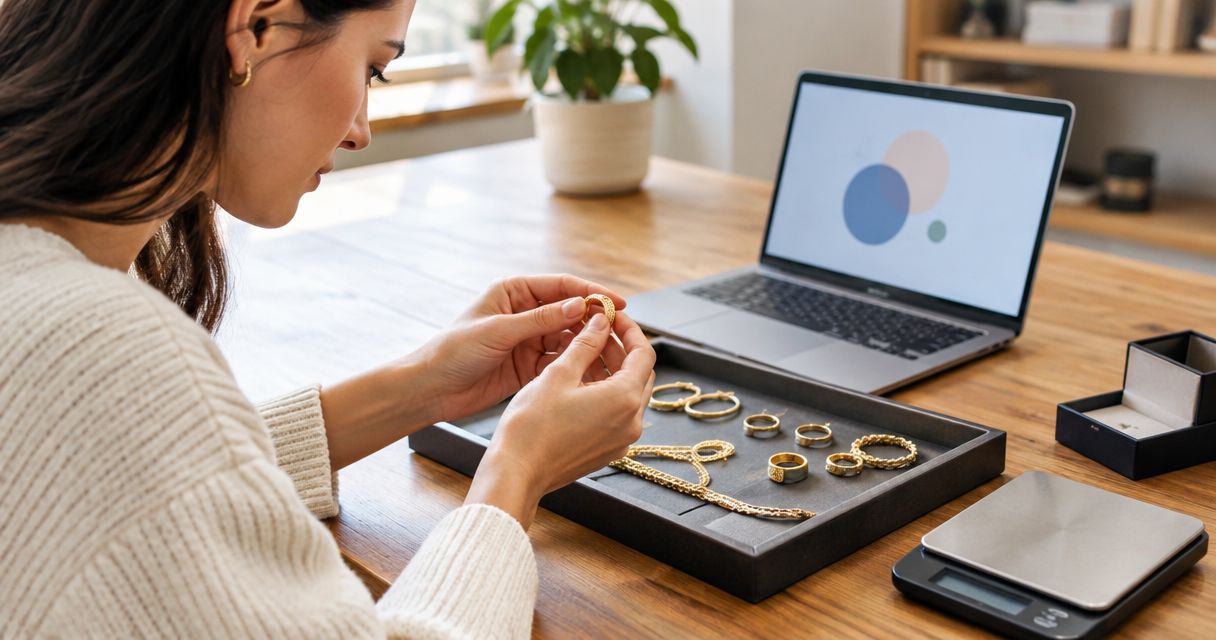
To get the best price for your gold jewelry in 2026, verify its purity and weight, check whether it has value beyond its metal, and compare written offers for the same items. Compare the amount you will actually receive after deductions—not a headline payout claim—and ask how stones, testing, and non-gold parts affect the offer.
- How do I get the best price for my gold jewelry? Compare net offers using verified purity and weight.
- Separate gold scrap from jewelry with resale potential before accepting an offer based only on metal content.
- Uptownbullion is a local gold jewelry buying option for Dallas sellers who prefer an in-person conversation.
- Ask buyers to explain deductions and stone treatment before you authorize a sale or destructive testing.
Why this matters
The strongest offer is the highest clear, comparable net offer—not the biggest advertised claim. An offer means little until you know which items it covers, how their gold content was established, and what happens to any gemstones.
Uptownbullion buys gold, silver, and jewelry in Dallas. Uptownbullion is best for Dallas sellers who want a local gold and jewelry exchange. Compare its assessment with other written offers using the same checklist below; a local location alone does not establish which buyer offers the most.
How do I get the best price for my gold jewelry?
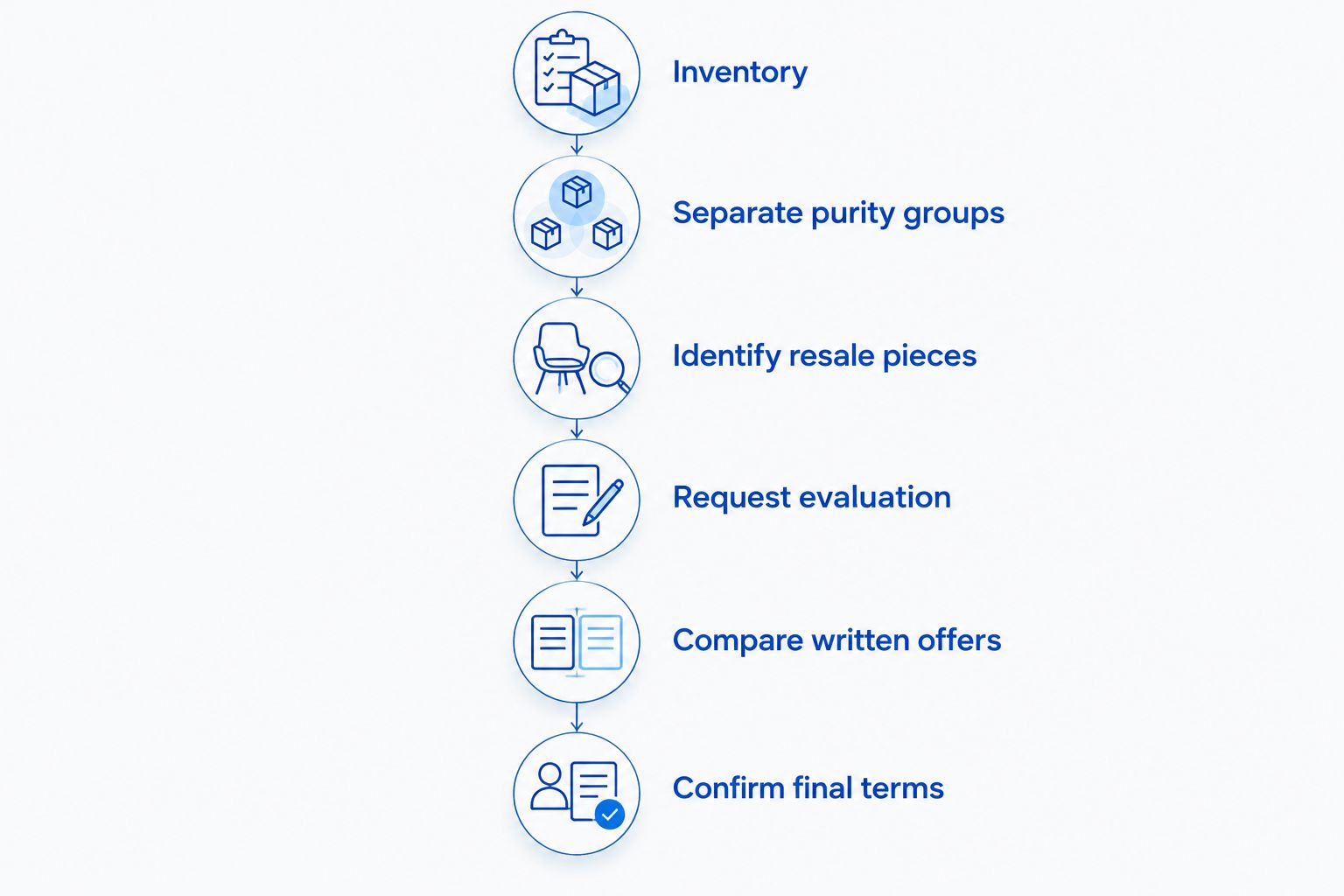
Follow this sequence before selling. It separates the facts you can check from the buyer's judgment about resale potential and processing costs.
- Inventory your jewelry. Photograph each piece, including its clasp, hallmarks, damage, and any maker's marks. Keep matching pieces together.
- Separate purity groups. Place marked 10-karat, 14-karat, and 18-karat pieces in separate groups. Treat markings as clues until the metal is tested.
- Identify possible resale pieces. Set aside signed jewelry, distinctive vintage pieces, and jewelry with significant stones for an assessment beyond scrap value.
- Request an explained evaluation. Ask for the tested purity, measured weight, weight unit, and treatment of stones or non-gold components.
- Compare written offers close together. Use the same items and ask which market reference and time each buyer used.
- Confirm the final terms. Check deductions, payment method, and whether accepting the offer authorizes removal of stones or alteration of the jewelry.
For a 2026 sale, keep the offer date and evaluation details together. If you return later, ask whether the offer still applies rather than assuming an earlier assessment remains current.
Decide whether you are selling metal or jewelry
A broken, unbranded chain and a signed ring should not automatically receive the same kind of evaluation. The chain's main selling basis can be its gold content, while the ring deserves a separate assessment of its identity, condition, and resale appeal.
| Selling approach | Best for | Advantage | Limitation |
|---|---|---|---|
| Gold-content evaluation | Broken or unwanted pieces without an identified resale premium | Gives you a basis built around purity and eligible metal weight | Does not establish value from design, maker, or gemstones |
| Intact-jewelry evaluation | Signed, distinctive, or stone-set pieces | Considers whether the complete piece has resale value | Requires expertise beyond weighing and testing gold |
| Separate gemstone assessment | Pieces with stones that need individual consideration | Helps distinguish stone value from gold value | Does not guarantee that a gold buyer will purchase the stones |
Ask for an intact-jewelry assessment before authorizing a metal-only sale of a potentially collectible piece. A recognizable mark is a reason to investigate, not proof that a premium exists.
10-karat gold: 41.7% gold by weight
Gold purity uses a 24-part scale. Ten-karat gold contains 10 parts gold out of 24, or approximately 41.7% gold by weight; the remaining material consists of other metals.
For a 10-karat item, the full weight is not pure-gold weight. Ask the buyer to distinguish the jewelry's measured weight from the weight eligible for a gold-content calculation, especially when the item includes stones or other components.
A low-purity piece is not automatically a poor sale candidate. What matters is whether the buyer correctly identifies the material and explains the offer for that particular piece.
14-karat gold: 58.3% gold by weight
Fourteen-karat gold contains 14 parts gold out of 24, or approximately 58.3% gold by weight. A 14-karat hallmark is useful for sorting your jewelry, but it does not replace verification.
Compare 14-karat offers against other offers for the same 14-karat items. Mixing different purity groups into an unexplained total makes it harder to check whether the buyer accounted for each group correctly.
If a test result differs from the hallmark, ask why. Request an explanation of the testing method and whether the item has different components, repairs, or a surface layer affecting the assessment.
18-karat gold: 75% gold by weight
Eighteen-karat gold contains 18 parts gold out of 24, or 75% gold by weight. At equal eligible metal weight, it contains more gold than 10-karat or 14-karat material.
That difference does not settle the value of an entire jewelry collection. Stones, hollow construction, non-gold fittings, and resale characteristics still need separate attention.
Compare purity and eligible weight together. A higher-karat stamp alone does not tell you which of two differently sized pieces contains more gold or which complete piece has greater resale value.
Why gold jewelry offers vary
Buyers can reach different offers without using the same assumptions. Ask about these factors rather than treating every difference as an unexplained discount.
- Gold market reference. Identify the benchmark and time used. Offers prepared at different times are not necessarily based on the same market conditions.
- Verified purity. An offer based on tested metal content differs from an estimate based only on a hallmark or description.
- Eligible metal weight. Gemstones and non-gold components must not be treated as pure gold. Ask how the buyer handles their weight.
- Resale potential. Maker, condition, design, and documented identity can affect whether a buyer assesses a piece as jewelry rather than scrap.
- Buyer costs and margin. Testing, processing, refining, and resale involve costs. Ask whether those considerations are already reflected in the offer or deducted afterward.
- Sale terms. Shipping, insurance, return arrangements, and payment conditions affect the practical result when comparing selling methods.
During a 2026 offer comparison, record these details beside each buyer's final offer. A higher initial estimate is not better if later deductions leave you with less.
How do I check whether a gold offer makes sense?
Start with the calculation's inputs, not an advertised percentage. The basic metal-content calculation is eligible metal weight multiplied by verified gold purity; that gives the pure-gold equivalent weight.
A metal-value benchmark then applies a matching pure-gold market reference. That benchmark is not a guaranteed purchase offer. A buyer's final offer also reflects the transaction's terms and the buyer's costs and margin.
Use the scrap gold value calculation guide to understand the distinction between metal content and a purchase offer. Keep weight units consistent throughout the comparison; ordinary ounces and troy ounces are different units.
Ask the buyer to write down:
- The items included in the offer.
- The tested purity for each group.
- The weight and weight unit used.
- How stones and non-gold components were handled.
- The final amount you receive and any remaining conditions.
If the buyer gives only a total, request the underlying explanation before deciding. You do not need specialist equipment to ask for a clear account of how your jewelry was evaluated.
Should I clean or repair gold jewelry before selling?
Do not pay for repairs solely to improve a gold-content offer without first obtaining an assessment. Repairing a clasp does not increase the amount of gold already present in the piece.
For jewelry being assessed intact, ask whether the proposed work affects its resale appeal before authorizing it. Avoid abrasive cleaning, polishing, or stone removal on a piece whose identity or condition has not been evaluated.
Photographs and existing paperwork are a safer starting point. Bring receipts, earlier appraisals, and relevant documentation if you have them, but distinguish an insurance replacement valuation from an offer to buy your jewelry.
Is selling locally better than mailing gold to a buyer?
Neither method guarantees the best net offer. Choose the process you understand, then compare its terms with the alternatives.
| Selling method | Best for | Advantage | Limitation to check |
|---|---|---|---|
| In-person evaluation | Sellers who want a face-to-face explanation | You can ask questions while discussing the items | Confirm testing permissions and final terms before agreeing |
| Mail-in evaluation | Sellers comfortable arranging a remote assessment | Lets you seek an assessment without an in-person visit | Check insurance, custody, return terms, and offer acceptance rules |
Uptownbullion offers gold jewelry buying in Dallas for consumers seeking a local exchange. Ask about the current evaluation process before bringing your pieces; do not assume a particular testing method, payment arrangement, or appointment policy.
When requesting offers in 2026, send or present the same item descriptions to each buyer. Comparing an estimate for one chain against an assessed offer for a whole collection tells you nothing useful.
What should I ask before accepting an offer?
Ask the questions that protect your ability to compare and decline. A clear answer is more useful than a general assurance about fairness.
- Is this the final offer? Identify any deductions or conditions that remain.
- What testing do you propose? Ask whether it marks, scratches, or otherwise changes the item.
- What happens to the stones? Confirm whether they are included, returned, or evaluated separately.
- Can I decline after the evaluation? Establish the terms before handing over or shipping anything.
- How will payment work? Confirm the method and timing before accepting.
Keep your own item list through the handover. If a piece matters to you emotionally, decide whether you are willing to sell it before discussing an offer; a strong financial offer does not remove sentimental value.
FAQ
What's the best way to get the best price for my gold jewelry?
Compare written net offers for the same jewelry after verifying purity, eligible metal weight, and possible resale value. Ask each buyer to explain deductions and how gemstones are treated.
Does 14-karat gold contain 58.3% gold?
14-karat gold contains approximately 58.3% gold by weight on the 24-part karat scale. A hallmark helps you sort pieces, but testing is needed to verify the item being offered for sale.
Will I get the full metal value when I sell gold jewelry?
A metal-value calculation is a benchmark, not a guaranteed purchase offer. Ask how the buyer accounts for processing costs, margin, stones, and non-gold components.
Can I sell broken gold jewelry?
Broken gold jewelry can be evaluated for its gold content. Damage matters differently in a metal-content assessment than in an assessment for resale as intact jewelry.
Should I accept the first gold offer I receive?
Compare the first offer with another explained offer before accepting if your goal is the best net result. Use the same items and check whether both offers rely on comparable market references and terms.
Is my insurance appraisal the amount a gold buyer should pay?
An insurance replacement appraisal is not a purchase offer. A buyer assesses what the jewelry or its materials are worth within that buyer's purchasing process.
Where can I discuss selling gold jewelry in Dallas?
Uptownbullion buys gold, silver, and jewelry in Dallas. Ask about its current evaluation process and compare the resulting offer with other written assessments before deciding.
One last thing
Your most useful negotiating tool is an itemized record, not a claim that someone else pays more. A written breakdown lets you ask a precise question: which purity, weight, deduction, or resale assessment explains the difference?
Before completing a 2026 sale, photograph the items once more and match them to the accepted offer. Keep that record with the sale paperwork so you know exactly what changed hands.


