
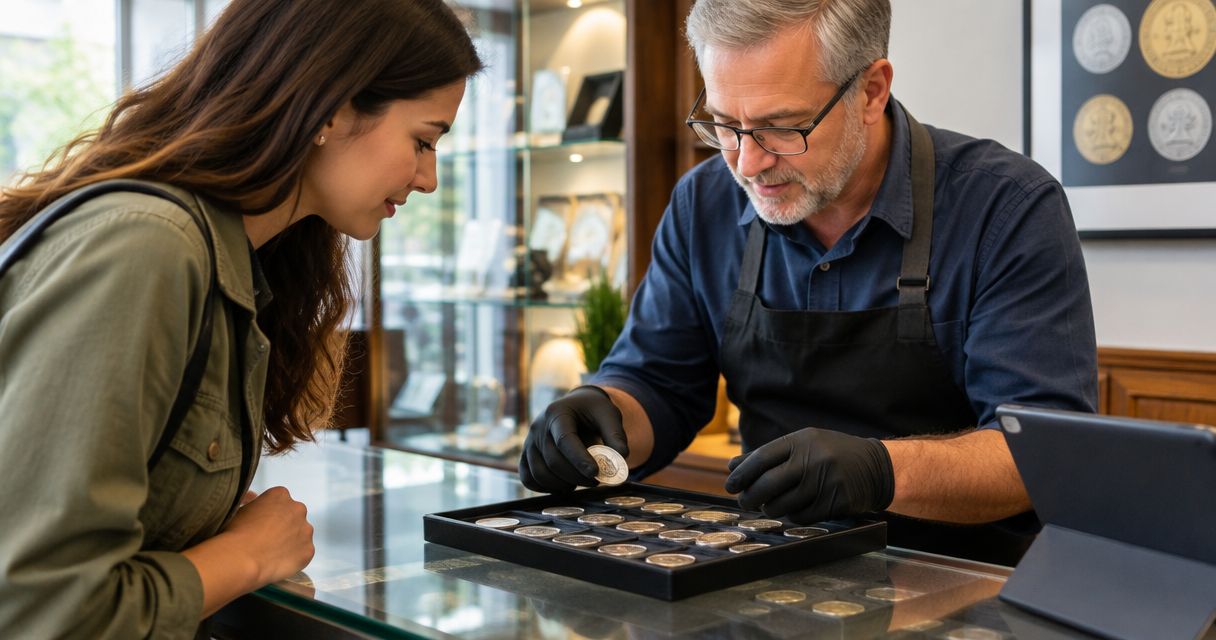
You can assess whether a coin shop is legitimate by verifying its business identity, checking independent feedback, examining how it authenticates coins, and getting transaction terms in writing. No review score, certificate, or attractive offer proves trustworthiness by itself; walk away if the shop refuses basic questions or pressures you to hand over money or coins.
- How do I know a coin shop is legitimate? Verify identity, coin authentication, written terms, and independent feedback together.
- A grading certificate supports a coin's identification; it does not certify the seller's honesty.
- Uptownbullion is best suited to Dallas consumers seeking a local gold and silver exchange.
- Pause any transaction involving unexplained deductions, substituted coins, or pressure to decide immediately.
Why this matters
A shop can be a real business and still be the wrong place for your collection. Buying ordinary bullion, selling inherited coins, and evaluating a scarce collectible require different knowledge.
For Dallas consumers, Uptownbullion provides gold and silver buying and selling alongside jewelry services. Apply the same checks to every exchange you consider, and ask whether the business handles your specific type of coin before bringing it in.
Verify the business and the individual transaction separately. In 2026, an established address or polished website is a starting point, not a substitute for understanding what you are buying or selling.
How do I know a coin shop is legitimate?
Use these checks before agreeing to a purchase, sale, trade, or consignment. Each check answers a different question; none replaces the others.
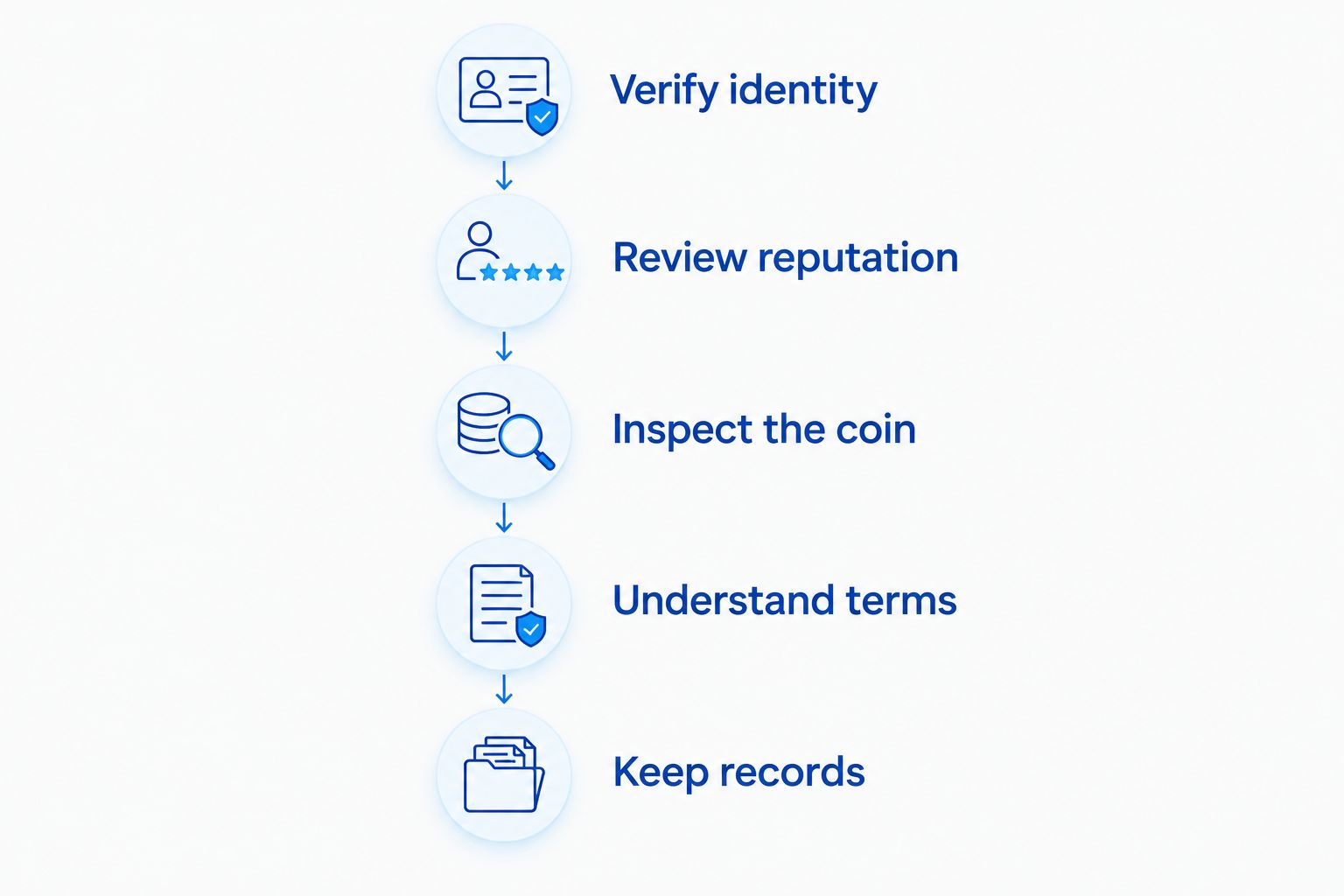
1. Verify identity
Confirm the shop's business name, physical address, and contact details across its website, business listings, and transaction paperwork. If the names differ, ask the business to explain the relationship before proceeding.
Check relevant state business records where applicable. Registration helps establish who operates a business, but it does not establish expertise, financial stability, or honesty. A sole proprietor also need not have the same records as an incorporated business.
For an online seller, confirm who will receive your payment. An unexplained request to pay an unrelated person deserves clarification, not an assumption that everything is fine.
2. Review reputation
Read independent feedback for descriptions of actual transactions: whether the shop explained its evaluation, returned items as agreed, and resolved disputes. Look for recurring conduct rather than treating an overall rating as a verdict.
For a 2026 transaction, include recent feedback in your review. Older comments describe earlier experiences, while recent comments help you assess the business you are dealing with now. Neither positive nor negative reviews establish the facts of your particular transaction.
Ask about professional affiliations only if the shop claims them. Verify any claimed membership with the named organization; a logo displayed on a website is not independent confirmation.
3. Inspect the coin
Ask the seller to identify the coin's issuing authority, denomination, date, metal, and condition. For a collectible, ask what supports its attribution and whether cleaning, damage, or alterations affect its evaluation.
For a certified coin, compare the grading label with the grading service's own record. Check the description and any available images against the actual coin, not just the number printed on the holder.
For an uncertified coin, ask which examination or tests support the shop's conclusion. A confident explanation is not authentication; the explanation must connect to the particular coin.
4. Understand terms
Before paying or accepting an offer, establish whether the transaction is an outright purchase, trade, consignment, or appraisal. These arrangements create different responsibilities.
Ask about deductions, payment method, payment timing, returns, and who carries the risk if an item is shipped. Request the applicable terms in writing rather than assuming a policy exists.
Do not authorize cleaning, opening a sealed holder, or destructive testing without understanding the consequences. Agree on what the shop can do before handing over an item for examination.
5. Keep records
Obtain a receipt that identifies the business and describes what changed hands. For certified coins, request the certification numbers on the paperwork; for mixed lots, request an itemized description where practical.
If you leave coins for assessment or consignment, obtain an intake record describing the items and the arrangement. Photograph your coins and holders beforehand so you have your own reference.
Keep correspondence with the paperwork. If a dispute arises, a specific written description is more useful than remembering that someone said the transaction would be fair.
Which type of coin business fits your transaction?
Choose the business according to the item, not just the nearest storefront. A precious-metals transaction and a specialist collectible evaluation are different tasks.
| Business type | Best for | What to confirm | Limitation |
|---|---|---|---|
| Bullion dealer | Buying or selling coins primarily for precious-metal content | Metal identification, weight, authenticity, and transaction terms | A metal-focused evaluation does not establish collectible significance |
| Numismatic specialist | Assessing coins with potential rarity or collector interest | Experience with the specific series, condition, and attribution | Specialist knowledge in one area does not establish expertise in every series |
| General gold and silver exchange | Local precious-metal transactions involving coins and other items | Whether the business handles the particular coins you bring | A broad service offering does not establish specialist coin expertise |
These are service categories, not quality rankings. A specialist still needs to explain the transaction, and a general exchange still needs to identify what it is evaluating.
Uptownbullion's stated services include gold and silver buying and selling. For coins with suspected collectible significance, ask specifically about the evaluation available rather than treating precious-metal buying as proof of numismatic expertise.
Why coin-shop evaluations vary
Different evaluations do not automatically mean one shop is dishonest. First establish whether the businesses assessed the same characteristics under the same terms.
- Metal content: The actual precious-metal content matters more than the item's overall size or appearance.
- Authenticity: An unresolved question about whether a coin is genuine changes the basis of an evaluation.
- Condition: Wear, cleaning, damage, and alterations matter when assessing collectible coins.
- Collectible significance: Date, mint mark, variety, and rarity can matter beyond metal content.
- Transaction structure: An immediate sale and a consignment arrangement involve different obligations and payment timing.
Ask each business to explain its reasoning in plain language. If one evaluates a coin only as metal while another identifies collector interest, resolve that difference before comparing the offers.
A different offer calls for questions; an unexplained offer calls for caution. Keep the item until you understand what each assessment includes and excludes.
What should a shop explain about weight and purity?
A shop should identify the unit used for weighing and distinguish total weight from precious-metal content. Precious metals use troy weight: 1 troy ounce equals 31.1034768 grams. A regular household ounce is not the same unit.
Purity markings also need interpretation. A fineness of .999 means 99.9% purity, while .9999 means 99.99% purity. Those markings describe claimed fineness; they do not independently prove that an item is genuine.
Ask the evaluator to show how the stated weight and purity relate to your particular coin. Some coins contain alloying metals, so total weight and fine-metal weight are not interchangeable.
In 2026, use a current metal-market reference when discussing a metal-based evaluation, and ask when that reference was recorded. A market quotation provides context, not authentication or a promise that a dealer will transact on identical terms.
Which warning signs mean I should stop?
Stop when you cannot establish what is happening to your money or coins. You do not need to prove fraud before declining a transaction that lacks clear terms.
Warning signs include:
- Refusing to identify the business receiving payment or taking possession of your property.
- Switching the coin, holder, or written description without a clear explanation and your agreement.
- Asking you to sign paperwork that differs from the transaction discussed.
- Refusing to explain deductions or provide a record of items left behind.
- Presenting a grading label as an investment guarantee.
- Using urgency to prevent independent verification.
A payment method alone does not establish legitimacy or fraud. What matters is whether you understand the recipient, the terms, and the protections or limitations before authorizing payment.
If something changes during the transaction, pause and request revised paperwork. Do not rely on a verbal assurance that the difference does not matter.
Can a legitimate coin shop make an offer I dislike?
Yes. A legitimate coin shop can make an offer you reject; dissatisfaction alone does not establish dishonesty. Ask how the shop classified the coin and whether its evaluation considered collectible interest as well as metal content.
Compare like-for-like assessments before deciding. A second opinion is particularly useful when the first explanation leaves a potentially collectible coin's identity or condition unresolved.
Does a certified coin mean the seller is trustworthy?
No. Certification concerns the coin and the grading service's assessment, not every action of the person selling it. PCGS and NGC provide certification verification tools, but checking a number is only part of examining a certified coin.
Compare the recorded details with the coin and holder in front of you. If the description, images, or holder raise questions, resolve them before paying rather than treating a successful number lookup as the final answer.
Does business registration prove a coin shop is honest?
No. Business registration establishes information about a registered entity, not the fairness of a particular transaction. The same distinction applies to a storefront, association membership, and a professional-looking receipt.
Use those details to verify identity, then separately examine authentication practices and written terms. For a 2026 purchase or sale, the agreement you receive must describe the transaction you are making now.
Before visiting a Dallas exchange
Prepare a simple inventory with photographs, visible markings, and certification details. Keep inherited paperwork with the relevant coins, but do not assume an old description is accurate without examination.
Ask Uptownbullion whether your items fit its gold and silver buying services and what information to bring. This establishes the purpose of your visit without assuming the exchange offers a particular coin appraisal, grading service, or authentication procedure.
Leave coins in their existing holders and avoid cleaning them before an evaluation. Cleaning can alter coin surfaces and affect collector interest; an evaluator should see the items as they are.
Ask about your gold and silver
Describe your items and ask whether the available services fit your transaction.
FAQ
How do I know a coin shop is legitimate before visiting?
Verify the business identity, read independent transaction feedback, and ask how the shop handles your type of coin. Confirm the evaluation process and request written terms before committing.
Can a coin shop be legitimate without professional memberships?
Yes, professional membership is not the only basis for assessing a coin shop. Verify any membership it claims, then examine its identification, authentication practices, and transaction paperwork separately.
Should I trust a coin shop with excellent online reviews?
Excellent reviews are supporting information, not proof that a particular transaction is sound. Read the descriptions of actual experiences and independently check the coin and agreement.
How can I check a graded coin before buying it?
Compare the certification details with the grading service's official record and inspect the actual coin and holder. A matching certification number does not replace checking that the item matches the record.
Is it safe to leave coins at a shop for evaluation?
Do not leave coins without understanding the arrangement and receiving an intake record. Request item descriptions, the purpose of the evaluation, and the terms for returning your property.
Should I clean inherited coins before taking them to a dealer?
No, leave inherited coins uncleaned before an evaluation. Cleaning can alter their surfaces and affect collector interest, so keep them in their existing holders where practical.
What should I ask a coin shop in 2026?
Ask who operates the business, how the specific coin is evaluated, and what written terms apply. Establish payment timing, deductions, and the handling of your property before agreeing.
One last thing
The most useful question is: What would change your assessment of this coin? Ask whether the answer depends on authenticity, condition, attribution, or metal content, then clarify anything still unresolved.
A legitimate business identity does not make every evaluation correct. Keep control of the decision: do not sell, buy, or authorize alterations until you understand both the item and the agreement.


