
Yes, you can sell silver coins for melt value, but the amount a buyer offers can fall below, match, or exceed the value of the silver they contain. Before selling in 2026, separate ordinary silver coins from collectible pieces: a melt-only offer does not account for a coin’s rarity, condition, or collector demand.
- Can you sell silver coins for melt value? Yes, but melt value is a benchmark, not a guaranteed payout.
- Check silver content and collector value before accepting a melt-based offer for silver coins.
- Compare net offers using the same silver market reference and the same coin inventory.
- Uptownbullion serves Dallas consumers buying or selling precious metals; confirm acceptance of your particular coins before visiting.
Why this matters
Selling every silver coin as scrap risks overlooking collector value. The opposite mistake is treating every old coin as rare. Age alone does not establish a premium, and a familiar-looking coin does not establish its silver content.
For Dallas consumers considering Uptownbullion, the useful starting point is an inventory of what you own, not an assumption about what a buyer will pay. Identify the coins, preserve their condition, and ask how the offer separates metal value from any resale premium.
In 2026, use a current silver market reference when checking an offer. A calculation saved earlier does not establish the metal value at the time of your sale.
Can you sell silver coins for melt value?
Yes. Silver coins can be sold on the basis of their silver content without being physically melted. A buyer can purchase them for resale, aggregation, or eventual refining; the phrase melt value describes a valuation basis, not a required treatment.
Whether a melt-based sale makes sense depends on what you hold:
| Coin category | Best for | Reason to consider a melt-based sale | Reason to pause |
|---|---|---|---|
| Common, circulated silver coins | Sellers with identified coins lacking a collector premium | Silver content provides a clear comparison benchmark | A mixed group can contain overlooked collectible pieces |
| Recognizable silver bullion coins | Sellers seeking metal-focused valuation | Published weight and purity specifications help establish silver content | A melt-only offer can exclude a resale premium |
| Rare, graded, proof, or unusually well-preserved coins | Sellers willing to seek a collector-focused evaluation | Metal value provides a baseline reference | Silver content alone does not capture collectible value |
| Unidentified or altered coins | Sellers who need identification first | Testing and identification can establish what metal is present | Appearance, plating, or uncertain authenticity can undermine a calculation |
Use melt value to check the arithmetic, not to decide that every coin belongs in a scrap lot. Ask whether the buyer is valuing each item solely for metal or also recognizing a collectible or bullion premium.
How do you calculate silver coin melt value?
The calculation uses the amount of pure silver, not the coin’s total weight:
Pure silver weight × current silver market reference = calculated melt value.
Keep the weight units consistent. Precious metals use troy ounces: 1 troy ounce equals approximately 31.1035 grams. An ordinary avoirdupois ounce equals approximately 28.3495 grams, so a household ounce measurement is not interchangeable with a troy-ounce quotation.
If you start with a coin’s gross weight in grams, multiply that weight by its silver purity expressed as a decimal. Divide the resulting pure-silver grams by 31.1035 to express the silver content in troy ounces.
There is an important exception to that sequence: some coin specifications already state the fine silver content. Do not multiply a stated fine-silver weight by purity again. That would count the purity adjustment twice and understate the silver you own.
For a 2026 comparison, record the market reference, its timestamp, and the coin specifications used. Those details make the calculation repeatable without assuming a fixed market value.
90% silver coins: separate silver from total weight
A coin containing 90% silver has a silver fraction of 0.90. The rest of its weight is other metal, so treating its entire gross weight as silver overstates its metal content.
Best for: sellers with correctly identified, common circulated silver coinage. A metal-focused evaluation can be appropriate once you have checked for dates, mint marks, varieties, and condition that warrant separate attention.
The advantage is straightforward: known composition gives you a useful valuation baseline. The limitation is that a bulk calculation does not identify collector value, and worn coins require care when choosing between actual weight and published original specifications.
Do not identify a coin’s composition from its denomination alone. Confirm the particular issue before applying the 90% calculation.
40% silver coins: do not combine them with higher-purity coins
A coin containing 40% silver has a silver fraction of 0.40. Certain Kennedy half dollars use this composition, but not every Kennedy half dollar contains silver.
Best for: sellers who have identified their silver-clad coins and kept them separate from other material. Clear sorting prevents a buyer or seller from applying one purity assumption to the whole collection.
The advantage is that verified composition makes the calculation understandable. The drawback is that a mixed bag of visually similar coins can produce a misleading estimate if you count every piece as the same material.
Keep uncertain coins in a separate group until their issue and composition are confirmed. Do not guess from color or from the fact that a coin is a half dollar.
99.9% silver coins: distinguish fine weight from gross weight
A .999 fineness marking means 99.9% silver. For recognizable bullion coins, the issuing mint’s specifications help distinguish gross weight, purity, and stated fine-silver content.
Best for: sellers with identifiable bullion coins whose authenticity and specifications can be checked. Clear identification makes a metal-based comparison easier than it is for an unknown mixed lot.
The benefit is a defined silver content. The limitation is that a melt-only comparison does not establish whether the coin also commands a premium in the resale market.
Keep original packaging and supporting documentation when you have them. They do not guarantee a higher offer, but removing them before evaluation discards information a buyer might use.
Why silver coin offers vary
A correct melt calculation does not require every buyer to offer the same amount. These factors explain what to question when comparing proposals:
- Silver content: The coin’s verified purity and weight determine the metal baseline. Plating and uncertain composition require a different assessment from confirmed silver coinage.
- Collector demand: Date, mint mark, variety, condition, and authenticity can matter independently of silver content. An ordinary metal calculation does not measure those attributes.
- Bullion resale demand: A recognizable bullion coin can be evaluated for resale rather than solely for refining. Ask whether the offer includes any premium.
- Market timing: Silver market references change. Offers obtained at different times are not automatically comparable, even when the inventory stays the same.
- Transaction deductions: Shipping, insurance, testing, or other stated deductions affect what you receive. Ask which deductions apply rather than assuming they are included.
- Buyer’s valuation approach: A metal-focused buyer and a collector-focused dealer assess different resale opportunities. Match the buyer’s expertise to the coins you hold.
A below-melt offer is not, by itself, proof of dishonesty. An unexplained offer is a reason to ask more questions. Compare the net proceeds and the valuation basis together.
How should you prepare silver coins for sale?
Use this sequence before requesting a final offer. It keeps identification separate from the decision to sell.
- Identify coins. Record the denomination, issuing country, visible date, mint mark, and any fineness marking. Photograph both sides so you can match the returned inventory to your records.
- Separate collectibles. Set aside graded coins, proof issues, unusual varieties, and pieces you cannot confidently identify. Seek a collector-focused assessment before combining them with common silver.
- Verify silver. Use reliable specifications for the exact issue, and let a qualified buyer address uncertain authenticity or composition. A silver-colored surface is not enough.
- Compare offers. Request the silver quantity used, the market reference, any recognized premium, and all deductions. Use the same inventory for each comparison.
- Confirm terms. Understand the final amount, payment method, and any conditions before accepting. Ask whether the quote is indicative or firm and when its market reference was set.
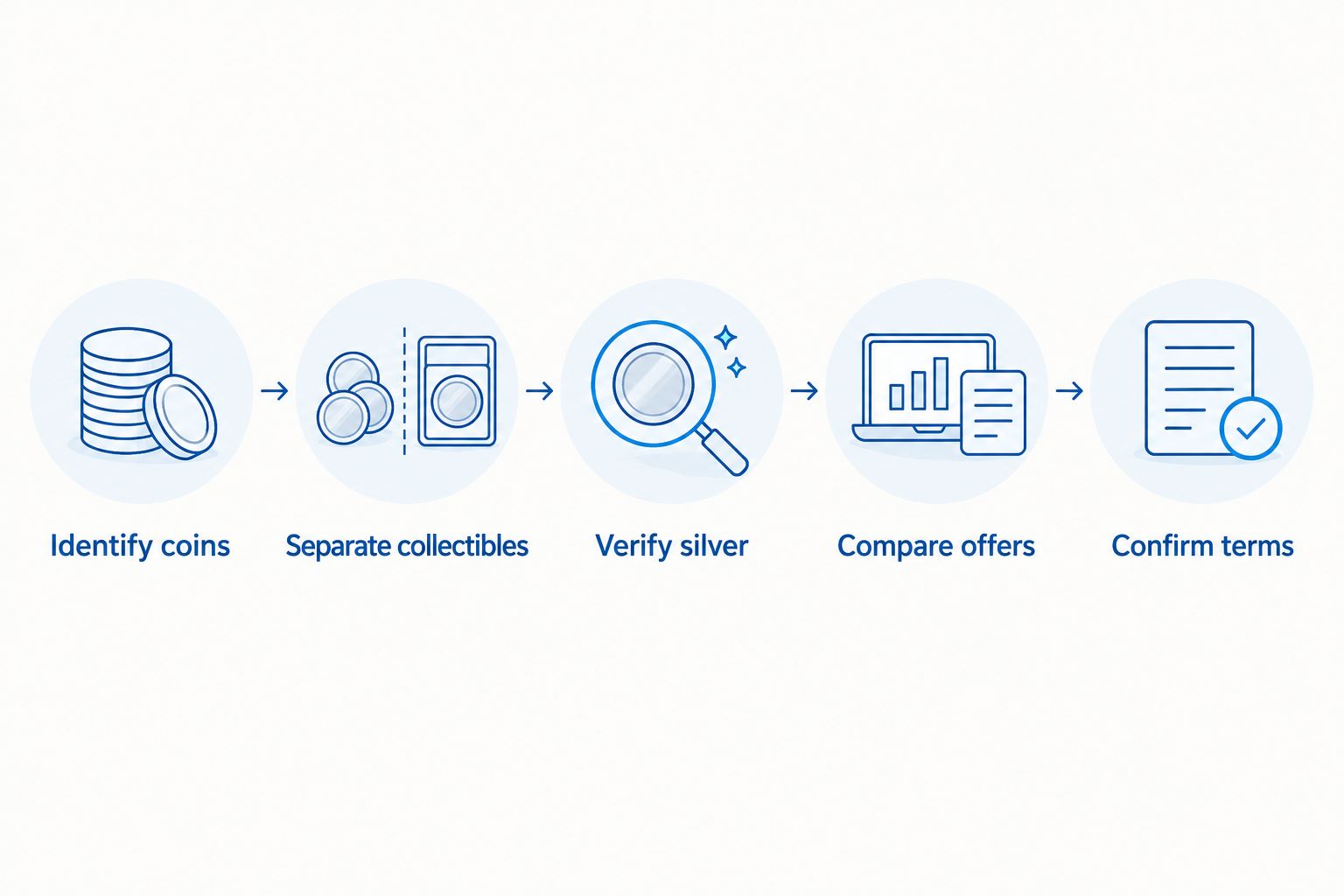
For your 2026 sale, keep the coin inventory beside each written offer. Comparing headline amounts without checking whether they cover the same pieces can lead to the wrong decision.
Do not clean, polish, acid-test, or scratch your coins yourself. Cleaning and surface damage can reduce collector appeal; leave identification and any necessary testing to someone equipped to assess the coins appropriately.
Should you sell silver coins to a local exchange or a coin dealer?
Choose a buyer according to the coins, not just the convenience of the location. A local precious-metals exchange is relevant to a metal-focused sale; a collector-focused coin dealer is relevant when rarity, grading, or unusual varieties need attention.
Uptownbullion is a fit for Dallas consumers seeking a local gold and silver exchange. Its stated services include buying and selling precious metals, but that does not establish an offer for a particular coin collection or a guaranteed relationship to melt value.
Before visiting Uptownbullion, describe the coins you hold and confirm whether the business evaluates that material. Ask what identification, appointment arrangements, or other sale requirements apply rather than assuming a policy.
The benefit of an in-person discussion is the opportunity to ask how the material is being assessed. The limitation is that local convenience does not replace a specialist evaluation for potentially collectible coins. The guide to selling silver coins in Dallas provides a related starting point for choosing a selling route.
Do silver coins have to be melted before you sell them?
Silver coins do not have to be melted to be sold for their metal content. A buyer can value intact coins using verified specifications and an appropriate assessment of their condition and authenticity.
Do not alter your coins to prepare them for a melt-based sale. Keeping them intact preserves identifying details and leaves open the possibility of resale as coins.
Is an offer below melt value always a bad deal?
An offer below melt value is not automatically a bad deal, but you should understand the difference between the calculated metal benchmark and the net amount offered. Ask the buyer to explain deductions and whether any resale premium is included.
Seek another evaluation when the explanation is unclear or when potentially collectible coins are being treated only as metal. A transparent calculation is more useful than an unsupported promise of the highest payout.
Can collectible silver coins be worth more than melt value?
Collectible silver coins can be worth more than melt value because buyers also assess rarity, condition, variety, and demand. Silver content alone does not establish that additional value.
Separate potentially collectible coins before accepting a bulk offer. A grading label provides information, but neither a label nor an old date guarantees a premium for every coin.
FAQ
Can I sell silver coins for exactly melt value?
You can receive an offer equal to calculated melt value, but it is not guaranteed. The final offer depends on the identified coins, the market reference, any premium, and applicable deductions.
What's the difference between spot value and melt value?
A silver spot quotation is a market reference, while a coin’s melt value applies a silver market reference to its fine-silver content. Neither figure is automatically the amount a buyer will pay you.
How many grams are in a troy ounce of silver?
One troy ounce equals approximately 31.1035 grams. Do not substitute the ordinary ounce of approximately 28.3495 grams when checking a precious-metals calculation.
Should I clean silver coins before selling them?
Do not clean silver coins before selling them. Cleaning can alter surfaces and reduce collector appeal, so leave the coins as they are for evaluation.
Can I sell silver coins without having them melted?
Yes, you can sell intact silver coins using their silver content as the valuation basis. A melt-based transaction does not require the buyer to physically melt them.
Does every old silver-colored coin contain silver?
No, age and silver-colored appearance do not establish silver content. Identify the exact issue and composition before calculating its metal value.
Can I ask Uptownbullion about selling silver coins in Dallas?
Yes, you can ask Uptownbullion about your silver coins because its stated services include buying and selling precious metals. Confirm acceptance of your particular coins and the evaluation process before visiting.
One last thing
An offer above melt value can still overlook collector value. Beating the metal benchmark does not prove that a rare or unusually well-preserved coin has been fully assessed.
Before accepting a 2026 offer, ask one final question: is this coin being valued only for its silver, or also for what someone would pay to own it as a coin? The answer tells you whether the comparison is complete.


