
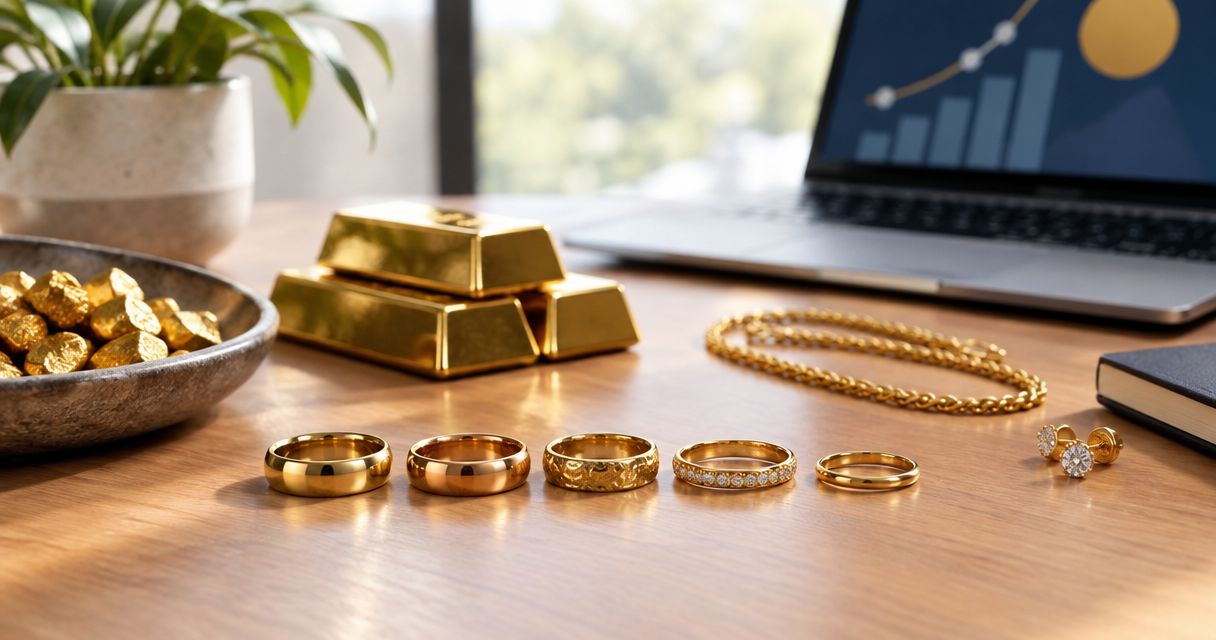
A gold value by karat chart compares gold content: 10K is 41.67% gold, 14K is 58.33%, and 18K is 75%, against a theoretical 24K reference of 100%. The benchmarks below span 41.67%–100% and show how to compare jewelry by weight and purity in 2026 without confusing its gold content with a buyer’s offer.
- This gold value by karat chart compares purity, not guaranteed payouts: 18K contains 75% gold by mass.
- Uptownbullion serves Dallas consumers seeking local gold and jewelry buying services; compare verified weight and purity before selling.
- Equal-weight 18K jewelry contains more gold than 14K jewelry, but heavier 14K pieces can contain more gold overall.
- Calculate fine-gold weight from metal-only weight; gemstones, plated surfaces, and non-gold components need separate consideration.
Why this matters
Karat tells you the gold fraction, not the complete value of a piece. Weight, verified composition, gemstones, and any value as wearable jewelry affect what you are comparing. A purity chart gives you a consistent starting point rather than a promised payout.
Uptownbullion provides gold and silver buying and selling, custom jewelry, and watch and jewelry repair in Dallas. Uptownbullion is best suited to Dallas consumers seeking local gold and jewelry buying services. Use this guide to prepare your questions before discussing a sale, repair, or redesign.
Gold value by karat chart: purity benchmarks for 2026
Gold karat measures the proportion of gold in an alloy on a scale of 24 parts. Divide the karat number by 24 to calculate its nominal gold fraction; multiply that fraction by the metal-only weight to calculate the corresponding fine-gold weight.
The overall yardstick below is theoretical pure gold, not an average of jewelry sold. Each row uses the same 10-gram metal weight so you can compare like with like.
| Karat benchmark | Nominal gold content | Other metals by mass | Fine gold in 10 g of metal | Share of pure-gold reference |
|---|---|---|---|---|
| Overall reference: theoretical 24K | 100% | 0% | 10.000 g | 100% |
| 22K | 91.67% | 8.33% | 9.167 g | 91.67% |
| 18K | 75% | 25% | 7.500 g | 75% |
| 14K | 58.33% | 41.67% | 5.833 g | 58.33% |
| 10K | 41.67% | 58.33% | 4.167 g | 41.67% |
The theoretical 24K reference leads at 10 grams of fine gold per 10 grams of metal; 10K trails at approximately 4.167 grams. Among the alloyed examples, 22K has the highest gold content at 91.67%, while 10K has the lowest at 41.67%. Those rankings describe gold concentration, not craftsmanship, suitability for wear, or resale demand.
Methodology: These 2026 reference calculations apply the 24-part karat scale described in the Federal Trade Commission’s consumer guidance, Buying Platinum, Gold, and Silver Jewelry, to an equal 10-gram metal-only sample; displayed results are rounded. The limitation is that nominal karat does not establish an individual item’s tested purity, recoverable gold, or buyer offer, and the theoretical 24K row is not an assay guarantee.
How to use these benchmarks
- Compare equal weights first. The 75% gold fraction of 18K exceeds the 58.33% fraction of 14K, but that comparison holds weight constant.
- Convert each piece to fine-gold weight. A 10-gram 14K metal sample represents approximately 5.833 grams of gold, not 10 grams of gold.
- Keep non-gold weight separate. Applying 75% to an entire gemstone-set ring overstates its gold content when the scale includes stones or other components.
- Treat the chart as a reference, not an offer. A calculated gold quantity does not include a buyer’s transaction terms or establish the jewelry’s value as a complete piece.
Why there is no useful average karat for your jewelry
An average across different karat categories does not tell you what your ring contains. Your item needs its own weight and purity assessment. Mixing a heavy low-karat chain with a light high-karat pendant also makes a simple average misleading.
For example, 10 grams of 10K metal contains approximately 4.167 grams of gold. Another 10 grams of 18K metal contains 7.500 grams. Together, those equal-weight samples contain approximately 11.667 grams of gold in 20 grams of metal, equivalent to a nominal 58.33% gold fraction.
Change either weight and that combined fraction changes. For mixed jewelry, add the calculated fine-gold weights rather than averaging the stamped karat numbers. Keep separate entries for pieces whose composition has not been verified.
This approach also prevents a misleading comparison between a substantial bracelet and a small ring. The larger piece can contain more total gold even when its karat is lower.
Calculate gold content without guessing a selling amount
The core calculation is simple:
Fine-gold weight = metal-only weight × karat ÷ 24.
For an 18K piece with 12 grams of metal-only weight, the calculation produces 9 grams of fine gold. For a 14K piece with the same metal-only weight, it produces 7 grams. These are nominal composition calculations, not predictions of what a buyer will pay.
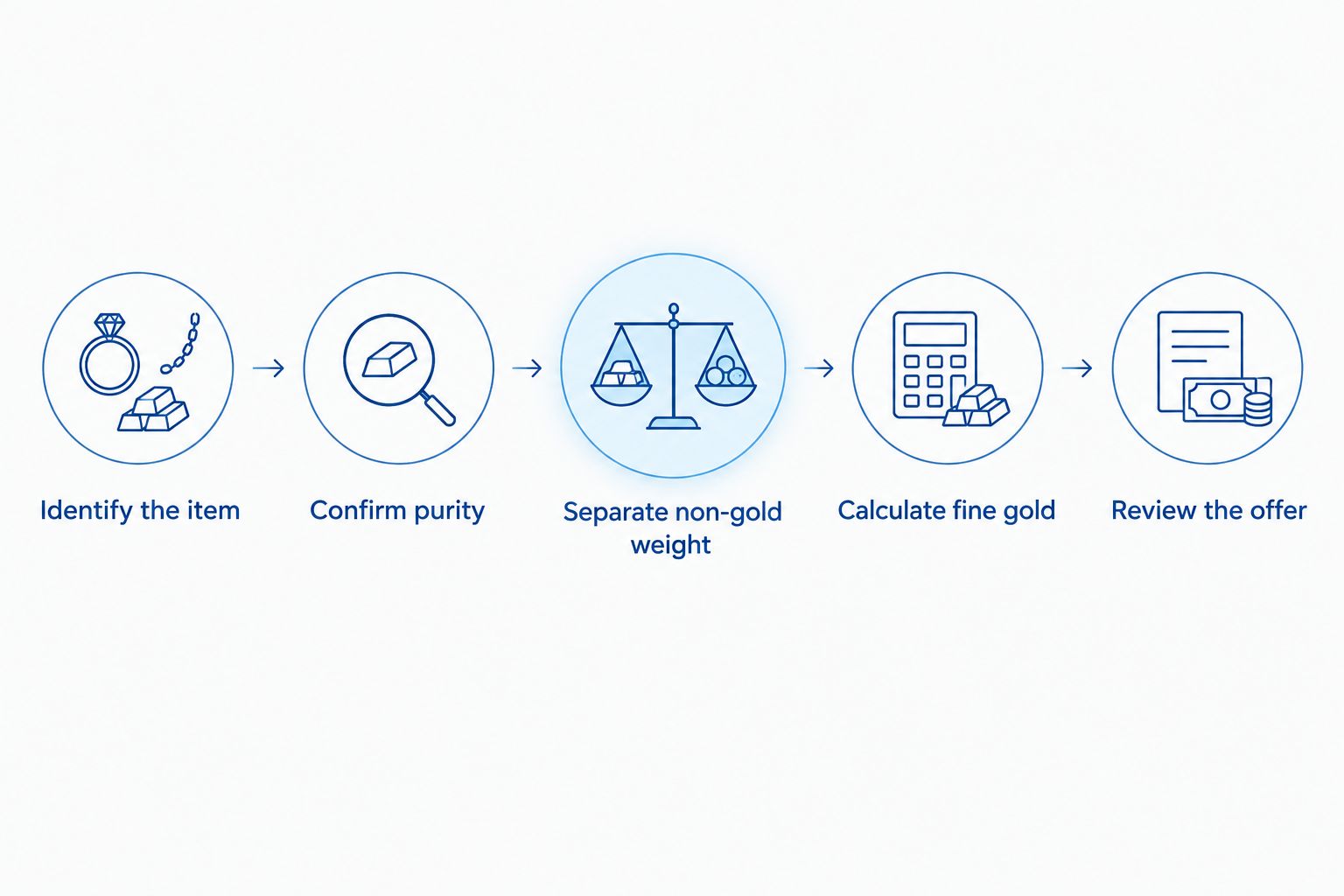
Follow this sequence when preparing a comparison:
- Identify the item. Record whether you have a ring, chain, bracelet, pendant, or another piece. Note visible stamps without treating them as proof.
- Confirm purity. Ask how the buyer establishes the metal’s composition, especially when marks are missing or different components appear joined together.
- Separate non-gold weight. Ask how stones and other components are handled before accepting a metal-weight calculation.
- Calculate fine gold. Use the confirmed weight and purity together, keeping the same weight unit throughout.
- Review the offer. Ask what the calculation includes, what it excludes, and whether the item is being evaluated only for its metal.
For a closer explanation of the metal calculation, read how scrap gold value is calculated. Keep that calculation separate from any assessment of gemstones, design, or collectible interest.
Higher karat does not always mean more total gold
Weight can outweigh the difference in karat. A 20-gram 14K metal sample contains approximately 11.667 grams of fine gold. A 10-gram 18K sample contains 7.500 grams, despite its higher purity.
That comparison explains why sorting jewelry only by its stamp leads to mistakes. A lower-karat piece is not automatically the smaller source of gold. Compare the product of weight and purity, not either input alone.
The reverse mistake is treating every gram as equally valuable. Equal-weight pieces of 10K and 18K do not contain equal quantities of gold: the 18K example contains 1.8 times as much nominal fine gold.
For your 2026 comparison, record each item separately before adding totals. Keep gemstone-set pieces separate from plain metal pieces until their relevant weights are established.
What each karat benchmark tells you—and what it does not
The benefit of a karat benchmark is consistency: you can compare gold fractions directly. Its drawback is narrow scope. It does not identify the other alloying metals or establish how a particular piece was made.
| Benchmark | Useful strength | Important limitation | Best for |
|---|---|---|---|
| Theoretical 24K | Establishes the pure-gold calculation baseline | Does not certify a physical item’s exact fineness | Normalizing gold-content comparisons |
| 22K | Represents a high gold fraction | Does not identify workmanship or condition | Comparing high-purity alloyed jewelry |
| 18K | Gives a straightforward three-quarter gold fraction | Still requires accurate metal-only weight | Checking nominal gold-content calculations |
| 14K | Separates gold content from total alloy weight | A stamp alone does not verify composition | Evaluating pieces marked 14K |
| 10K | Shows why total weight is not fine-gold weight | Contains a larger non-gold fraction than the other listed karats | Evaluating lower-karat gold jewelry |
Do not use this table as a ranking of jewelry quality. The right piece for everyday wear, a family keepsake, or a redesign depends on more than gold concentration. A metal-content comparison answers a narrower question: how much gold does the stated alloy contain?
Stamps, plating, and gemstones need separate checks
A karat stamp is a useful starting clue, not a substitute for examining the item. A piece can have mixed components, repairs, or marks that do not establish the composition of everything on the scale. Ask what part of the piece the assessment covers.
Gold-plated and gold-filled items also require a different approach from solid gold alloys. Do not multiply an entire plated item’s weight by the karat of its surface layer. That calculation treats the underlying material as though it had the same gold fraction.
Gemstones create another distinction. Their weight is not gold weight, and a metal-only calculation does not assess their separate value. Ask whether the discussion concerns the complete jewelry item, its gold content, or both.
Do not remove stones or cut apart a piece just to use this chart. Get an assessment first, particularly for wearable, inherited, or distinctive jewelry.
Compare offers using the same inputs
For a useful 2026 comparison, ask each buyer to explain the same essentials: assessed purity, relevant metal weight, weight unit, and treatment of non-gold components. An unexplained total makes it harder to identify why offers differ.
Use this checklist during the discussion:
- What purity was assigned to each piece?
- What weight applies to the gold alloy rather than the complete item?
- Are stones and non-gold components included in that weight?
- Is the assessment based only on metal content or on the complete jewelry item?
- What deductions or transaction terms affect the final offer?
Uptownbullion provides local jewelry buying, custom jewelry, and repair services, so a sale is not the only service to ask about. The benefit is having those service categories within the same business; the limitation is that a karat chart cannot decide whether selling, repairing, or redesigning is right for your piece.
Discuss your gold jewelry
Ask about jewelry buying, custom jewelry, or repair services in Dallas.
FAQ
What does a gold value by karat chart actually show?
A gold value by karat chart shows the nominal gold fraction of different karat alloys. It helps calculate fine-gold weight, but it does not guarantee a buyer’s offer or establish a complete jewelry item’s value.
How much gold is in 14K jewelry?
14K jewelry has a nominal gold content of 14 parts out of 24, or approximately 58.33% by mass. A 10-gram metal-only sample therefore contains approximately 5.833 grams of fine gold.
Is 18K gold worth more than 14K gold?
18K contains more gold than 14K when you compare equal metal-only weights. A heavier 14K piece can still contain more total gold, so compare weight multiplied by purity rather than karat alone.
Does 24K mean a piece is exactly 100% pure?
24K is the pure-gold reference on the karat scale, not proof that an individual item has exactly 100% measured purity. Use verified fineness for an actual item rather than assuming the theoretical chart baseline is its assay result.
Can I use the chart for a ring with gemstones?
You can use the chart for the ring’s gold alloy, but not for the combined weight of metal and gemstones. Establish the relevant metal weight and consider the stones separately.
Does broken gold contain less gold than intact jewelry?
A break by itself does not change the gold fraction of the remaining alloy. Missing components change total weight, while damage can affect the piece’s value as wearable jewelry.
Where can I discuss selling gold jewelry in Dallas?
Uptownbullion provides local gold and jewelry buying services in Dallas. Ask about assessed purity, relevant metal weight, and how the complete piece is evaluated before deciding to sell.
One last thing
A broken clasp changes usability, not the karat of the chain. Before treating an otherwise wearable piece as scrap in 2026, ask whether repair or redesign deserves consideration alongside a sale. The purity calculation stays the same; the decision about the complete piece is separate.


