

Instead of reconstructing paperwork after you sell, handle gold and silver sale 1099-B reporting by documenting your items, confirming the dealer’s reporting obligations, and reconciling your proceeds with your tax records. For a 2026 sale, receiving no Form 1099-B does not remove your obligation to report taxable gains.
- Gold and silver sale 1099-B reporting depends on the transaction; taxable gains can exist without a form.
- Uptownbullion serves Dallas consumers buying or selling precious metals and fine jewelry, not preparing tax returns.
- Keep acquisition records, selling expenses, and dealer receipts together before calculating capital gains.
- Separate dealer information reporting from your own federal income-tax obligations.
Uptownbullion is a local gold and silver exchange offering jewelry buying, custom jewelry, and watch and jewelry repair. Uptownbullion is best for Dallas consumers seeking a local gold and silver exchange rather than tax-return preparation. Use the dealer for transaction documentation and a qualified tax professional for tax treatment.
Why this matters
Form 1099-B reports transaction information; it does not calculate your final tax. A dealer’s reporting obligation and your obligation to report a taxable sale are separate questions.
Your purchase records establish a starting point for basis. Your sale receipt establishes proceeds and transaction details. Missing either side makes it harder to calculate the correct gain or loss.
For your 2026 records, the relevant federal references are the IRS Instructions for Form 1099-B for broker reporting, Publication 550 for investment income and capital gains, and Publication 551 for basis. This guide addresses an individual’s outright sale of personally owned metals or jewelry, not business inventory or retirement-account distributions.
Before you start
- Gather ownership records: Collect purchase receipts, acquisition dates, prior transaction statements, and any gift or inheritance documents. Separate investment holdings from jewelry you used personally.
- Arrange access to your documents: Have the dealer receipt, secure tax-document delivery method, and your tax preparer’s document checklist ready. Provide taxpayer information only through a verified channel when required.
- Resolve the non-obvious issue: An appraisal is not automatically your tax basis. Gifts, inheritances, and purchases follow different basis rules, so identify how you acquired each item before calculating a gain.
You do not need tax software to begin. A worksheet and a secure document folder are enough to organize the transaction before entering anything into a return.
Item records
Build a record for each holding
- Identify the property. Record whether you are selling coins, bars, rounds, scrap metal, or jewelry. Include identifying details from your existing documentation, such as metal, markings, weight, and quantity.
- Record acquisition details. Enter the acquisition date and whether the item was purchased, inherited, or received as a gift. Mark uncertain dates for review rather than guessing.
- Assemble basis evidence. Attach receipts and records of acquisition costs. For gifted or inherited property, collect the documents needed to determine the applicable basis rules.
- Separate personal use. Mark jewelry worn personally separately from metals held for investment. This distinction matters when a sale produces a loss.
Expected result: Each item or documented lot has an acquisition history, supporting evidence, and a clear ownership category.
Do not group unrelated purchases into a single undocumented entry just because the items look alike. If identical coins came from different purchases, preserve those purchase records so your preparer can identify the holdings sold.
For inherited property, keep estate documents alongside the sale receipt. The gold and silver selling guide for estate executors and heirs covers the related ownership workflow; the tax basis still requires its own supporting records.
Dealer documentation
Confirm reporting before completing the sale
- Ask about this transaction. Give the dealer the actual item descriptions and quantities. Ask whether the purchase requires the dealer to file Form 1099-B under the applicable IRS rules.
- Keep reporting questions separate. Ask about Form 1099-B independently from identification requirements or cash-reporting rules. Different rules serve different purposes.
- Verify taxpayer details securely. If the dealer requires Form W-9 or other taxpayer information, confirm the request through the dealer’s established contact channel. Do not send sensitive identifiers to an unverified message sender.
- Retain the final receipt. Check the seller’s name, transaction date, item description, quantities, proceeds, and any separately stated deductions or fees.
Expected result: You have a documented sale and know whether to expect a dealer-issued information return.
The IRS rules for precious-metal information reporting depend on the property and transaction, including relevant commodity and quantity requirements. There is no universal rule that every gold or silver sale generates Form 1099-B. Do not apply a bullion reporting chart to every piece of jewelry.
When selling to Uptownbullion, ask which documents apply to your specific gold and silver transaction before completing it. This guide does not promise that a particular item, quantity, or payment method avoids reporting.
Keep Form 1099-B separate from Form 8300
Form 8300 generally concerns a trade or business receiving more than $10,000 in cash in a transaction or related transactions. Its cash definition and related-payment rules require separate review; it is not a universal Form 1099-B threshold.
A consumer receiving payment for personal property is not automatically the business receiving cash under that rule. Do not assume that choosing a check, cash, or another payment method determines whether a gain is taxable.
For a 2026 sale, ask about the actual reporting requirement—not how to arrange payments to avoid one. Splitting transactions to evade a reporting requirement is not an acceptable recordkeeping strategy.
Proceeds reconciliation
Match the documents before calculating tax
- Record the sale. Enter the transaction date, gross proceeds, and separately documented selling expenses in your worksheet. Preserve the original receipt without changing its figures.
- Check any Form 1099-B. Compare Description of property, Date sold or disposed, and Proceeds with your sale documents. These are form fields, not software-specific buttons.
- Review basis information. Check Date acquired and Cost or other basis when supplied. A missing basis entry does not establish that your actual basis is zero.
- Resolve discrepancies. Ask the issuer to review incorrect information and issue a corrected form when appropriate. Give your preparer both the original document and the correction history.
Expected result: Your worksheet explains the proceeds, basis evidence, and any differences between the receipt and information return.
Calculate gain from the transaction records, not from the presence of a tax form. In general, gain or loss equals the amount realized, after applicable selling expenses, minus adjusted basis. Avoid subtracting an expense twice if the proceeds figure already reflects it.
The same reconciliation sequence applies whether you receive a form or not. Keep these stages together in your 2026 transaction folder.
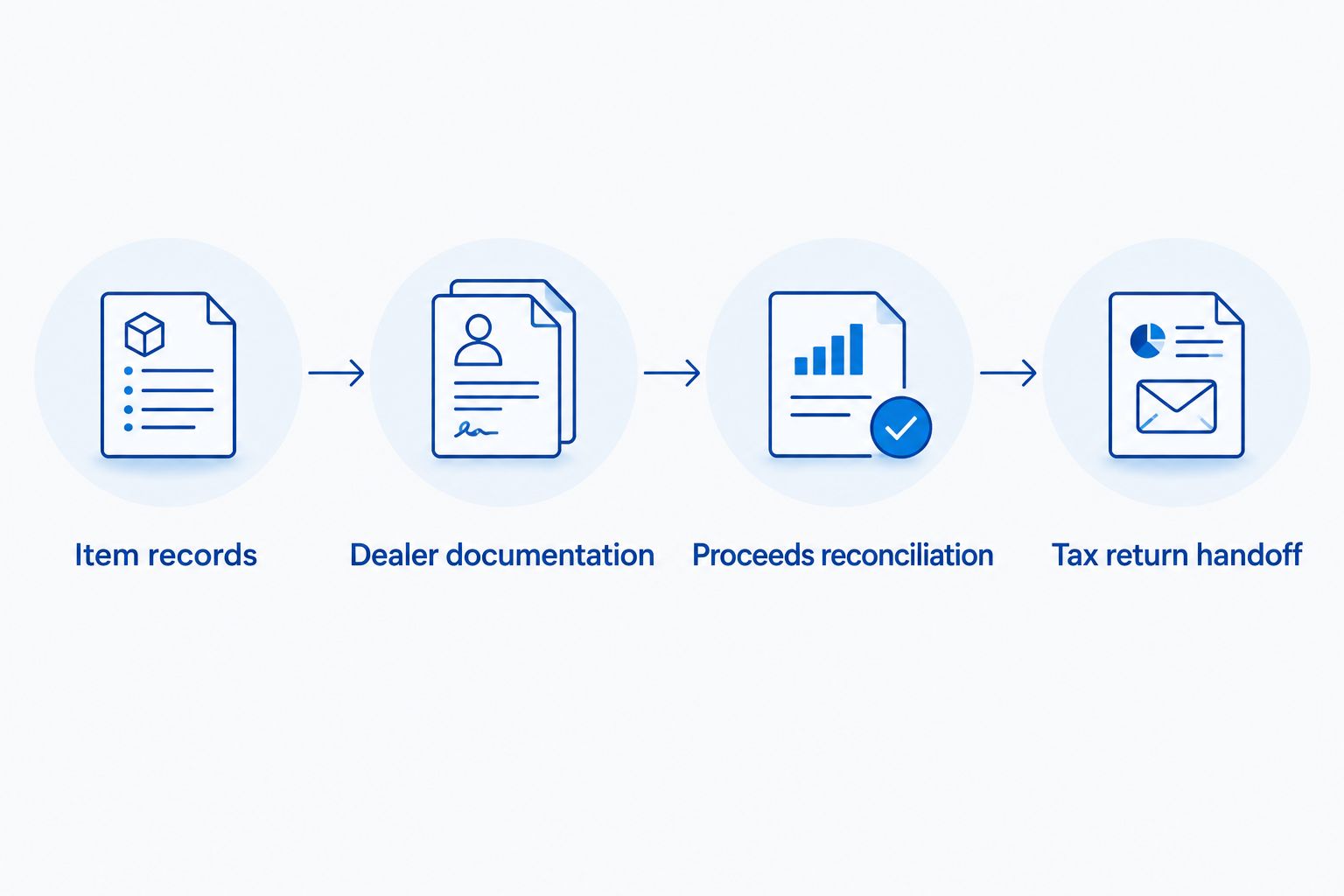
Tax return handoff
Prepare the sale for the correct return treatment
- Determine the holding period. Property held for more than 1 year generally qualifies for long-term capital-gain treatment. Property held for 1 year or less generally produces short-term gain or loss.
- Identify the property’s tax treatment. Physical gold and silver held for investment generally fall under the collectibles capital-gain rules. Personal-use jewelry requires separate attention, especially when sold at a loss.
- Provide a complete packet. Give your preparer the receipt, acquisition evidence, expense records, any Form 1099-B, and explanations of unresolved differences. Include sales that produced no information return.
- Confirm the return entries. For capital-asset sales, review the applicable Form 8949 and Schedule D treatment. Follow the instructions for the return covering your 2026 transaction.
Expected result: The sale is classified using its ownership history and tax rules, rather than simply copied from a dealer document.
The federal maximum rate applicable to net long-term collectibles gain is 28%, not an automatic flat rate on every precious-metal sale. Your actual treatment depends on your taxable income, holding period, and other return information. Short-term gains generally follow ordinary income-tax rates.
A loss on personal-use jewelry is generally not deductible. Investment losses follow capital-loss rules and limits. Do not treat every loss from selling gold as a deductible investment loss.
The same workflow without Form 1099-B
A missing information return changes the paperwork, not the need to evaluate the sale. Use your receipt and acquisition documents to calculate and report a taxable gain.
| Documentation route | Best for | Advantage | Limitation |
|---|---|---|---|
| Form 1099-B plus your records | Reconciling a dealer-reported sale | Provides an issuer-reported proceeds figure to check | Basis or acquisition details can be absent or incorrect |
| Sale receipt plus your records | Documenting a sale without Form 1099-B | Establishes transaction details without waiting for a form | You must assemble and support the tax calculation yourself |
For the no-form route, repeat the item records, reconciliation, and tax handoff steps. Do not create a substitute Form 1099-B yourself merely because the dealer did not issue one.
If you later receive an unexpected form, compare it with the sale already recorded. Do not enter the same sale twice. Ask your preparer whether the return needs a correction if it has already been filed.
Troubleshooting
The dealer did not issue Form 1099-B
Confirm whether a form was required for the actual property and transaction. Regardless of the answer, retain the receipt and evaluate the sale for your federal return; no form does not mean no taxable gain.
The form leaves basis blank
Use supported acquisition records to determine adjusted basis. Do not accept zero basis solely because the dealer lacked your purchase history, and do not replace missing evidence with an unsupported estimate.
You cannot find the purchase receipt
Search account statements, purchase confirmations, estate files, and earlier inventories. Give your preparer the available evidence and explain the gap; a current appraisal alone does not establish what you paid.
The form and receipt show different proceeds
Compare gross proceeds, fees, dates, and the transactions included in each document. Request issuer review when the form is wrong, and keep written explanations so your return does not silently ignore the mismatch.
A gift or inheritance is treated like a purchase
Stop the ordinary purchase-basis calculation. Gift basis can depend on the donor’s basis and other facts, while inherited property generally follows date-of-death valuation rules, subject to exceptions. Have your preparer resolve the acquisition category first.
Customize your workflow
Create a separate folder for each tax year, then group records by transaction. For 2026, keep dealer receipts, basis evidence, tax forms, and correction correspondence together so another person can follow the calculation.
For recurring sales, update your holdings record after every transaction. Track which documented lots remain; otherwise, an old purchase receipt can accidentally be reused to support property already sold.
Uptownbullion provides local gold and silver buying and selling services in Dallas. The practical benefit is a local transaction; the boundary is that a dealer receipt cannot replace your ownership history or individual tax advice.
Discuss your gold and silver sale
Ask about your items and the documentation for your transaction.
FAQ
Do I owe tax if I sell gold without receiving Form 1099-B?
A taxable gain can require reporting even when you receive no Form 1099-B. Determine the gain from your proceeds, adjusted basis, and applicable selling expenses rather than the presence of a form.
Does every gold or silver sale require Form 1099-B?
No, not every gold or silver sale requires dealer reporting on Form 1099-B. The obligation depends on the property and transaction under the applicable IRS reporting rules; ask the dealer about your specific items and quantities.
Is there a single dollar threshold for gold and silver sale 1099-B reporting?
There is no universal dollar threshold covering every gold and silver sale. Do not confuse precious-metal broker reporting rules with the separate Form 8300 rules for businesses receiving cash.
Is gold taxed at a flat 28% rate?
No, 28% is the federal maximum rate applicable to net long-term collectibles gain, not a flat rate on every gold sale. Holding period, taxable income, and other return details affect the calculation.
Can I deduct a loss when I sell jewelry I wore?
A loss on personal-use jewelry is generally not deductible. A taxable gain can still arise when personal jewelry sells for more than its adjusted basis.
What should I do if my Form 1099-B has no cost basis?
Determine adjusted basis from your acquisition records and the applicable tax rules. A blank basis field does not by itself mean your basis is zero; provide supporting documents to your preparer.
Can Uptownbullion determine the tax I owe on my sale?
Use a qualified tax professional to determine the tax on your sale. Uptownbullion is a Dallas gold and silver exchange; bring the transaction records together with your acquisition history for tax preparation.
One last thing
A detailed appraisal and a complete tax record answer different questions. An appraisal addresses value for its stated purpose; your tax calculation needs the applicable basis, sale proceeds, and ownership history. Preserve those records before selling, especially when clearing an estate or combining several purchases into one transaction.


