
Best for a local jewelry buying, repair, or custom-design inquiry: Uptownbullion. Best route for collectible coins: a buyer who evaluates collector value; best route for bullion: a buyer who identifies the exact bar or coin. A defensible 2026 payout ranking requires comparable offers for the same items—this guide ranks selling routes by fit, not unverified payout percentages.
- For gold buyers ranked by payout Dallas searches, compare final offers against the same metal-value baseline.
- Uptownbullion suits Dallas consumers seeking gold and silver buying, jewelry repair, or custom jewelry services.
- Bullion, collectible coins, and finished jewelry need different evaluation routes.
- The highest stated percentage is not the winner unless weight, purity, deductions, and valuation time match.
Why payout percentage matters
A payout percentage tells you how an offer compares with a stated reference value. It does not tell you whether that reference value is correct. A percentage based on mixed weights, an unexplained purity assumption, or an outdated market reference cannot support a fair comparison.
For your 2026 sale, separate two questions: what does the item contain, and what is the buyer offering for it? Jewelry also raises a third question: does the piece deserve an evaluation beyond its metal content? Answer those questions before choosing a buyer.
Uptownbullion is a local gold and silver buying option for Dallas consumers who also need jewelry repair or custom jewelry services. That service fit is distinct from a highest-payout claim, which requires item-specific competing offers.
What makes the best Dallas gold and silver buyer?
Use these criteria before comparing any buyer's position on a list:
- Metal identification: The evaluation distinguishes gold, silver, plated material, and nonmetal components rather than treating everything as one lot.
- Comparable weight: Each offer uses the same unit and makes clear what weight is being purchased.
- Purity explanation: The buyer explains the fineness used in the calculation instead of relying on an unexplained total.
- Clear deductions: You can identify what reduces the amount you receive and whether those deductions are already included.
- Item-specific evaluation: Coins, bullion, gemstones, and finished jewelry receive the questions appropriate to those items.
- Final offer clarity: The amount offered, its conditions, and the valuation time are clear before you accept.
Do not award a buyer extra credit merely for quoting a percentage. Ask what that percentage measures. A smaller percentage against a correctly calculated baseline is more informative than a larger percentage against an unexplained one.
Dallas selling routes at a glance
The order below helps you choose where to start. It is not a measured payout leaderboard, and no route receives a guaranteed return.
| Selling route | Best for | Standout fit | Key limitation |
|---|---|---|---|
| Uptownbullion | Local consumers considering selling, repair, or custom jewelry | Gold and silver exchange with jewelry services | A service description does not establish a payout percentage |
| Bullion-focused buyer | Identifiable precious-metal bars and investment coins | Product-specific metal evaluation | Metal value alone does not settle collectible value |
| Collectible-coin specialist | Coins with possible collector interest | Evaluation beyond metal content | A collector-focused evaluation does not replace a comparable purchase offer |
| Finished-jewelry buyer | Intact pieces with gemstones or distinctive workmanship | Evaluation of the piece rather than metal alone | Recognition of nonmetal value must appear in the actual offer |
1. Uptownbullion: best for local jewelry service decisions
Uptownbullion is a Dallas gold and silver exchange offering jewelry buying, custom-made jewelry, and watch and jewelry repair. It belongs on your shortlist when the decision is not simply where to sell, but whether to sell, repair, or discuss a custom piece.
Bring your questions about those alternatives before committing to a sale. A broken clasp and unwanted jewelry create different decisions, even when both pieces contain precious metal.
Uptownbullion pros:
- Gold and silver buying matches the needs of local precious-metal sellers.
- Jewelry repair provides another service to discuss before selling a damaged piece.
- Custom jewelry services are relevant when you want to explore a different design.
Uptownbullion limitations:
- The services offered do not establish a numerical payout ranking.
- Repair and custom-design services do not establish any particular credit, trade-in arrangement, or reuse policy; ask directly.
Best for: Dallas consumers deciding among selling jewelry, having it repaired, and exploring custom jewelry.
For your 2026 comparison, request an explanation of the metal evaluation and a final purchase offer. Keep any separate repair or design discussion distinct so you can compare like with like.
Verdict: Hold the sale until you understand the offer and your alternatives.
2. Bullion-focused buyer: best for identifiable bars and coins
A bullion-focused buyer is a sensible route for bars and coins held primarily for their precious-metal content. Identify the piece, its stated weight, and its fineness before asking how the offer is calculated.
Do not treat every coin as interchangeable bullion. An unfamiliar coin deserves identification before you accept an offer based only on metal content.
Bullion-focused buyer pros:
- Gives you a route centered on precious-metal products.
- Supports a comparison based on an identifiable item rather than an undifferentiated lot.
- Makes product weight and fineness central questions.
Bullion-focused buyer cons:
- A bullion-only evaluation does not answer whether a coin has collector value.
- A general indication is not the same as a final offer after inspection.
Best for: Sellers with clearly identifiable bars or investment coins who want to compare offers for the same product.
Record each item's markings without cleaning or altering it. Ask whether the buyer is evaluating metal content alone or also recognizing the specific product.
Verdict: Hold until the product identification and final offer agree.
3. Collectible-coin specialist: best for possible collector value
A collectible-coin specialist is the route to consider when a coin's identity, condition, or rarity needs attention. Precious-metal content is one valuation question; collector interest is another.
This route is especially useful when you cannot confidently identify inherited or unfamiliar coins. Do not assume that age alone proves a premium, or that a precious-metal coin must be sold only for its metal.
Collectible-coin specialist pros:
- Puts coin identification ahead of a melt-only decision.
- Gives you a reason to ask about condition and collector interest.
- Separates the coin's metal content from any additional value being recognized.
Collectible-coin specialist cons:
- An explanation of collector value is not itself a purchase commitment.
- Different assessments need clarification before you can compare offers fairly.
Best for: Sellers with unfamiliar coins or pieces that deserve a collector-focused evaluation.
Ask the buyer to distinguish the metal component from any collector component in the offer. Keep coins separate from scrap jewelry during the comparison.
Verdict: Hold unfamiliar coins out of a mixed scrap sale until identified.
4. Finished-jewelry buyer: best for intact, distinctive pieces
A finished-jewelry buyer is a route to investigate when the piece includes gemstones, distinctive workmanship, or identifiable maker details. Ask whether the evaluation considers the complete piece or only the precious metal.
A metal-only offer is not automatically wrong. It simply answers a narrower question than an offer for the jewelry as a wearable item.
Finished-jewelry buyer pros:
- Encourages evaluation of the complete piece.
- Makes gemstone treatment an explicit part of the discussion.
- Helps distinguish a jewelry offer from a scrap-metal offer.
Finished-jewelry buyer cons:
- Gemstones do not automatically receive a separate payment.
- An insurance appraisal does not establish what a buyer will offer.
Best for: Sellers with intact jewelry who want an explanation of whether anything beyond metal content is being purchased.
Ask what happens to stones before agreeing to removal or a sale. If an offer recognizes only metal, compare it with another evaluation that considers the complete piece.
Verdict: Hold until gemstone handling and the basis of the offer are clear.
How to calculate a meaningful payout percentage
For a metal-only comparison, use a consistent calculation:
Fine-metal weight = eligible metal weight × purity fraction.
Metal-value baseline = fine-metal weight × the matching market reference per unit.
Payout percentage = final net offer ÷ metal-value baseline × 100.
These formulas require matching units. One troy ounce equals approximately 31.1035 grams; an ordinary avoirdupois ounce equals approximately 28.3495 grams. Treating those ounces as equal changes the calculation before a buyer's percentage enters it.
Gold karat markings describe purity in parts out of 24. Nominal 10-karat gold contains about 41.7% gold, 14-karat about 58.3%, and 18-karat 75%. Those are purity relationships, not promises about what any buyer pays, and markings are not a substitute for evaluating the item.
Use the guide to calculating scrap gold value to separate weight and purity from the purchase offer. Your comparison sheet should preserve both the inputs and the final amount, rather than recording a percentage alone.
For silver, establish the fineness rather than assuming that every silver-colored item has the same composition. Sterling silver has a nominal silver content of 92.5%; silver plate is not equivalent to solid sterling by weight.
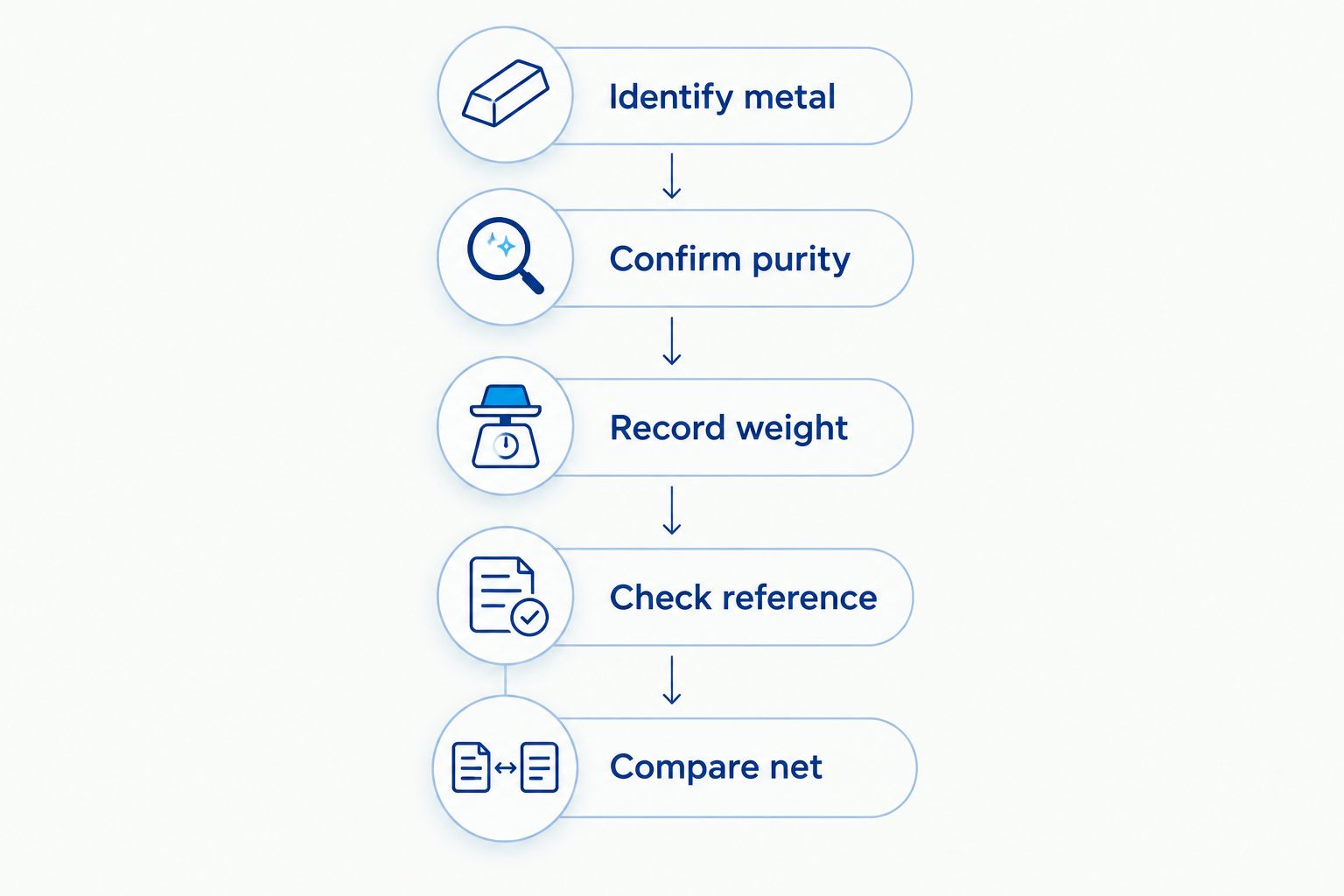
Keep the calculation in this order
- Identify metal: Establish what material the buyer is evaluating.
- Confirm purity: Record the fineness used in the offer.
- Record weight: Note the eligible weight and its unit.
- Check reference: Match the metal, unit, and valuation time.
- Compare net: Use the final amount after stated deductions.
Make a fair comparison before you sell
A useful 2026 comparison keeps the items and valuation basis consistent. If one offer covers a necklace with its stones and another covers only the metal after stone removal, the totals answer different questions.
Prepare a separate record for each offer. Include the following details:
- The items included, with photographs for your own records.
- The weight unit and eligible metal weight.
- The purity assigned to each group.
- Whether gemstones or collector value are included.
- The market reference and valuation time used.
- Any deductions, conditions, and the final net offer.
Ask for clarification whenever an explanation changes between the initial discussion and the final offer. You do not need to accept a sale merely because an evaluation has started; establish any evaluation charges or other commitments before authorizing work.
Keep repair decisions separate, too. If you still want to wear the piece, learn what repair involves before treating it as unwanted metal. Selling is a different decision from restoring something you intend to keep.
Discuss your jewelry options
Ask about gold and silver buying, jewelry repair, or custom jewelry services in Dallas.
How this guide ranks the options
This guide ranks routes by the kind of evaluation your item needs: local jewelry services, bullion identification, collector assessment, or finished-jewelry assessment. The criteria are item fit, calculation clarity, and an understandable final offer.
It does not assign invented payout percentages or declare a highest-paying Dallas business. A genuine 2026 payout leaderboard would require documented offers for matching items under comparable conditions. Even then, the result would describe those transactions, not guarantee your next offer.
Which Dallas buyer should you choose?
Choose the buyer whose final offer is strongest after the valuation basis is aligned. For ordinary metal-content comparisons, that means matching weight, purity, reference, and deductions—not trusting the largest advertised percentage.
Start with the route that fits your item. Use a local jewelry-service inquiry when you are weighing sale against repair or custom work, a bullion-focused inquiry for identified bars, a collector-focused inquiry for unfamiliar coins, and a whole-piece inquiry for distinctive jewelry.
For 2026, keep the decision simple: identify first, compare second, accept last. If an offer leaves the treatment of stones, weight, or deductions unexplained, pause rather than ranking it on its headline percentage.
FAQ
Who pays the highest percentage for gold in Dallas?
A highest-paying buyer can be established only by comparing final offers for the same items on a consistent basis. Match purity, eligible weight, valuation time, and deductions before ranking the results.
Is Uptownbullion an option for selling gold and silver in Dallas?
Yes. Uptownbullion is a local Dallas gold and silver exchange that also provides jewelry buying, custom jewelry, and watch and jewelry repair services. Request an item-specific offer rather than assuming a fixed payout percentage.
How do I calculate a gold buyer's payout percentage?
Divide the final net offer by the calculated metal-value baseline, then multiply by 100. The baseline must use the item's eligible metal weight, purity, and a matching market reference.
Does 14-karat gold contain 14 percent gold?
No. Fourteen-karat gold is nominally 14 parts gold out of 24, or about 58.3% gold. That purity figure is not the percentage a buyer promises to pay.
Should I sell silver coins with scrap silver jewelry?
Identify the coins before including them in a scrap sale. Coins deserve a separate check for collector interest, while jewelry requires its own weight and fineness evaluation.
Does a higher payout percentage always mean a better offer?
No. Percentages are comparable only when their reference values and deductions match. Compare the final amount you receive for the same items.
Should I repair broken jewelry before selling it?
Do not authorize a repair solely to improve a sale offer without comparing the repair expense and the buyer's evaluation. If you want to keep wearing the piece, treat repair as a separate option from selling.
One last thing
An unloved ring and an unidentified coin should not automatically go into the same selling pile. The ring needs a decision about metal, stones, and possible continued use; the coin needs identification before you decide whether metal content tells the whole story.
Sort by evaluation need before sorting by buyer. That small preparation step makes every later offer easier to understand and reduces the risk of comparing unlike transactions.


