

Yes, you can negotiate the price when selling gold, but the buyer does not have to raise the offer. Your strongest argument is a clear comparison of tested purity, gold weight, and competing offers—not what you originally paid for the jewelry. Before accepting, ask whether the offer includes deductions and whether stones or other non-gold parts receive separate consideration.
- Can you negotiate the price when selling gold? Yes—but a higher offer is not guaranteed.
- Compare tested purity, gold weight, deductions, and the final payout before making a counteroffer.
- Uptownbullion is a local gold-selling option for Dallas consumers who prefer an in-person transaction.
- Separate gold content from gemstone, collectible, and jewelry resale value before accepting a metal-only offer.
Why this matters: A higher headline offer is not necessarily a better deal if it uses a different weight, purity assumption, or set of deductions. Start with how scrap gold value is calculated, then negotiate the amount you will actually receive. For a sale in 2026, use current information rather than an old estimate or purchase receipt.
Can you negotiate the price when selling gold?
Yes—ask for a better offer after you understand how the buyer calculated the first one. A counteroffer is useful when you can identify a meaningful difference, such as another buyer's higher net offer for the same items under comparable market conditions.
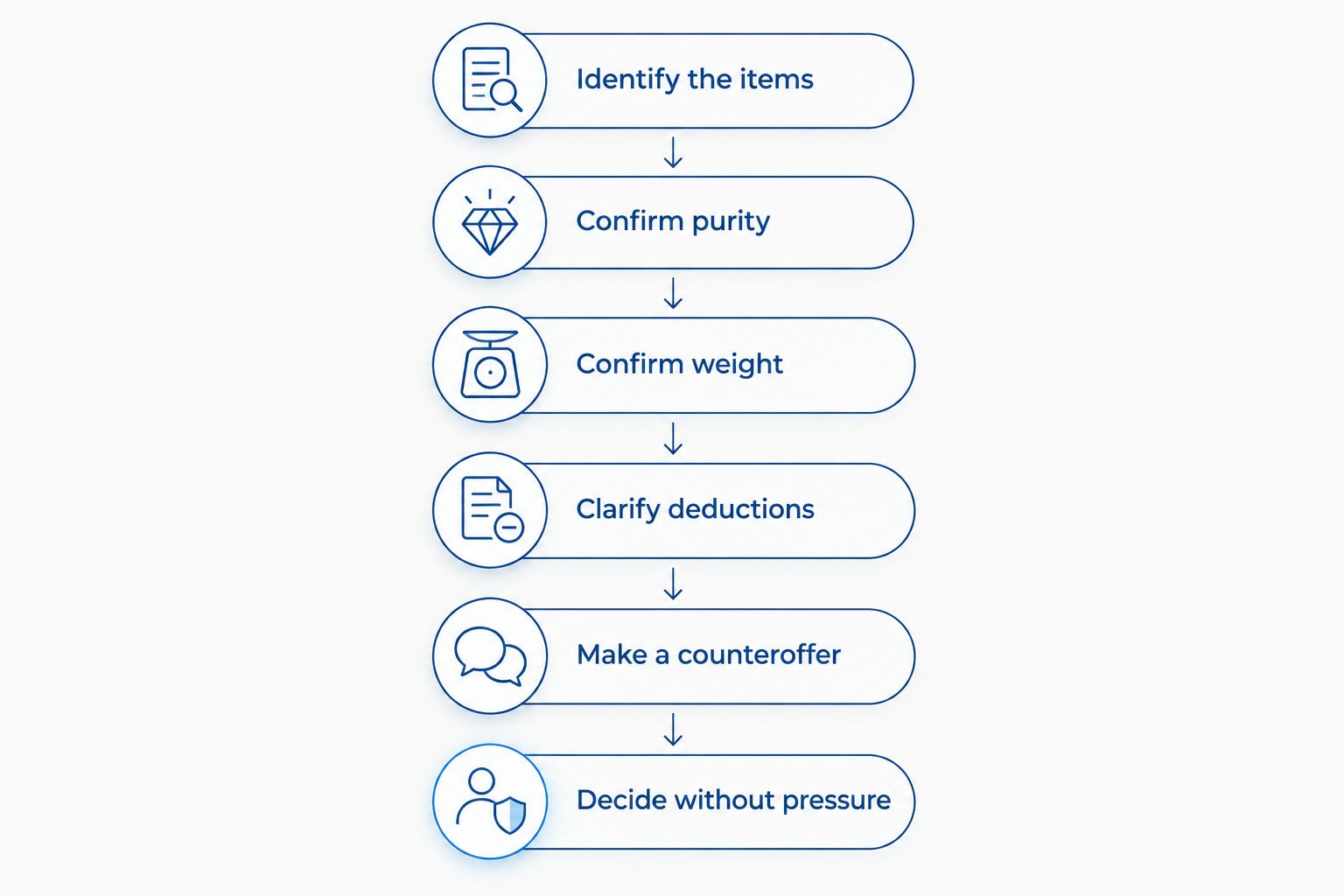
Follow this sequence before agreeing to sell:
- Identify the items. Separate jewelry, bullion, coins, and pieces with stones. Ask whether the buyer is assessing each item for metal content, resale potential, or collectible value.
- Confirm purity. Ask what testing supports the karat classification. A hallmark is useful information, but it is not a substitute for checking the item.
- Confirm weight. Record the unit used and ask how stones, clasps, and other components affect the calculation. Compare equivalent units across buyers.
- Clarify deductions. Ask whether testing, refining, shipping, or other charges apply. Establish the final amount payable before negotiating.
- Make a supported counteroffer. Refer to a genuine competing offer or ask which part of the calculation can change. Keep the discussion factual.
- Decide without pressure. Accept only when you understand the terms. Decline if the buyer will not explain the assessment clearly enough for you to compare it.
A higher request alone does not establish that your gold is worth more. The useful question is whether the buyer can improve the offer while keeping the assessed items and transaction terms unchanged.
Compare the basis of the offer, not just the total
Two buyers can assess the same piece differently because they intend to do different things with it. Establish what each offer covers before treating the amounts as directly comparable.
| Assessment basis | Best for | Advantage | Limitation |
|---|---|---|---|
| Gold-content assessment | Sellers evaluating broken or unwanted gold | Makes purity and metal weight central to the discussion | Does not establish a separate value for design, stones, or collectibility |
| Jewelry resale assessment | Sellers with wearable pieces worth evaluating intact | Considers the item as jewelry rather than only as metal | Requires a buyer interested in reselling that type of piece |
| Collectible assessment | Sellers with potentially collectible coins or unusual pieces | Examines characteristics beyond gold content | Needs relevant expertise; rarity should not be assumed |
Ask whether an offer includes the entire item, including its stones and fittings. If a buyer assigns no separate amount to a gemstone, that does not by itself establish that the gemstone has no value elsewhere.
For your 2026 comparison, record the date and scope of each assessment. An offer for a complete ring and an offer for its recoverable gold are not necessarily competing offers for the same thing.
10-karat gold: approximately 41.7% gold
On the karat scale, 10-karat gold represents 10 parts gold out of 24, or approximately 41.7% gold by mass. That purity matters more to a metal-content calculation than the jewelry's original retail cost.
Ask the buyer to keep confirmed 10-karat pieces distinct from higher-purity pieces when explaining the assessment. Combining everything into one unexplained total makes it harder to check whether the calculation reflects what you brought in.
The practical advantage is clarity: you can compare offers using the same purity category. The limitation is that a stamp alone does not prove the item's composition or establish the final payout.
14-karat gold: approximately 58.3% gold
On the karat scale, 14-karat gold represents 14 parts gold out of 24, or approximately 58.3% gold by mass. Equal-weight pieces of 14-karat and 10-karat gold therefore contain different amounts of gold.
When negotiating a 14-karat item, check that the buyer's stated purity and weight agree with the assessment being discussed. If testing produces a different result from the hallmark, ask for an explanation before moving to the counteroffer.
Higher purity increases the gold content at an equal metal weight. It does not establish what a buyer must offer or whether the piece deserves a separate jewelry resale assessment.
18-karat gold: 75% gold
On the karat scale, 18-karat gold represents 18 parts gold out of 24, or 75% gold by mass. Do not compare a per-weight offer for an 18-karat piece with one for a lower-purity piece without accounting for that difference.
Ask whether the recorded weight includes stones or non-gold components. A heavier complete item does not automatically contain more gold than a lighter item with fewer non-gold parts.
Keep the negotiation focused on verified composition and the final payable amount. Purity supports the calculation; it does not replace the need to understand deductions and terms.
Why gold offers vary
Gold offers vary because the underlying material, market reference, assessment method, and transaction terms differ. Check these factors before concluding that a lower offer is simply a negotiating tactic:
- Gold purity: The proportion of gold changes the metal content of an otherwise equal-weight item. Ask how purity was established.
- Assessed weight: Stones and other non-gold components affect how total item weight relates to gold-bearing metal weight. Confirm the measurement unit.
- Market timing: Gold market values change. Compare offers made under comparable conditions, and ask when an offer expires.
- Buyer deductions and margin: A buyer's offer is not the same as a market reference for pure gold. Ask which charges are included or deducted.
- Resale or collectible characteristics: An intact piece or collectible coin needs a different assessment from a metal-only calculation. Ask which basis applies.
- Transaction conditions: Shipping, insurance, payment arrangements, and return terms can affect your decision. Confirm applicable conditions before handing over or sending items.
For negotiations in 2026, a fresh, clearly explained offer is more useful than an older estimate without supporting details. Comparing totals without checking these factors can lead you to challenge the wrong part of the transaction.
What should you say when asking for a higher offer?
Ask whether the buyer can improve the final payout for the same assessed items. Then connect the request to something specific: a competing assessment, an unexplained deduction, or a question about how an intact piece was classified.
You do not need an aggressive opening demand. Use a short discussion built around these points:
- Ask the buyer to explain the weight and purity used.
- Confirm whether the stated offer is the amount you will receive.
- Present any genuine competing offer accurately, including its conditions.
- Ask whether there is room to improve the final amount.
- Request clarification if the revised offer changes which items are included.
Do not invent another offer or describe an online estimate as a confirmed purchase offer. An estimate made before physical inspection is not equivalent to an assessed offer for the items in front of you.
If the buyer declines, decide whether the explanation and final terms meet your needs. Continuing the discussion is optional; a clear refusal gives you information for your next decision.
Should you tell a gold buyer what another buyer offered?
Yes, share a genuine competing offer when it covers the same items and comparable terms. Include whether the other buyer inspected the pieces, assessed stones separately, and applied deductions.
A higher total is useful evidence only when you understand what produced it. Avoid presenting an expired or conditional estimate as an immediately available alternative.
Can you negotiate after accepting a gold offer?
Ask to resolve your concerns before accepting and completing the sale. After acceptance, your options depend on the agreement and applicable law, so do not assume that you can reopen the negotiation or reverse the transaction.
Read the documents before signing. If any term conflicts with what you understood, pause and ask for clarification first.
Does broken gold give you less negotiating room?
Broken gold still contains gold, so damage does not remove its metal content. However, condition matters when the alternative is selling the piece as wearable jewelry rather than for its metal.
Compare broken items using confirmed purity and assessed weight. Do not assume that repairing a piece will increase your net proceeds enough to justify the work.
Choosing an in-person gold buyer in Dallas
Uptownbullion is a local option for Dallas consumers who want to sell gold in person. The business buys gold, silver, and jewelry and also provides custom jewelry and watch and jewelry repair services.
An in-person visit lets you discuss the physical items directly. The trade-off is that a local visit alone does not tell you whether the offer is the strongest available; you still need a clear assessment and a meaningful comparison.
When considering Uptownbullion for gold selling, bring your questions about purity, weight, and the basis of the offer. Ask whether the piece is being considered for gold content or as intact jewelry, without assuming either assessment will produce a particular result.
Use the same checklist at every buyer you consider in 2026. Consistent questions make differences easier to understand and keep the discussion focused on the transaction rather than sales pressure.
When should you walk away from a gold offer?
Walk away when you cannot establish what you are selling, how the buyer assessed it, or what you will receive. An unexplained offer is difficult to compare, even if the total initially sounds appealing.
Pause the transaction if the buyer will not clarify the measurement unit, explain deductions, or distinguish an estimate from a final offer. Also pause if you feel pushed to include an item you intended to keep.
Before visiting buyers, decide which pieces you are genuinely willing to sell. Separate sentimental items from sale items so that a negotiation does not turn into a rushed decision about something you wanted to retain.
FAQ
Can you negotiate the price when selling gold in 2026?
Yes, you can ask a gold buyer to improve an offer in 2026, but the buyer does not have to agree. Support your request with confirmed purity, assessed weight, clear deductions, and a genuine competing offer.
Should I accept the first offer for my gold?
Accept the first offer only if you understand the assessment and are satisfied with the final terms. Comparing another assessed offer gives you more information, but it does not guarantee an increase.
Does a gold buyer have to pay the market value of gold?
A gold market reference is not a guaranteed purchase offer for your jewelry. Purity, gold-bearing weight, deductions, and the buyer's margin affect the amount offered.
Can I negotiate more for an item with diamonds?
Ask whether the buyer assigns a separate value to the diamonds before negotiating the complete item. A gold-only assessment does not establish the stones' value.
Is an insurance appraisal useful when negotiating a gold sale?
An insurance appraisal is not a cash purchase offer. Check its stated purpose before using it to support an expected resale amount.
Does Uptownbullion buy gold in Dallas?
Uptownbullion is a local gold and silver exchange in Dallas that buys gold, silver, and jewelry. Ask directly about the assessment and terms for the items you want to sell.
Should I compare online and in-person gold offers?
Compare online and in-person offers using the same items, assessment basis, and final payable amount. Check inspection conditions, shipping obligations, insurance, and return terms where applicable.
One last thing
The best counteroffer sometimes starts with correcting the comparison, not demanding more. If one buyer assessed a ring as scrap and another considered selling it intact, the difference is about the assessment basis as well as negotiation.
Before your 2026 sale, write down what each offer includes and excludes. You will have a clearer decision—and a stronger reason for any counteroffer you make.


