
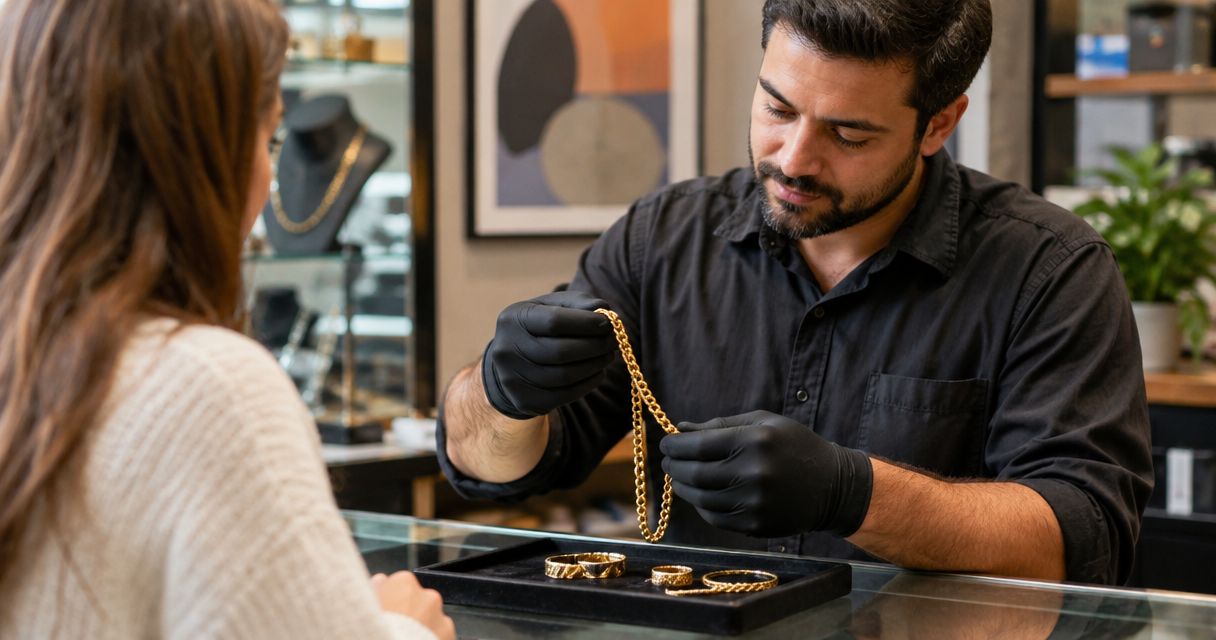
Yes, pawn shops can give a fair price for gold, but you need an explained valuation and comparable offers to judge the deal. In 2026, distinguish an outright sale from a pawn loan: a sale transfers ownership, while a loan adds repayment obligations and the risk of losing your jewelry if you do not repay under the agreement.
- Can pawn shops give a fair price for gold? Yes—compare purity, weight, deductions, and the final offer.
- A pawn loan and a gold sale are different transactions; compare sale offers with sale offers.
- Uptownbullion is a local gold and silver exchange option for Dallas consumers selling precious metals.
- Gold content provides a starting point, but signed jewelry and collectible coins need separate consideration.
Can pawn shops give a fair price for gold?
A pawn shop can make a fair offer when its assessment of your gold is accurate and its terms compare favorably with other buyers evaluating the same items. The word pawn alone tells you neither whether the offer is fair nor whether a specialist buyer will offer more.
Start by identifying the transaction you actually want. The following comparison separates selling your gold from borrowing against it.
| Transaction | Best for | Main advantage | Main limitation |
|---|---|---|---|
| Outright sale to a pawn shop | Sellers who want to transfer ownership permanently | You can evaluate a purchase offer without taking on a loan | You must check how the buyer treats purity, stones, and resale value |
| Pawn loan secured by gold | Owners who want the item back and can meet the agreement | You retain a contractual route to reclaim the item | Repayment terms apply, and failure to repay puts the item at risk |
| Outright sale to a gold exchange | Sellers comparing a precious-metal-focused buyer | Gives you another offer against which to assess the pawn shop | A metal-based assessment alone does not establish collectible or designer value |
Compare like transactions, not just the amount handed to you. A pawn loan is not a competing purchase offer, even when both involve the same ring.
For a local comparison, Uptownbullion provides gold and silver buying services in Dallas. Compare the explanation behind each offer as carefully as the offer itself.
Why this matters
A gold item can have several different measures of value: its precious-metal content, its usefulness as wearable jewelry, and any additional designer or collectible appeal. An insurance replacement appraisal answers a different question from what a buyer will pay you today.
That distinction matters when selling gold in 2026. A large gap between an old appraisal and a purchase offer does not, by itself, prove dishonesty; the documents may describe different markets and purposes.
Your goal is not to make a buyer match a retail replacement figure. It is to establish what you own, understand what the buyer is paying for, and compare the amount you would actually receive.
Keep sentimental value separate, too. A commercially reasonable offer can still be the wrong decision if you want to keep the piece or pass it to someone in your family.
How do you check whether a gold offer is fair?
Use the same process with every buyer. Consistent information makes differences in the offers easier to explain and gives you a clear reason to accept, negotiate, or walk away.
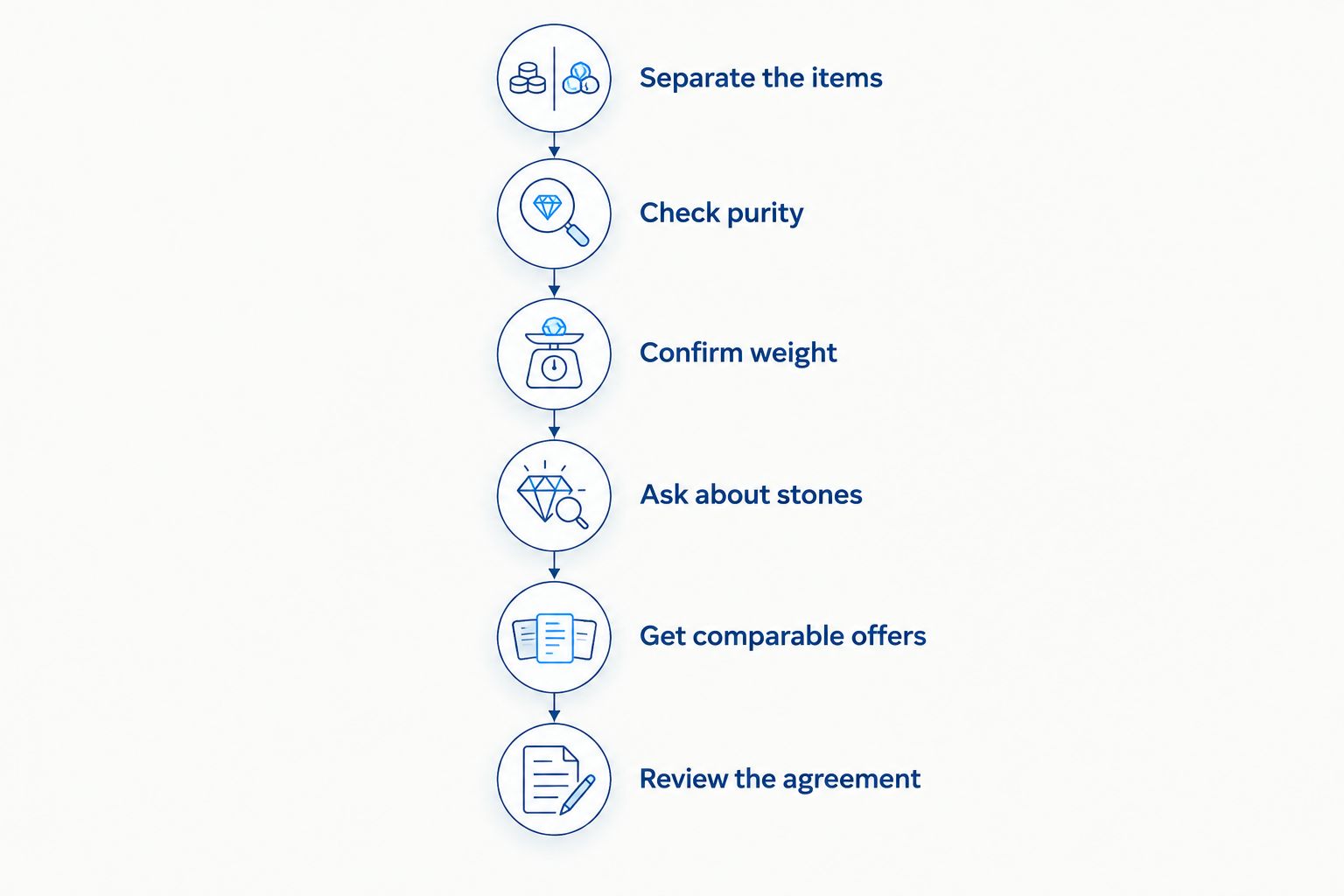
1. Separate the items
Group rings, chains, coins, and other pieces before asking for an assessment. Keep documentation and identifiable designer pieces with their matching items rather than presenting everything as an undifferentiated scrap lot.
Photograph the pieces and note any hallmarks you can read. These records help you track what you brought and compare itemized explanations afterward; photographs do not establish purity or authenticity.
Leave uncertain pieces in a separate group. Gold-colored jewelry, gold-plated jewelry, and solid gold are not interchangeable, and appearance alone cannot settle the distinction.
2. Check purity
Gold purity affects how much gold an item contains. The karat system uses 24 parts: nominally, 18-karat gold contains 75% gold, while 12-karat gold contains 50% gold.
Those percentages describe gold content, not the share of a benchmark value that a buyer must pay. An 18-karat piece is not automatically entitled to a particular payout percentage.
Ask how the buyer verified the metal rather than treating a stamp as conclusive. Before authorizing a test, ask whether it will leave a mark or otherwise affect the piece, especially if you might keep it.
3. Confirm weight
Ask which weight belongs to which purity group and what unit the scale displays. A weight without a unit is not enough information to compare assessments.
Precious-metal benchmarks commonly use troy ounces; one troy ounce equals approximately 31.1035 grams. An ordinary household ounce and a troy ounce are different units, so do not compare them as though they were identical.
A piece's gross weight can also include gemstones and non-gold components. Ask how the buyer accounts for those parts, and request an explanation before accepting any adjustment you do not understand.
4. Ask about stones
Do not assume that an offer for a gold ring includes payment for its diamonds or colored stones. Ask whether the buyer is valuing the complete ring, only the metal, or the metal and stones separately.
If stones are excluded, establish what happens to them before agreeing to the transaction. Ask whether removal is involved and whether that would change the ring's condition.
This is particularly important when comparing a whole-jewelry offer with a scrap-metal offer. Different treatment of the stones can explain part of the difference without telling you which transaction better suits your needs.
5. Get comparable offers
Ask each buyer to assess the same items and state the final amount you would receive after any deductions. Compare offers close together, since a changing gold market makes distant assessments less useful as direct comparisons.
For your 2026 comparison, record the transaction type, purity findings, weight units, treatment of stones, and any stated deductions. Ask when the offer expires rather than assuming it stays open.
A higher headline offer is not enough if the terms change before payment. Choose using the final amount and the conditions attached to it.
6. Review the agreement
Read the paperwork before surrendering ownership or accepting a pawn loan. Confirm that the description of the items matches what you brought and that the document describes the transaction you intended.
For a loan, examine the repayment obligations and what happens if you do not repay. For a sale, establish the payment method and when ownership transfers.
Do not sign a document you cannot explain back in plain language. A straightforward request for clarification is part of checking the deal, not an obstacle to completing it.
Why gold offers vary
Different offers do not automatically mean someone has misrepresented your jewelry. First identify whether the buyers disagree about the item itself, the transaction, or the amount they are willing to pay.
These factors explain what to investigate:
- Verified purity: Different findings about gold content change the metal assessment. Ask buyers to explain conflicting results before choosing between them.
- Eligible metal weight: Stones, clasps, and other components affect the difference between total item weight and the weight treated as gold-bearing material.
- Benchmark timing: Gold-market movements affect comparisons made at different times. Keep the assessment dates with your notes.
- Treatment of the complete piece: One buyer can assess an item as jewelry while another considers only recoverable metal. Ask which approach the offer uses.
- Business margin and deductions: A buyer needs a margin; you still need to understand the final offer and any deductions applied to it.
- Sale versus loan: A loan reflects a lending agreement, not simply a purchase valuation. Evaluate its obligations separately.
There is no shop label that guarantees the strongest offer in 2026. The useful question is whether the buyer explains the assessment and whether another comparable offer improves your outcome.
For the calculation behind the metal component, read how scrap gold value is calculated. Use that calculation as a reference point, not a promise of the amount a business must offer.
Should I sell gold to a pawn shop or a gold exchange?
Choose between a pawn shop and a gold exchange by comparing explained purchase offers for the same items. A specialist business name does not remove the need to verify purity, weight, and terms.
A pawn shop is a relevant option when you want an outright purchase offer or need to understand a secured loan. Its limitation is that those are different services, so you must be explicit about which one you want.
A gold exchange is a relevant comparison when you are selling precious metals. Its limitation is that a metal assessment alone does not answer every question about designer jewelry, gemstones, or collectible coins.
Uptownbullion is best for Dallas consumers seeking a local gold and silver exchange. Its stated services include jewelry buying, but you should still compare the offer and ask how your particular pieces are being assessed.
Before visiting, separate anything you are not ready to sell. Keeping those pieces out of the transaction makes your decision clearer and avoids treating an entire jewelry box as a single sell-or-keep choice.
Contact Uptownbullion about selling gold
Discuss selling gold or jewelry at a local Dallas gold and silver exchange.
Is a scrap-gold offer fair for designer jewelry?
A scrap-gold offer assesses metal value, so it does not establish the full resale value of designer jewelry. Before accepting it, ask whether the buyer considered the maker, condition, matching components, and supporting documentation.
A recognizable signature does not guarantee an additional payment. It does give you a reason to seek an assessment of the complete piece rather than assuming melting is the only relevant outcome.
The same caution applies to collectible coins. Keep them separate from ordinary scrap jewelry until you understand whether the assessment considers collectible interest as well as metal content.
Should I clean or repair gold before selling it?
Do not alter gold jewelry merely to prepare it for an assessment. Ask the intended buyer what preparation is necessary before cleaning, polishing, or arranging repairs.
Cleaning does not increase the gold content. Repairs change the condition of the piece, but they do not guarantee that a buyer will increase the offer enough to justify the work.
For old or potentially collectible pieces, preserve markings and existing condition while seeking advice. Bring detached components with the item rather than discarding them or trying to reattach them yourself.
FAQ
Can pawn shops give a fair price for gold in 2026?
Yes, pawn shops can give a fair price for gold in 2026, but you need comparable purchase offers to judge it. Check verified purity, metal weight, treatment of stones, and the final amount after deductions.
Do pawn shops pay the full gold benchmark value?
Do not assume a pawn shop will pay the full gold benchmark value. The benchmark is a reference for gold content, while a purchase offer also reflects the buyer's margin and terms.
Is pawning gold the same as selling it?
No, pawning gold is a secured loan, while selling gold transfers ownership. A pawn loan has repayment obligations, and failure to repay under the agreement puts the item at risk.
Does an 18-karat stamp prove my jewelry is real?
No, an 18-karat stamp alone does not prove authenticity or purity. Nominally, 18-karat gold contains 75% gold, but the buyer still needs to verify the material.
Will a buyer include my diamonds in a gold offer?
Do not assume diamonds are included in a gold offer. Ask whether the buyer values the stones separately, excludes them, or assesses the complete piece as jewelry.
Should I accept the first offer for my gold?
Compare another explained offer before deciding whether the first offer is fair. Make sure both assessments cover the same items and the same kind of transaction.
Does broken gold jewelry still have value?
Broken gold jewelry still contains precious metal if it is genuine gold. A broken clasp or missing component does not remove the remaining gold content, although condition matters when assessing the complete piece as jewelry.
One last thing
The most useful question is not simply whether a buyer can increase the offer. Ask: What exactly are you paying for, and what are you excluding?
That question separates metal weight from stones, a whole-jewelry assessment from a scrap assessment, and a purchase from a loan. It also gives you something specific to compare rather than relying on assurances about fairness.
For your 2026 sale, keep a written record of each assessment until you decide. Accept an offer because you understand it and it suits your needs—not because you feel obliged to finish the transaction during the visit.


