

Best local starting point: Uptownbullion. Best for an identifiable designer collection: a specialist jewelry buyer. Best for retaining control of the asking terms: consignment. Best for a documented collectible: an auction house. This 2026 guide explains which selling route fits your jewelry and what to check before accepting an offer.
- Uptownbullion is best for Dallas sellers seeking a local jewelry-buying starting point.
- To sell designer jewelry brands in Dallas, compare whole-piece offers before accepting a metal-only valuation.
- Specialist buyers, consignment businesses and auction houses serve different selling needs; confirm each business accepts your piece.
- Compare written terms, deductions and payment conditions—not just the headline offer.
Why this matters
Designer jewelry presents two different questions: what are the materials worth, and what will someone pay for the finished piece? A precious-metal assessment answers the first question. It does not, by itself, establish the second.
Uptownbullion is best for Dallas sellers seeking a local jewelry-buying starting point. For signed or collectible pieces, also seek an assessment that considers the maker, design, condition and supporting documents. Choose the route that explains those factors rather than assuming every jewelry buyer evaluates them alike.
What makes the best place to sell designer jewelry?
Use these criteria when comparing Dallas selling options in 2026:
- Whole-piece assessment: Ask whether the buyer considers the jewelry as a finished object or primarily as recoverable metal and stones.
- Relevant experience: Ask whether the business handles your maker, collection and jewelry type. General jewelry buying does not establish expertise in every designer.
- Clear transaction type: Establish whether you are receiving a purchase offer, a consignment proposal or an auction estimate.
- Written deductions: Request an explanation of commissions, testing charges, shipping obligations and other deductions that apply.
- Custody and payment terms: Confirm who holds the jewelry, what happens if you decline and when payment becomes due.
- Documented identification: Match descriptions, markings and included accessories to the actual piece before handing it over.
A reassuring conversation helps, but written terms give you something concrete to compare. Do not treat a verbal estimate as a completed sale agreement.
Dallas designer-jewelry selling options at a glance
The ranking below separates selling routes by purpose. Only the named local business is a specific recommendation; the other entries explain which type of business to approach for a different need.
| Selling option | Best for | Standout feature | Key limitation |
|---|---|---|---|
| Uptownbullion | Starting with a local jewelry buyer | Dallas gold, silver and jewelry buying | Confirm acceptance and assessment of your particular designer piece |
| Specialist jewelry buyer | A recognizable maker or collection | Focus on the identity of the finished piece | Relevant expertise and purchase interest require confirmation |
| Jewelry consignment business | Setting agreed selling terms without accepting an outright offer | Sale through an intermediary | Payment depends on the consignment agreement and a completed sale |
| Jewelry auction house | A collectible supported by attribution or provenance | A bidding-based selling process | An estimate is not a guaranteed result |
| Precious-metal buyer | A damaged piece being considered for material value | Assessment centered on metal content | A metal-only offer does not establish designer resale value |
1. Uptownbullion: best for a local jewelry-buying starting point
Uptownbullion is a local gold and silver exchange in Dallas that buys jewelry and offers custom jewelry and watch and jewelry repair services. Start here when you want to discuss selling precious-metal jewelry with a local business rather than begin with shipping or an intermediary.
For designer jewelry, identify the maker and collection before asking about a sale. Confirm whether the proposed assessment considers the complete piece, including its design and stones, or concentrates on material value. Those are different bases for an offer.
Best for: Dallas consumers seeking an initial local jewelry-buying conversation.
Uptownbullion pros:
- A Dallas location fits sellers who prefer a local business.
- Jewelry buying is an explicitly offered service.
- Gold and silver buying fits precious-metal jewelry inquiries.
Uptownbullion limitations:
- Confirm whether the business buys your specific designer and jewelry type.
- Do not assume authentication, consignment or auction services are included.
Bring photographs, markings and any existing paperwork to the discussion. Ask what information is needed before taking the jewelry in, especially if the piece has a significant stone or an uncertain attribution.
Verdict: Hold the piece until you understand the offer's basis; use this option as a local starting point.
2. Specialist jewelry buyer: best for a recognizable collection
A specialist jewelry buyer is the route to investigate when a piece's maker and collection are central to the sale. The purpose is to obtain a whole-piece assessment rather than assume the jewelry should be valued only by its materials.
Ask the specialist to identify the collection and explain which details support that identification. A signature alone is not a complete authentication process. Construction, markings, condition and supporting records all deserve attention.
Best for: Signed jewelry with an identifiable design or collection.
Specialist jewelry buyer pros:
- You can request an assessment centered on the finished piece.
- Collection-specific questions help test the buyer's relevant knowledge.
- An outright purchase proposal gives you terms to compare with other routes.
Specialist jewelry buyer cons:
- A specialist does not necessarily buy every designer or collection.
- A purchase offer and an independent appraisal serve different purposes.
For a 2026 sale, ask which current evidence supports the assessment. Separate completed-sale evidence from advertised asking amounts, and check whether the comparison pieces match your jewelry's size, materials and condition.
Verdict: Hold until the specialist explains the attribution and provides the purchase terms in writing.
3. Jewelry consignment: best for agreeing selling terms first
Consignment means a business sells the jewelry on your behalf under an agreement rather than simply purchasing it outright. You retain the role of seller while an intermediary handles the selling process defined in the contract.
This route fits owners who do not need to accept a direct purchase offer and want to agree how the piece will be presented. Read the entire agreement before leaving the jewelry, including what happens if it does not sell.
Best for: Sellers willing to wait for a sale under agreed terms.
Jewelry consignment pros:
- You can negotiate the initial asking terms before handing over the piece.
- An intermediary handles the agreed buyer-facing work.
- The agreement can define approval requirements for reductions.
Jewelry consignment cons:
- Leaving jewelry on consignment does not guarantee a sale.
- Commissions and other contractual deductions affect your proceeds.
- Withdrawal rights and payment conditions depend on the agreement.
Ask who insures the jewelry while it is in custody, how buyer returns are handled and what authorizes a reduction. Get an itemized intake receipt with photographs and identifying details.
Verdict: Wait if you need a completed sale before the consignment process can deliver one.
4. Jewelry auction house: best for a documented collectible
An auction house is a route to investigate when a piece has a collectible identity supported by attribution, provenance or other meaningful records. Start with an evaluation request rather than assuming every signed piece belongs at auction.
Ask the auction house whether the jewelry fits a particular sale and what evidence supports its estimate. The estimate describes an expectation, not an obligation to purchase your piece or a guaranteed auction result.
Best for: Collectible jewelry supported by useful documentation.
Jewelry auction house pros:
- A bidding process provides an alternative to accepting one buyer's offer.
- Catalog descriptions can explain attribution and provenance.
- A reserve, when agreed, defines a minimum acceptable bidding threshold.
Jewelry auction house cons:
- Acceptance into a sale is not automatic.
- Seller charges and settlement terms require careful review.
- The jewelry can remain unsold.
Before choosing an auction route in 2026, request the proposed sale schedule, reserve terms, deductions and unsold-item conditions. Compare the resulting agreement with a direct offer, not just with an auction estimate.
Verdict: Hold until the auction house confirms suitability and you accept the unsold-item terms.
5. Precious-metal buyer: best for a material-value assessment
A precious-metal buyer is the route to consider when you specifically need to understand the metal component of a piece. This is particularly relevant when jewelry is broken, incomplete or no longer intended for wear.
Damage does not prove that a designer piece has lost its identity or collectible interest. Obtain a whole-piece assessment before authorizing stone removal, destructive testing or sale for recovery of materials.
Best for: Sellers comparing material value after considering whole-piece resale.
Precious-metal buyer pros:
- Metal content provides a distinct basis for evaluation.
- Broken jewelry can still contain precious metal.
- A material assessment helps distinguish metal value from other proposed value.
Precious-metal buyer cons:
- A metal-only assessment does not establish designer resale value.
- Stones and nonmetal components require separate consideration.
- Destructive changes can remove details needed for later identification.
For reference, 18-karat gold is 75% gold, 14-karat gold is approximately 58.3% gold, and sterling silver is 92.5% silver. These describe metal fineness—not a promised payout or proof of authenticity.
Verdict: Skip a metal-only sale until you have considered whether the complete designer piece deserves a separate assessment.
Prepare your jewelry before requesting offers
Keep preparation factual and reversible. Your goal is to help a buyer identify the jewelry without changing the evidence that supports its identity.
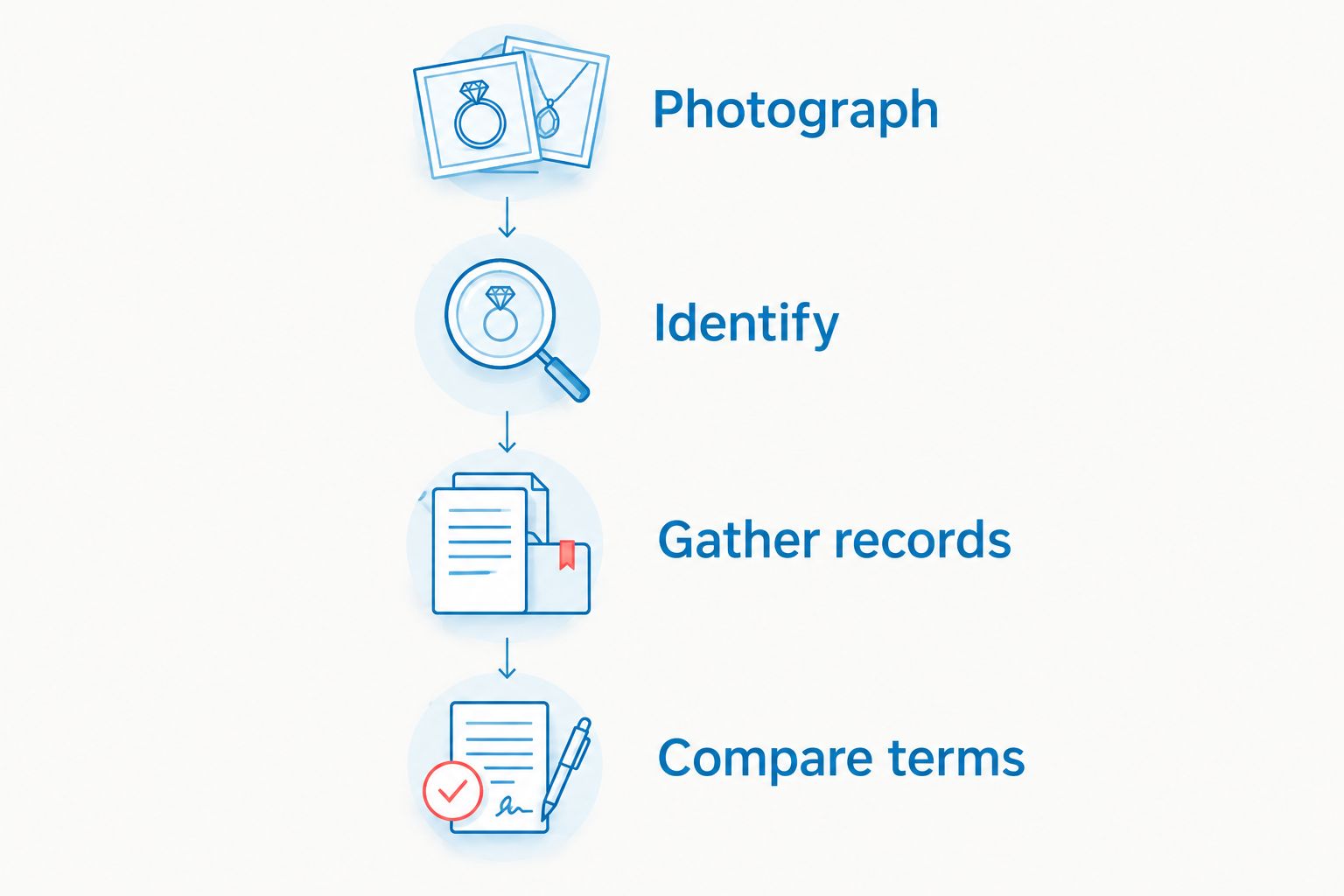
- Photograph: Capture the front, back, clasp, markings, wear and damage.
- Identify: Write down the maker, collection if known, material markings and any uncertainty.
- Gather records: Collect receipts, certificates, service records and included packaging you already have.
- Compare terms: Request written explanations covering the offer, deductions, custody and payment.
Do not polish, repair or remove stones solely to prepare for a sale without discussing the consequences with a qualified evaluator. Those changes alter the condition you are asking someone to assess. Record existing damage honestly instead of trying to hide it.
Compare offers on the same basis
Use a separate line for each piece when comparing proposals. A combined offer for several items makes it harder to see how an individual designer piece has been treated.
Ask each business the same questions:
- Is this an outright purchase offer or an estimate for a future sale?
- Does the assessment consider the finished jewelry, metal, stones or a combination?
- What deductions apply before I receive payment?
- What testing or handling requires my permission?
- What happens if I decline or the jewelry remains unsold?
Keep replacement-value insurance appraisals separate from purchase offers. An insurance valuation addresses a different purpose and does not require a buyer to pay that amount.
How the ranking works
This ranking prioritizes fit, not an unsupported claim about who pays most. A local jewelry buyer is the default starting point; specialist buying, consignment, auction and material assessment each address a different selling need.
The same criteria apply throughout: whole-piece consideration, relevant experience, clear transaction type, written deductions and custody terms. No route wins every category.
Which selling route should you choose?
Start with Uptownbullion for a local designer-jewelry selling inquiry, then seek a specialist assessment when the maker or collection needs closer attention. Choose consignment only when its contract fits your willingness to wait, and investigate auction when documentation supports a collectible identity.
For your 2026 decision, the strongest next move is not an immediate commitment. It is obtaining an understandable offer and comparing it with the right alternative before surrendering ownership.
Discuss your jewelry sale
Ask whether your designer piece fits the jewelry-buying service and what information to bring.
FAQ
What's the best place to sell designer jewelry in Dallas?
The best starting point depends on whether you need a local purchase offer, specialist assessment, consignment or auction. Begin with a local jewelry buyer and seek collection-specific expertise before accepting a metal-only valuation for a signed piece.
Should I sell designer jewelry for its gold value?
Do not accept a metal-only valuation until you have considered the finished piece's resale identity. Maker, collection, condition and documentation belong in that discussion alongside metal content.
Can I sell designer jewelry without the original receipt?
Ask the buyer what documentation is required; an original receipt is not the only evidence available for identifying jewelry. Bring existing certificates, service records and clear photographs, and confirm ownership and identification requirements before visiting.
Is consignment better than selling jewelry outright?
Consignment fits sellers willing to wait under an agreed contract, while an outright sale involves accepting a buyer's purchase terms. Compare deductions, custody, withdrawal rights and payment conditions before choosing.
Should I repair broken designer jewelry before selling it?
Get an assessment before authorizing repairs for resale. A repair changes the condition being evaluated, so ask whether the proposed work helps the sale and preserves identifying details.
Does an insurance appraisal tell me what a buyer will pay?
No, an insurance appraisal does not establish a purchase offer. Insurance replacement value and the terms a buyer offers for your existing jewelry serve different purposes.
What should I ask before leaving jewelry with a buyer?
Ask for an itemized receipt, custody terms and an explanation of any testing or changes requiring permission. Confirm return arrangements if you decline the offer and payment conditions if you accept.
One last thing
Treat removable parts as part of the selling decision. Before handing over a necklace, bracelet or earrings, photograph and list any detachable pendants, extenders, backs or spare components included in the transaction. Your intake receipt should match what you actually leave behind.


