
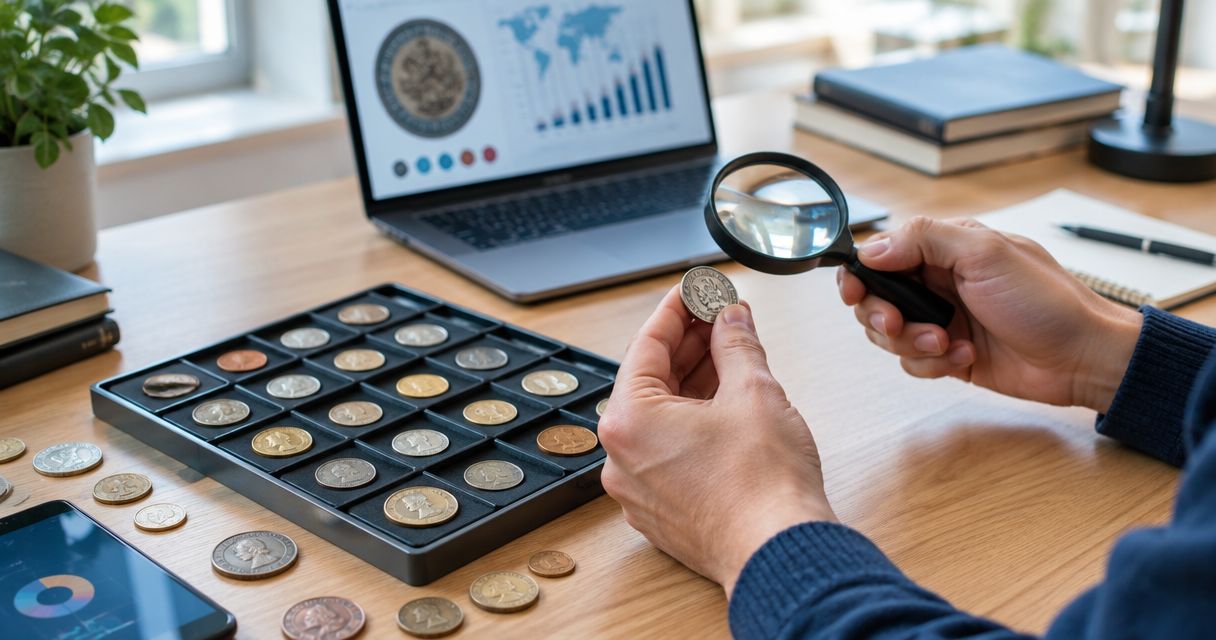
Instead of repeatedly sorting unfamiliar coins and guessing what a buyer will accept, use this foreign coin identification to buyback offer workflow to document each piece, check its identity, and request a clearly explained offer. This 2026 guide separates identification from valuation so you do not mistake a coin’s denomination, metal content, or collectible appeal for the same thing.
- Foreign coin identification to buyback offer starts with documented identity, not a guessed metal value.
- Uptownbullion is best for Dallas consumers seeking a local gold and silver exchange.
- Keep potentially collectible coins separate from metal-based sale groups until their identity is checked.
- Confirm that a buyer handles your specific foreign coins before arranging an evaluation.
Why this matters
A foreign coin can require several separate decisions: what it is, whether it is genuine, what it contains, and which buyer handles it. An identification match answers only the first question. It does not establish authenticity or an offer.
Identify first, choose the sale route second, and review the offer last. Combining those decisions encourages you to treat an unfamiliar coin as ordinary scrap before checking its other characteristics.
Uptownbullion provides gold and silver exchange services in Dallas. For a 2026 foreign-coin inquiry, confirm whether the business handles the particular coins you own rather than assuming every precious-metals buyer purchases every foreign issue.
Before you start
- Prepare your materials: Gather the coins, existing holders, certificates, purchase records, a camera, and a worksheet. Use a gram scale and millimeter ruler or caliper if available; record the instrument’s displayed precision rather than adding extra decimal places.
- Check access and authority: Confirm that you have permission to sell the collection. Ask the intended buyer which identification, ownership records, appointment arrangements, and evaluation materials to bring.
- Avoid the hidden mistake: Do not polish, chemically clean, scratch, or acid-test unfamiliar coins. Cleaning and destructive testing can damage surfaces and reduce collectible appeal; keep sealed or professionally graded coins in their holders.
The workflow below uses worksheet labels, not a particular app or buyer’s interface. Copy the bold labels into a notebook or spreadsheet; no paid identification account is required to organize the collection.
Coin inventory
Start with a record that keeps each physical coin tied to its photographs. A detailed description is not useful if you cannot tell which coin it describes.
- Assign an Item ID. Put the identifier on a separate holder or envelope, never on the coin. Keep existing labels, receipts, and packaging with the corresponding item, but treat handwritten descriptions as leads rather than proof.
- Create a Photo set. Take 3 photographs per loose coin: the front, back, and edge. Photograph through an existing sealed holder rather than opening it, and record when the edge is obscured.
- Record Visible details. Copy the lettering, denomination, displayed date, symbols, and any small mint mark exactly as seen. Use a separate note for uncertain readings instead of silently completing worn characters.
- Add Measurements and Condition notes. Record weight in grams and diameter in millimeters when you can measure without damage. Describe scratches, holes, bends, solder, or mounting marks without assigning a professional grade.
Expected result: Every coin has an identifier, an image record, and a factual description. You can send an inquiry or discuss an item without relying on memory.
For your 2026 inventory, record the date you photographed each item. That makes later additions and changes easier to distinguish from the original collection.
Identity check
A visual resemblance is a starting point. Confirm the full combination of features before attaching a catalog identity or metal composition to a coin.
- Enter a Candidate identity. Look for the issuing country or authority, denomination, date, design, and mint mark in an issuing mint’s information, a recognized coin reference, or a specialist catalog. Record the reference title and access date alongside the match.
- Compare the full specification. Check both faces, the edge, diameter, weight, and published composition where available. A matching portrait alone does not distinguish different denominations, dates, or varieties.
- Set an Identification status. Use plain labels such as tentative, reference-matched, or unresolved. Keep authenticity separate: a catalog match does not prove that the physical coin is genuine.
- Flag exceptions. Set aside coins with unclear dates, unexpected measurements, unusual edges, or conflicting reference information. Do not force a match just to complete the worksheet.
Expected result: Each coin has either a supported candidate identity or a clear unresolved question. Only reference-matched items move into a composition-based group, and the buyer still needs to assess the physical pieces.
Foreign dates do not always use the Gregorian calendar. Preserve the original inscription before adding a converted date, and check which calendar applies to that issue.
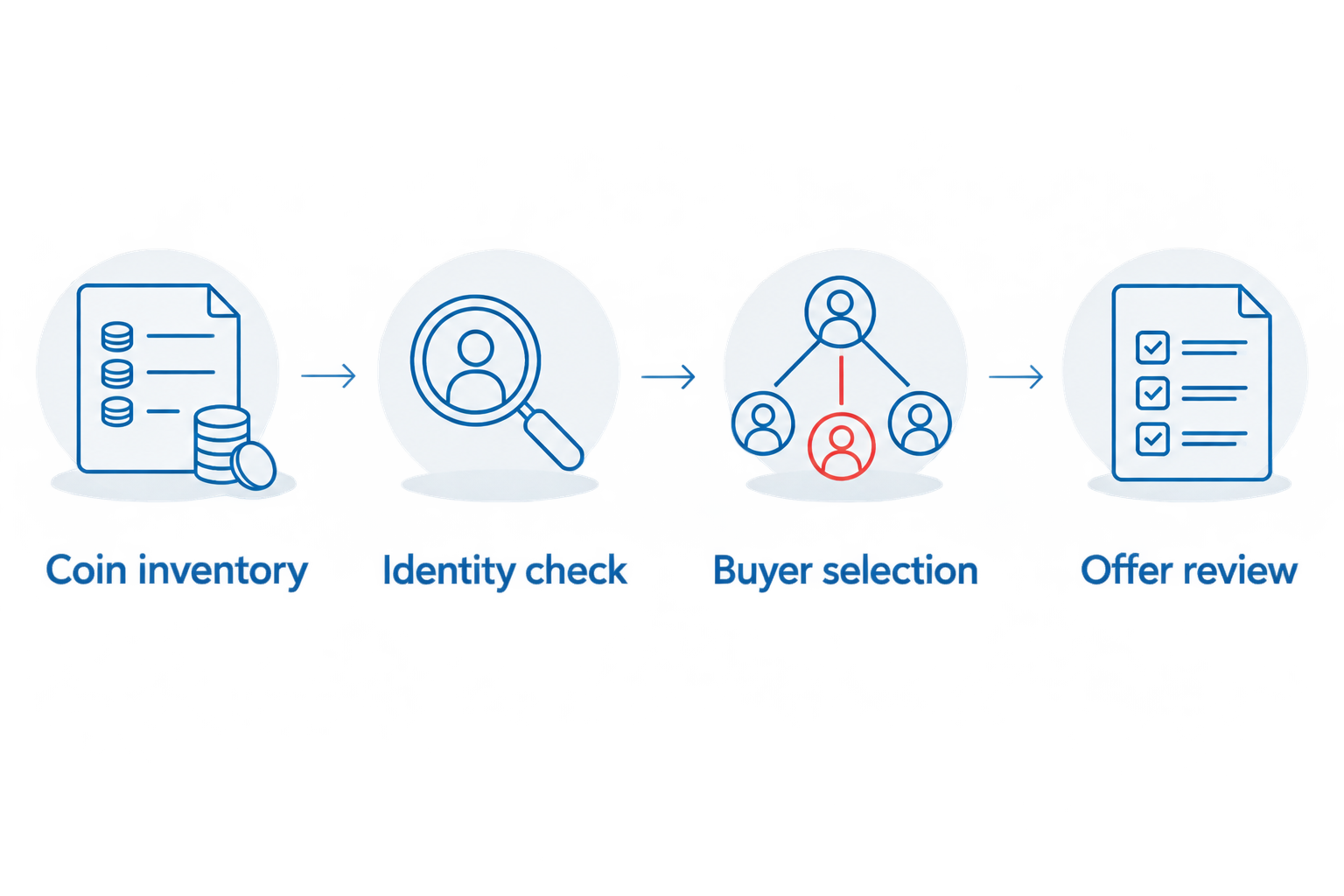
Buyer selection
Choose the evaluation route according to what needs checking. A mixed collection does not need to follow a single route simply because the coins arrived in the same box.
| Evaluation route | Best for | Main advantage | Main limitation |
|---|---|---|---|
| Precious-metals evaluation | Identified gold or silver coins being considered for a metal-based sale | Focuses the discussion on verified composition and fine-metal weight | Does not by itself establish collectible significance |
| Collector-focused evaluation | Coins with unresolved variety, condition, or collector questions | Examines characteristics beyond metal content | Requires issue-specific knowledge; identification still needs verification |
| Identification-only review | Coins with unclear country, date, denomination, or composition | Resolves basic questions before a sale decision | Does not itself produce a purchase offer |
- Write a Buyer inquiry. State that you have foreign coins, list the candidate countries and denominations, and explain whether composition is verified or uncertain. Ask whether the buyer evaluates those specific types.
- Confirm the Evaluation scope. Ask whether the review concerns metal content, collectible characteristics, or both. Ask how the buyer handles coins outside that scope and whether the evaluation creates any obligation to sell.
- Record Testing permission. Ask what examination or testing is proposed before handing over the coins. State any restrictions on opening holders, removing mounts, or using a method that alters a surface.
Expected result: You know what the buyer will examine and what remains outside the review. No specialist capability or purchase commitment is assumed.
Uptownbullion’s gold and silver exchange is a starting point for Dallas precious-metals inquiries, not proof that every foreign coin fits its buying scope. Use the contact page to confirm suitability before bringing the collection.
Offer review
Keep identification evidence and commercial terms together, but do not confuse them. A buyer’s explanation should make clear which items the offer covers and how they were grouped.
- Request an Item breakdown. Ask the buyer to connect each coin or clearly defined group to your inventory. Separate items you are retaining, items needing further review, and items included in the proposed transaction.
- Record the Valuation basis. For a metal-based evaluation, ask about measured weight, verified fineness, and the reference timestamp. For a collector-focused evaluation, ask which identity, condition, and variety findings support the assessment.
- Review Written terms. Confirm any deductions, payment method, transfer arrangements, and the period for which the terms apply. Ask whether a later evaluation requires fresh testing or a revised offer.
- Document your Decision. Accept only after the item list and terms match your understanding. If a material question remains unresolved, retain the affected coin and request clarification before authorizing its sale.
Expected result: Your records show exactly what is being sold, what supports the evaluation, and what you agreed to. Keep a copy of the final transaction document.
For metal-weight discussions, 1 troy ounce equals approximately 31.1035 grams. Do not substitute an ordinary household ounce or compare gross coin weight with fine-metal weight; alloyed coins contain more than the precious metal alone.
Ask about your foreign coins
Confirm whether your coins fit the buying scope and what to bring before arranging an evaluation.
Update an offer when the collection changes
Use a shorter repeat workflow when you find another envelope of coins, receive new identification evidence, or revisit an earlier evaluation. Preserve the original record instead of overwriting it.
- Additions: Assign new item identifiers and photograph the added coins. Do not insert them into an earlier weighed group without making the change explicit.
- Identity corrections: Record the previous candidate, the corrected identification, and the supporting reference. Recheck any grouping that depended on the earlier composition assumption.
- Offer renewal: Ask the buyer to confirm current terms and whether another physical review is required. A previous conversation is not a standing commitment.
For a revised 2026 inquiry, send a concise change summary: added items, corrected identities, and questions still open. This keeps the discussion focused without presenting old evaluation notes as current terms.
Expected result: You can explain what changed between the original collection and the new request. The buyer can distinguish an added coin from a corrected record.
Troubleshooting
The lettering is unfamiliar or partly worn
Photograph under soft light from different angles and copy only the characters you can actually read. Compare the design and denomination as well as the script; use an identification specialist when the evidence remains incomplete.
Do not rub the surface to reveal lettering. Leave an uncertain character marked as uncertain.
The coin looks silver but its composition is unknown
Treat color as an observation, not a metal test. Match the exact issue to published specifications and ask the evaluator how composition will be checked.
Do not calculate fine-metal content from an assumed purity. Similar-looking coins can use different alloys.
Measurements disagree with a reference
Recheck the units, scale setup, and whether packaging was included in the measurement. Compare the exact denomination and variety, not just the general design.
If the discrepancy remains, pause the identification. Wear, alteration, a mistaken match, and authenticity questions require different explanations; a home measurement alone does not settle them.
A buyer offers only a single total
Ask which items are included and whether any potentially collectible pieces received separate consideration. A grouped offer is easier to assess when the grouping and evaluation basis are explicit.
If those details remain unclear, keep the collection and seek a review that addresses the unresolved questions. You do not need to accept an unexplained grouping.
Customize your workflow
For a large collection, add worksheet fields for storage location and related documents. Group coins only after identification, and keep uncertain pieces separate from confirmed composition groups.
For an inherited collection, preserve the original envelopes and the previous owner’s notes. Those notes provide context, but they do not establish authenticity, ownership authority, or current transaction terms by themselves.
For a combined jewelry-and-coin inquiry, maintain separate inventories. Jewelry hallmarks and coin specifications are different evidence, even when both items contain the same precious metal.
Uptownbullion also provides jewelry buying, custom-made jewelry, and watch and jewelry repair services. Describe those items separately when asking which services fit your needs rather than treating every object as part of one metal sale.
FAQ
How do I go from foreign coin identification to a buyback offer?
Document each coin, check its candidate identity, confirm an appropriate buyer, and request clearly explained terms. Keep unresolved coins separate until their identity or composition questions are addressed.
Can a coin shop buy coins from another country?
A coin shop’s buying scope determines which foreign coins it will consider. Send the country, denomination, photographs, and any supported composition information before arranging an evaluation.
Should I clean foreign coins before showing them to a buyer?
No—leave unfamiliar coins uncleaned. Polishing, chemicals, and abrasive handling can damage surfaces and reduce collectible appeal.
Does identifying a foreign coin prove that it is genuine?
No—identification and authentication are separate tasks. A design match establishes a candidate issue, while the physical coin still requires appropriate examination.
Is a silver-colored foreign coin necessarily silver?
No—color does not establish silver content. Check the exact issue’s published specifications and ask how the evaluator verifies composition.
What should I bring to a foreign-coin evaluation?
Bring the coins, their existing holders, your inventory, and relevant records. Confirm the buyer’s identification requirements and proposed testing methods before the visit.
Does Uptownbullion buy every type of foreign coin?
Universal foreign-coin acceptance is not established by the listed services. Contact the Dallas gold and silver exchange with your specific coin details to confirm its buying scope.
One last thing
An unresolved coin belongs in a separate holder, not in a guessed metal group. That small sorting decision preserves your ability to investigate it before agreeing to a sale.
For your final 2026 check, compare the physical collection against the written item list before authorizing transfer. The right explanation attached to the wrong coin is still a transaction error.


