
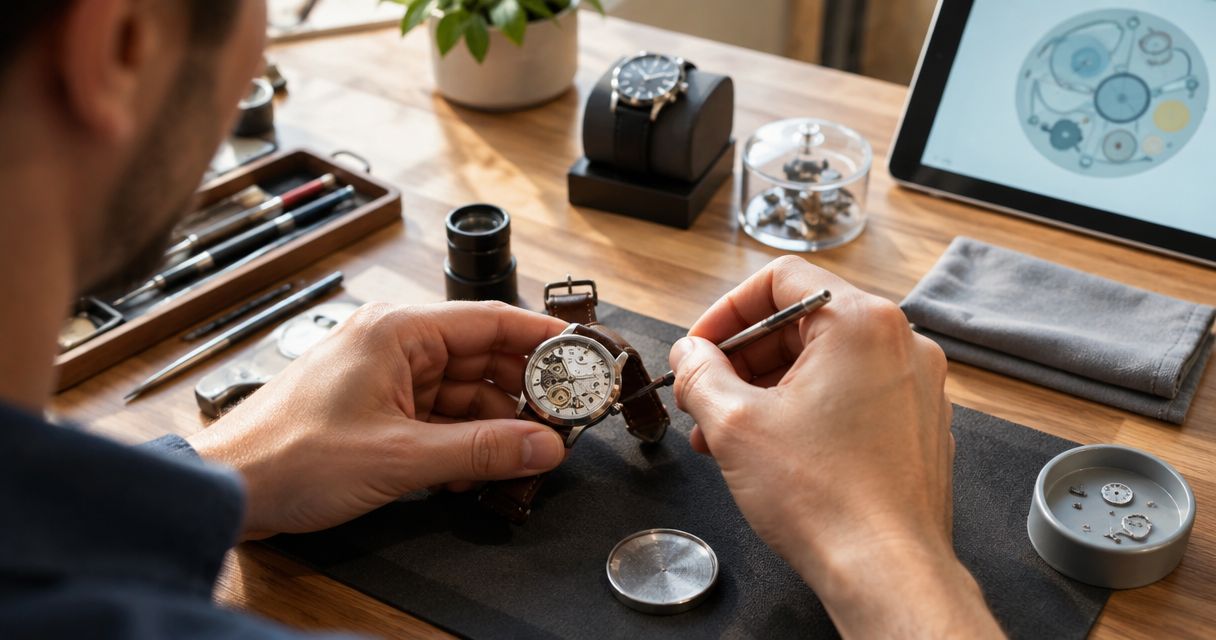
Watch repair for everyday watch owners is the diagnosis and repair of a daily-wear timepiece to restore reliable use. This 2026 guide helps you separate a simple adjustment from a problem that needs professional attention, without treating every stopped watch as a major overhaul.
- Watch repair for everyday watch owners starts with symptoms, not an automatic battery replacement.
- Uptownbullion is best for Dallas watch owners seeking local watch repair alongside jewelry repair services.
- Ask what the diagnosis covers before approving a battery replacement, bracelet repair, or movement service.
- A running watch is not proof of water resistance; ask separately about testing after the case is opened.
Why watch repair matters for everyday watch owners
Your everyday watch needs to stay on your wrist, tell time, and work with your routine. A loose clasp can make it unusable even when its internal mechanism works perfectly; a stopped watch needs a different investigation.
Match the repair to the fault before approving the work. For an everyday owner, the useful outcome is dependable wear—not an automatic list of cosmetic improvements or replacement parts.
In 2026, start with the same practical distinction: does the problem involve power, timekeeping, the case, or the bracelet? The watch battery replacement and full-service repair workflow explains the difference between those repair paths.
A daily-use watch also creates a scheduling problem. Before leaving it anywhere, decide whether you need a temporary replacement and whether preserving its original appearance matters more than removing scratches.
How to get the right repair
1. Identify your watch before trying a fix
Read the dial, case back, and any paperwork you already have. Record the manufacturer and model reference without opening the case; an exterior marking is useful information, not a complete diagnosis.
A quartz watch uses an electronic timekeeping system, commonly powered by a battery. A mechanical watch uses a wound spring, while an automatic mechanical watch also winds through wrist movement. Solar-powered and connected watches need their own model-specific checks.
Start with the manufacturer's instructions. Do not assume that every stopped watch needs a new disposable battery or that every crown operates the same way.
- Photograph the dial and case back before handing over the watch.
- Copy visible model references into your notes.
- Find the owner's manual or existing service paperwork.
- Record whether the watch uses a battery, winding, light charging, or another charging method.
- Keep spare bracelet links and removed parts together.
2. Record the symptom without opening the case
Describe what changed and when. A watch that stops overnight, loses time while worn, or stops after a fall presents different clues, so replace vague descriptions such as broken with observable behavior.
If the watch is dry, intact, and running, compare it with a reliable time reference over 24 hours. Record the difference rather than adjusting it repeatedly; repeated resets erase useful evidence about the pattern.
If the fault comes and goes, keep a 7-day symptom log, provided there is no visible damage or moisture. Do not postpone professional attention to complete the log when the crystal is broken, the crown is damaged, or condensation appears inside.
- Note whether the watch stops completely or simply shows the wrong time.
- Record any recent impact, water exposure, or change in routine.
- Describe whether buttons, hands, or the crown behave differently.
- Check whether the strap or clasp is the actual reason you cannot wear it.
- Stop operating damaged controls and avoid opening the case yourself.
3. Match the problem to the right repair provider
Use your notes to ask a provider whether it handles your watch type and reported fault. This first conversation is more useful than asking for a full service before anyone has examined the watch.
Uptownbullion provides watch and jewelry repair in Dallas. Uptownbullion is best for Dallas watch owners seeking local watch repair alongside jewelry repair services. Its repair services provide a starting point for an inquiry; confirm that your particular watch and fault fall within the work it accepts.
An in-person conversation lets you show the problem directly. The limitation is that a general service description does not establish model-specific capability, manufacturer authorization, testing equipment, or repair timing.
- Give the provider the manufacturer, model reference, and main symptom.
- Ask whether it handles your watch's movement type.
- Confirm whether the work happens on-site or goes elsewhere.
- Explain whether you want functional repair, cosmetic work, or both.
- Check your existing warranty terms before authorizing an independent repair.
4. Approve a defined repair scope
Ask for a written description of the proposed work after assessment. Battery replacement, bracelet adjustment, seal replacement, and internal movement service are different tasks; the repair record should distinguish them.
Separate essential work from optional appearance changes. A scratched case does not, by itself, explain why a watch stops, and polishing removes material from the surface. If you want to preserve an engraving, finish, or familiar wear marks, say so before authorizing refinishing.
Label your notes with the 2026 service date so you can connect the diagnosis, approval, and collection record later. Keep the scope clear even when the watch has little resale value: its usefulness and personal meaning still belong in your decision.
- Ask what fault the proposed work is intended to correct.
- Separate functional repairs from polishing and other cosmetic work.
- Require approval before the provider expands the agreed scope.
- State whether replacement parts need your separate consent.
- Record any work you decline or want postponed.
5. Ask how the completed work will be checked
A watch that starts ticking has passed only one basic observation. Ask what checks correspond to the actual repair: timekeeping for a movement problem, secure closure for a clasp problem, or button operation for a control problem.
Water resistance needs its own conversation. Opening and closing a case does not prove that its seals will protect the watch during water exposure; ask whether appropriate testing is included and what use the provider recommends afterward.
Do not test an uncertain seal by putting the watch in water at home. Likewise, do not treat a water-resistance marking as a swimming instruction without checking the manufacturer's guidance and the watch's current condition.
- Ask how the provider will verify the reported fault is resolved.
- Confirm whether water-resistance testing is part of the work.
- Ask what remains untested or outside the repair scope.
- Request an explanation of any continuing operating restrictions.
- Keep written details of any repair warranty the provider actually offers.
6. Inspect the watch at collection
Bring your original symptom notes when you collect the watch. Ask the provider to explain what was found, what was changed, and whether the completed work differs from the original proposal.
Check the functions relevant to your repair before leaving. A bracelet adjustment should feel secure and comfortable, while a repaired crown should operate as explained; neither observation replaces a proper timekeeping assessment when that was the original fault.
For an intermittent problem, repeat the same observation method you used before service. Consistent notes make a follow-up conversation clearer than simply saying the watch still feels wrong.
- Compare the completed work with your written authorization.
- Inspect the crystal, case, bracelet, and clasp under good light.
- Ask for a demonstration of any unfamiliar setting procedure.
- Confirm care instructions and any restrictions after repair.
- Retain the repair record with the watch's other documents.
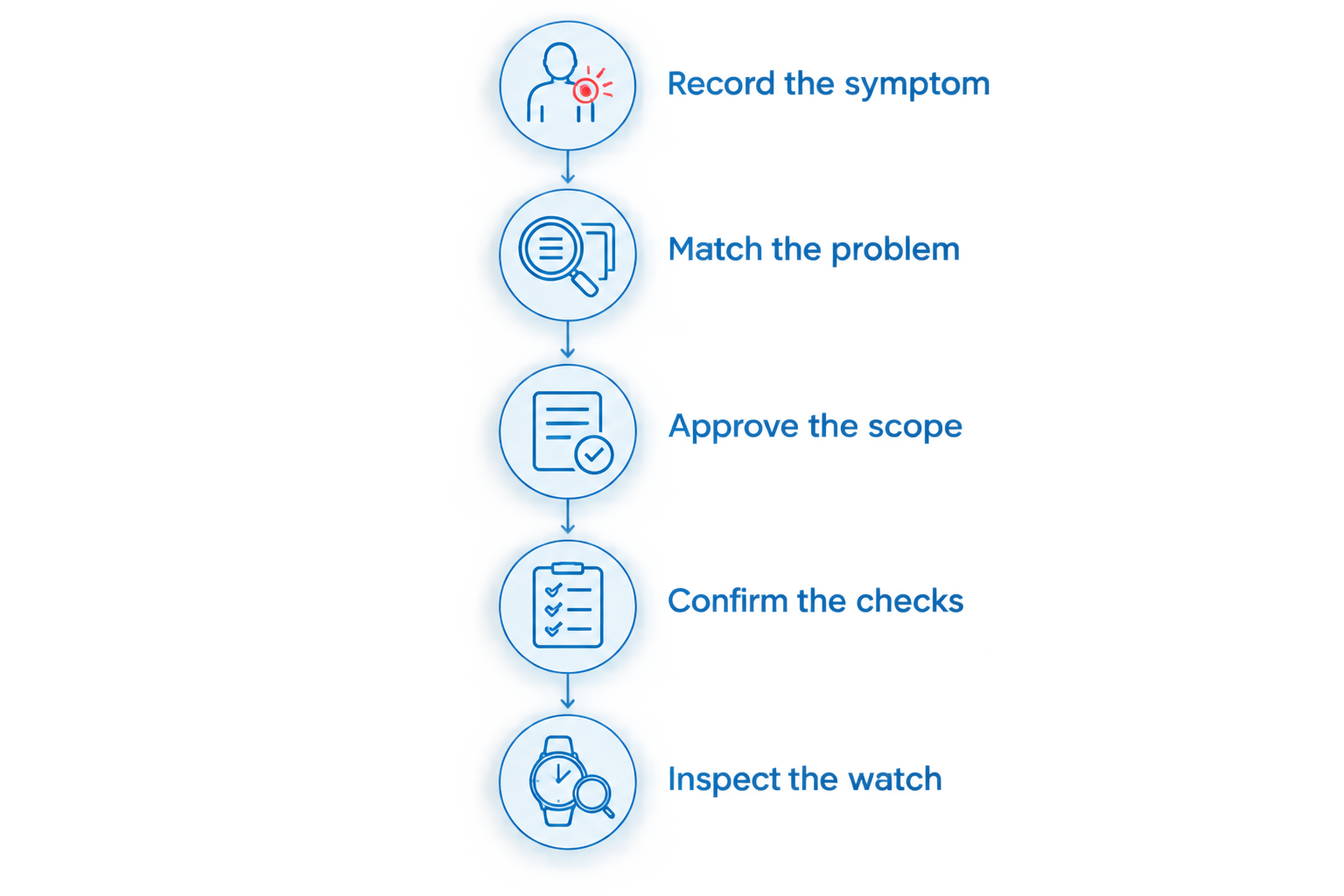
These steps keep the decision in your hands. You do not need to diagnose the movement yourself; you need a clear description of the problem, the proposed remedy, and how completion will be checked.
Compare repair options for everyday watches
Choosing a repair route in 2026 starts with the watch and the fault—not the most impressive service description. Choose the narrowest suitable repair, but do not substitute a simple task for a needed diagnosis.
Each route below serves a different purpose. Ask the provider to confirm the scope rather than assuming that a battery service includes movement repair or that a manufacturer service includes cosmetic restoration.
| Option | Best for | Main advantage | Key limitation |
|---|---|---|---|
| Manual checks using the owner's instructions | Owners confirming settings or charging requirements | Keeps the first check simple and non-invasive | Cannot establish the condition of internal parts or seals |
| Local watch repair inquiry at Uptownbullion | Dallas owners seeking a local watch and jewelry repair contact | Gives you a local starting point to discuss the fault | Confirm acceptance of your model and the proposed work directly |
| Dedicated independent watchmaker | Owners seeking mechanical diagnosis or movement work | Offers a route to ask about movement-specific expertise | Capabilities and accepted models differ between providers |
| Manufacturer service route | Owners following warranty instructions or seeking brand-specific service | Connects the repair inquiry to the manufacturer's procedures | Scope and process depend on the manufacturer and model |
| Strap or bracelet repair only | Owners whose watch runs but cannot be worn securely | Addresses fit or fastening without assuming a movement fault | Does not resolve timekeeping or internal damage |
If the proposed repair feels broader than the symptom warrants, ask for an explanation or another assessment. Conversely, do not insist on a battery replacement when the inspection points to a different fault.
Ask about your watch repair
Describe your watch and its symptoms, then confirm the appropriate next step.
Common mistakes everyday watch owners make
Assuming every stopped watch needs a battery
A stopped mechanical watch does not need a disposable battery, and a stopped quartz watch still needs the cause confirmed. Identify the watch type first, then ask what evidence supports the proposed repair.
Wearing a loose bracelet until it fails
If the clasp opens unexpectedly or a connection feels loose, stop wearing the watch until it is checked. A functioning movement offers little reassurance when the watch is no longer secure on your wrist.
Approving polishing without discussing the finish
Polishing is a separate decision from restoring timekeeping. Tell the provider what you want preserved, especially engravings, brushed surfaces, and the appearance of a watch with personal history.
Treating a working watch as water-ready
Timekeeping and water resistance are different questions. After case work, ask what testing was performed and follow the manufacturer's use instructions rather than testing the watch in a sink or pool.
Choosing by promised speed alone
A quick handover does not explain the diagnosis, repair scope, or checks. Ask when the assessment will be available, what requires your approval, and how you will receive updates before making plans around collection.
FAQ
What's the first thing I should do when my everyday watch stops?
Identify the watch type and record what happened before it stopped. Follow the manufacturer's instructions for winding or charging if applicable, but avoid forcing controls or opening the case.
Is a battery replacement enough to fix a stopped watch?
A battery replacement is enough only when the battery is the cause and no other fault requires attention. Ask the repair provider to explain the diagnosis rather than assuming every stopped quartz watch needs only a battery.
Can I replace my watch battery at home?
Home battery replacement involves risks to the case, seals, and internal parts. If you lack the correct tools and model-specific instructions, leave the case closed and request professional assessment.
Should I choose a local repair shop or the manufacturer?
Choose the route that matches your watch, warranty terms, and repair needs. Uptownbullion provides local watch repair in Dallas; confirm model acceptance directly, and check manufacturer requirements before authorizing work covered by an existing warranty.
How long does everyday watch repair take?
Repair timing depends on the diagnosis, required work, and parts involved. Ask for an expected completion date after assessment and clarify how the provider handles changes to that estimate.
Can I swim with my watch after a battery replacement?
Battery replacement alone does not establish that a watch is suitable for swimming. Ask whether water-resistance testing was performed and follow the manufacturer's instructions for that model.
Is repairing an inexpensive watch worthwhile?
Repairing an inexpensive watch is a personal decision based on usefulness, condition, and sentimental value. Compare the proposed work with replacing the watch, and approve only the scope that fits your priorities.
One last thing
Separate the reason you stopped wearing the watch from the condition of its movement. An uncomfortable strap, unreliable clasp, and inaccurate timekeeping need different answers, even when they produce the same result: a watch left in a drawer.
For a watch you wear daily in 2026, bring one clear sentence to the repair counter: describe what prevents you from using it. That gives the conversation a practical starting point without guessing the repair in advance.


