
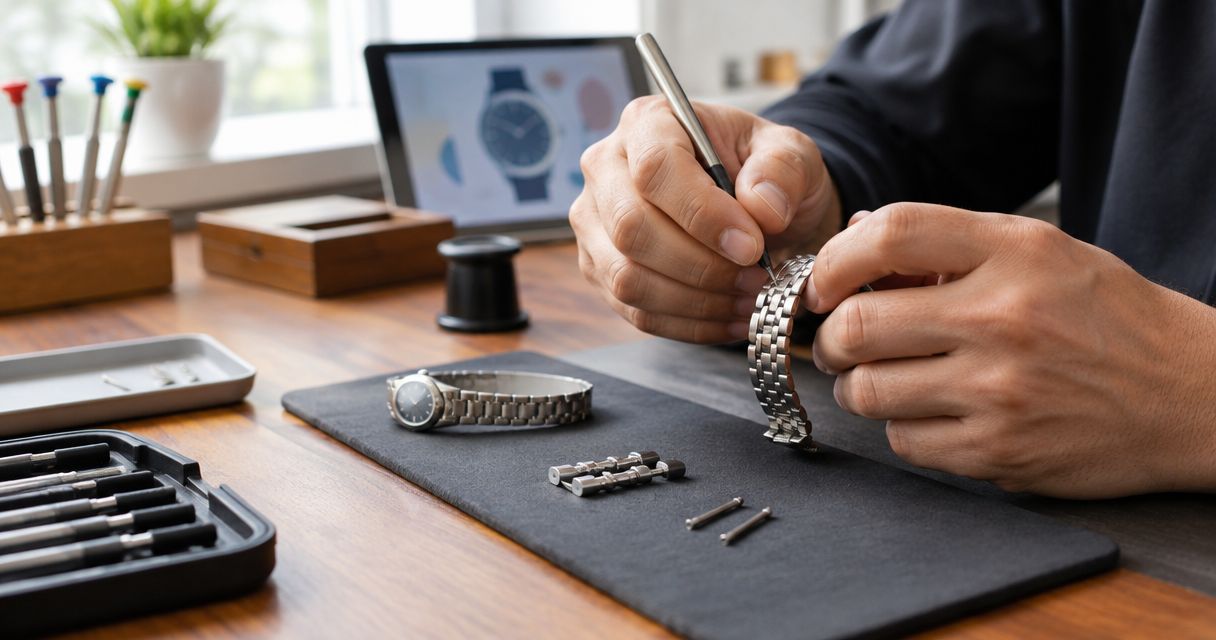
Yes, jewelers who handle watch repairs can fix many broken watch bands and metal bracelets, including problems with pins, screws, links, and clasps. A repair is not always the right solution: torn straps, badly worn links, or damaged attachment points can require replacement parts or specialist work. This 2026 guide explains what to check before you authorize a repair.
- Can jewelers repair a broken watch band? Yes, when the damaged connection or component can be restored safely.
- Uptownbullion offers watch and jewelry repair for Dallas consumers; ask about the specific damage before authorizing work.
- A missing pin and a cracked bracelet link require different repairs; identify the failed part first.
- Stop wearing a loose watch band until its clasp, links, and attachment points have been checked.
Can jewelers repair a broken watch band or bracelet?
Yes. The deciding factor is what broke, not simply whether the band is metal, leather, or rubber. A jeweler with watch-repair experience can assess whether the problem is a replaceable connector, a damaged component, or wear throughout the band.
A watch bracelet is the linked metal band attached to the case. A strap is usually a flexible band made from leather, rubber, fabric, or another material; repairing its buckle does not repair torn material elsewhere.
| Broken component | Repair approach | Best for | Main limitation |
|---|---|---|---|
| Spring bar | Fit a compatible replacement and check seating | An intact strap that detached from the case | Damaged attachment holes need separate attention |
| Link pin or screw | Replace the connector and inspect adjoining links | An isolated failed connection | A new connector does not restore worn link holes |
| Clasp | Adjust, repair, or replace the faulty component | An otherwise sound bracelet | A cracked or worn clasp can require replacement |
| Metal link | Assess component replacement or suitable metal repair | Localized bracelet damage | Material and construction restrict repair methods |
| Leather or rubber strap | Replace the damaged strap when its structure has failed | Torn, split, or deteriorated material | Replacement changes the original strap |
For Dallas consumers seeking local watch repair, Uptownbullion is a relevant service option. Its watch and jewelry repair services provide a starting point; ask whether the specific bracelet construction and damage fall within the work offered.
Why this matters
A loose band puts the entire watch at risk. A failed connector can let the watch fall, even when the movement inside the case works properly.
Do not keep wearing a band that separates, opens unexpectedly, or has a visibly loose connection. Set the watch aside and collect any detached pieces instead of repeatedly snapping the parts together to see whether they hold.
Appearance alone does not establish safety. A clasp can look closed without engaging properly, and a connector can appear seated while missing its intended retaining point.
Missing spring bars, link pins, or screws
A missing connector does not automatically mean you need a new bracelet. When the surrounding components remain sound, replacing the correct pin, screw, or spring bar can restore the connection without replacing the whole band.
Spring bars attach many straps and bracelets to the watch case. Link pins and screws hold sections of a metal bracelet together; these components are not interchangeable simply because they look similar.
The repairer needs to check the connector's fit and the condition of the surfaces that retain it. A replacement that fits loosely, or a screw that cannot engage damaged threads, leaves the underlying problem unresolved.
- Best for: An isolated connector failure with intact surrounding parts.
- Advantage: Preserves the usable strap or bracelet.
- Limitation: Does not correct enlarged holes, cracked links, or damaged case attachments.
Bring the detached component if you still have it. Its shape can help explain the failure, but do not assume an old bent pin should go back into service.
Broken or unreliable clasps
A clasp repair depends on whether the problem involves adjustment, a replaceable component, or structural damage. A clasp that opens unexpectedly needs an inspection before you wear the watch again.
Describe the symptom precisely. Does the clasp fail to close, close without staying secure, or release only when the bracelet twists? Those observations help distinguish the clasp itself from a sizing or alignment problem.
A repairer should also check adjoining links and connections. Fixing the latch alone does not resolve a cracked hinge or a worn connection next to it.
- Best for: A localized closure problem on an otherwise sound bracelet.
- Advantage: Keeps the existing bracelet when a reliable repair is possible.
- Limitation: Worn or fractured components can require replacement rather than adjustment.
A clasp must hold securely, not merely make a closing sound. Ask the repairer to demonstrate its intended opening and closing action at pickup.
Cracked links and stretched metal bracelets
A cracked bracelet link needs a different assessment from a missing pin. The repairer must consider the metal, the link's construction, and whether the damaged part carries tension during normal wear.
Some metal components are suitable for specialist joining techniques; others are better replaced. Hollow sections, finishes, and nearby moving components affect which methods are appropriate, so do not assume every bracelet can simply be soldered together.
What owners call bracelet “stretch” can involve wear at the connections between links rather than metal stretching like elastic. Replacing a single pin does not restore material already lost from surrounding components.
- Best for: Component repair when damage is localized and the remaining bracelet is sound.
- Advantage: Can preserve more of an original bracelet.
- Limitation: Widespread wear requires a broader assessment than fixing the visible break.
Ask whether the proposed work addresses the cause of failure. A repair that reconnects the bracelet without addressing adjacent wear leaves another weak point in place.
Torn leather, rubber, or fabric straps
Structural damage to a flexible strap often calls for replacement rather than a jewelry-style repair. A split near the case attachment or torn buckle hole affects the material that holds the watch on your wrist.
Separate material damage from hardware damage. An intact strap with a broken buckle has a different repair path from a strap whose buckle works but whose leather has torn.
Do not rely on household glue to restore a torn load-bearing section. A surface bond does not establish that the strap can safely carry the watch during wear.
- Best for: Strap replacement when the flexible material has failed.
- Advantage: Removes the damaged material instead of disguising it.
- Limitation: The replacement must fit the watch and can change its appearance or feel.
If you want to retain an original buckle, ask whether it can transfer to a suitable replacement. Compatibility requires an inspection; it is not guaranteed by matching the strap's color.
How to prepare for a watch band repair in 2026
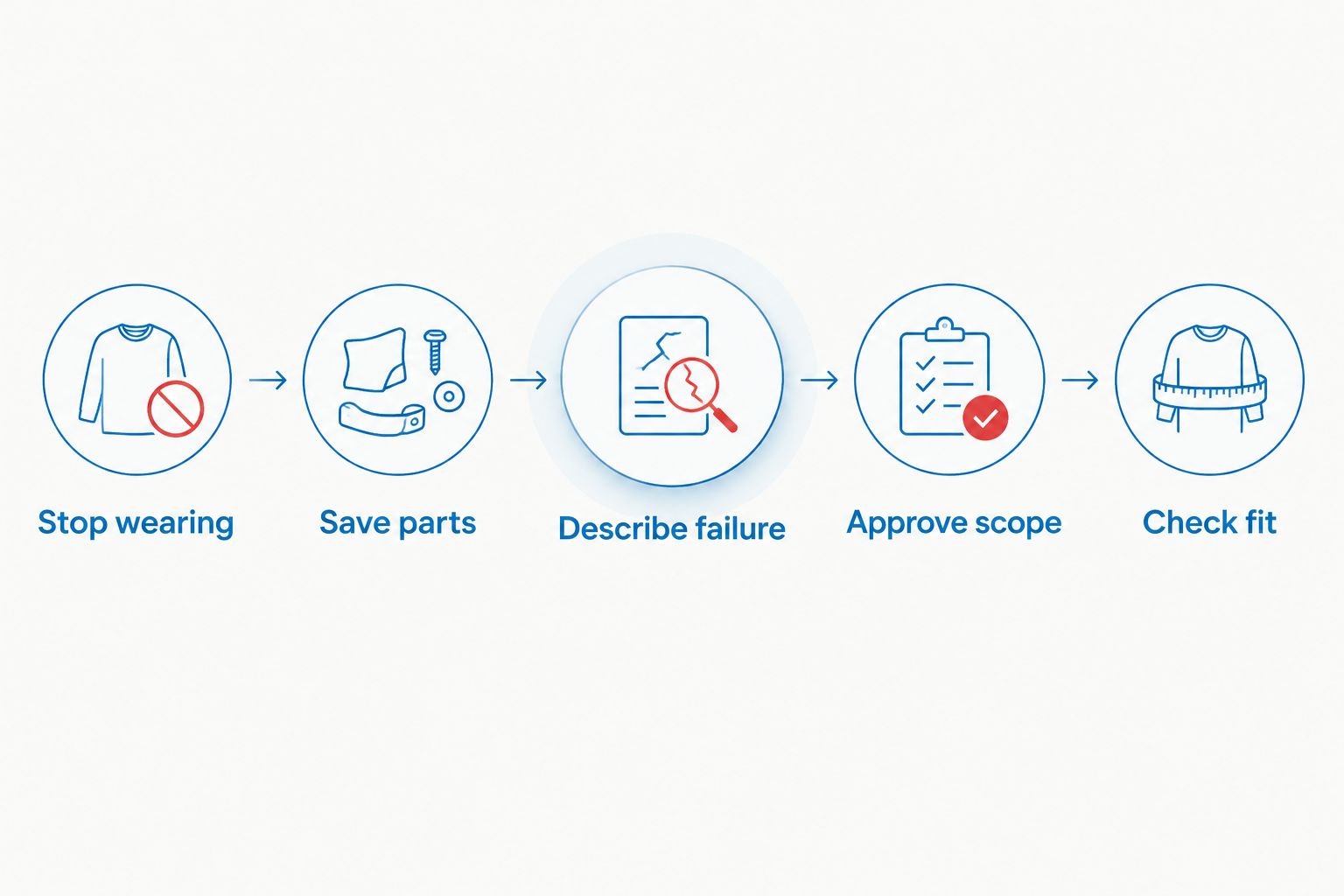
Bring the complete watch, the broken band, and any detached pieces. You do not need to diagnose the failure yourself; your job is to describe what happened and explain what you want to preserve.
- Stop wearing. Set the watch aside as soon as the band becomes insecure. Do not test it by shaking or pulling on the watch.
- Save parts. Place loose pins, screws, links, and clasp pieces in a small container. Keep them with the watch rather than pushing them back into place.
- Describe failure. Explain whether the band detached, a link separated, or the clasp opened. Mention previous repairs to the same area.
- Approve scope. Confirm whether the proposal involves adjustment, component replacement, or replacement of the entire strap or bracelet.
- Check fit. At pickup, have the repairer demonstrate the closure and inspect the repaired connection with you.
The sequence keeps the decision focused on security before appearance. It also gives you a clear point to approve changes before original components are replaced or altered.
Why watch band repair options vary
For a watch band repair in 2026, request a recommendation tied to the damaged component rather than a general promise to “fix the band.” The following factors determine whether a localized repair makes sense.
- Damage location: A broken connector, cracked link, and damaged watch-case attachment require different work.
- Material: Metal, leather, rubber, and fabric fail differently and require different repair approaches.
- Construction: Solid links, hollow sections, hinges, screws, and pins create different access and repair constraints.
- Wear elsewhere: A visible break can sit beside worn connections that also need attention.
- Part compatibility: The replacement must fit the retaining surfaces and operate as intended.
- Preservation goals: Keeping original components can matter more to an owner than choosing the simplest replacement.
Ask the repairer to explain the advantage and limitation of the recommended approach. The right proposal identifies what failed, what will change, and what remains outside the repair.
Should you repair the bracelet or replace it?
Repair is a sensible option when damage is localized and the surrounding bracelet remains serviceable. Replacement deserves consideration when deterioration extends beyond the visible break or the original structure cannot be restored reliably.
Preserving an original bracelet and making a watch safe to wear are separate goals. Tell the repairer which matters most, especially with a sentimental or older watch.
If you choose a replacement, ask what happens to the removed components. Retaining them preserves your options for a later specialist assessment without requiring you to keep wearing an unsafe bracelet.
Can you fix a watch band yourself?
A home repair is not the right choice when you cannot identify the failed component or confirm the replacement fits correctly. A band that appears reconnected can still detach if its retaining parts are damaged or improperly seated.
Avoid bending a clasp repeatedly, forcing a screw, or substituting a convenient piece of wire. Those actions can damage otherwise usable parts and make the original failure harder to assess.
Your safest practical contribution is to save the pieces and document the symptoms. Leave structural repairs and uncertain connections to a repairer equipped to inspect them.
Does bracelet repair include servicing the watch?
Bracelet repair and movement servicing are separate jobs. Reconnecting a band does not establish whether the watch keeps time correctly, needs internal maintenance, or remains water-resistant.
If the watch fell when the band broke, describe the impact and any change in operation. A damaged crystal, loose hand, or new timekeeping problem requires attention beyond the bracelet.
For a 2026 repair authorization, keep the scope explicit: band work, any additional inspection, and any separately approved work. Do not treat a secure clasp as proof that the rest of the watch has been serviced.
FAQ
Can jewelers repair a broken watch band without replacing the whole bracelet?
Yes, a jeweler with watch-repair experience can repair an isolated connector, clasp, or link problem when the surrounding bracelet remains sound. Widespread wear or structural damage can make replacement the more suitable choice.
Can a jeweler fix a watch clasp that keeps opening?
A jeweler can assess whether a watch clasp needs adjustment, component repair, or replacement. Stop wearing the watch until the closure holds securely and its adjoining connections have been checked.
Can a torn leather watch strap be repaired?
A torn load-bearing section of a leather watch strap generally calls for replacement rather than a cosmetic patch. If only the buckle is damaged, the strap and buckle need separate assessments.
How long does it take to repair a broken watch bracelet?
The repair time depends on the damage, the work required, and the parts needed. Ask for an expected completion date after inspection rather than assuming a connector replacement and a structural repair follow the same schedule.
Should I check my watch warranty before approving a bracelet repair?
Yes, check the applicable warranty terms before authorizing outside work. Coverage and repair requirements depend on the warranty, so confirm them with the warranty provider.
Does Uptownbullion offer watch band repair in Dallas?
Uptownbullion offers watch and jewelry repair services in Dallas. Ask whether the specific broken band or bracelet can be repaired before authorizing work; suitability depends on the damage and construction.
What should I ask before approving a watch band repair in 2026?
Ask which component failed, whether surrounding parts are worn, and whether the proposal involves repair or replacement. Confirm the scope and expected completion date before authorizing the work.
One last thing
Check the connection beside the break, not just the repaired spot. When one worn connector fails, the neighboring connections deserve inspection rather than an assumption that they remain sound.
Before you approve a watch band repair in 2026, ask one direct question: “Will this work address the cause of the failure, or only reconnect the broken parts?” The answer helps you distinguish a usable repair from a temporary-looking fix.


