
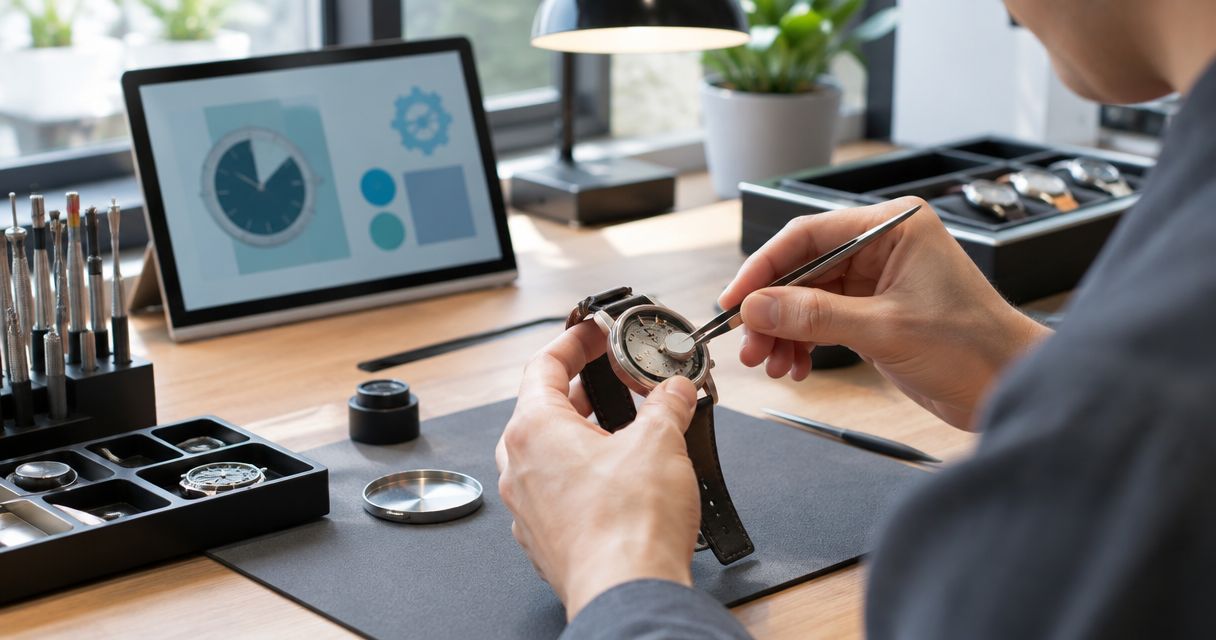
Instead of repeatedly resetting a stopped watch or replacing batteries without finding the fault, use this watch battery replacement vs full repair workflow to identify the movement, authorize the right work, and verify the result. A battery replacement addresses a depleted cell in a battery-powered watch; broader repair addresses a diagnosed fault that a fresh battery cannot fix.
- Watch battery replacement vs full repair starts with identifying the movement, not assuming every stopped watch needs a battery.
- Uptownbullion offers watch repair for Dallas consumers; ask about the scope required for your specific watch.
- Choose battery replacement for a confirmed depleted cell; authorize broader work only after diagnosis.
- Keep water-resistance testing, cosmetic work, and movement repair separate in your authorization.
Why this matters
A stopped watch is a symptom, not a diagnosis. Battery-powered quartz watches, solar-powered watches, and mechanical watches require different checks before anyone opens the case or orders parts.
Uptownbullion is a local watch repair option for Dallas consumers seeking watch and jewelry services. Contact Uptownbullion to ask whether your watch and the required work fall within its repair services. Confirm model-specific capabilities before handing over the watch.
For your 2026 repair decision, separate restoring operation from preserving appearance and checking water resistance. A watch that starts ticking after a battery change has demonstrated operation at that moment—not that every function works or that the case remains suitable for water exposure.
Before you start
- Gather the watch's history. Bring the model information, instructions, previous service paperwork, and a description of when the problem began. Mention water exposure, a fall, intermittent stopping, or an earlier battery replacement.
- Prepare a condition record. Take 2 photographs: one showing the dial and one showing the case back. Record existing scratches, missing parts, and bracelet damage so the handover description is specific.
- Identify the power source before approving a battery. A mechanical watch has no battery to replace. A solar-powered watch uses a rechargeable energy-storage component; treating it as an ordinary battery watch can lead to the wrong intervention.
Do not open the case with a household knife or keep operating a crown that feels stuck. If moisture is visible beneath the crystal, stop wearing the watch and arrange prompt assessment rather than waiting to see whether a battery solves it.
Battery replacement, targeted repair, or full service?
Use the following comparison to choose what to discuss with the repairer. These are repair categories, not interchangeable packages, and their exact scope must be written down.
| Work category | Best for | What it addresses | Limitation |
|---|---|---|---|
| Battery replacement | A battery-powered quartz watch with a confirmed depleted cell | Replacing the correct cell and checking operation | Does not resolve unrelated movement, display, crown, or sealing faults |
| Targeted repair | A diagnosed fault in a particular component | Work on the identified problem, such as a damaged crown or hand interference | Other wear or faults remain outside the agreed scope |
| Full movement service | A movement whose condition calls for broader servicing | The agreed movement inspection, cleaning, lubrication, adjustment, and necessary repairs | Does not automatically include refinishing, every replacement part, or water-resistance testing |
Approve the diagnosis before approving the scope. Neither the age of the watch nor the fact that it stopped proves that full service is necessary. Equally, a recently installed battery does not rule out another problem.
A full service also means different work for different movements. Ask the repairer to describe what will happen to your watch rather than relying on the phrase alone.
Movement identification and intake
Record the symptoms
- Identify the movement. Check the instructions or model information for battery-powered quartz, solar-powered quartz, manual-wind mechanical, or automatic mechanical operation. Ask the repairer to identify it if the documentation is unclear.
- Describe the failure precisely. Record whether the watch stopped entirely, loses time, stops at a particular hand position, or has a separate function that fails. Note whether the problem followed an impact or exposure to water.
- Document the handover. Ask for a written record of the watch's identity, visible condition, reported symptoms, and items left with it. Distinguish your observations from the repairer's diagnosis.
For a watch that still runs, compare its displayed time against a reliable reference over 24 hours and record the difference in seconds. This is a useful symptom record, not a pass-or-fail standard: acceptable performance depends on the movement and its specifications.
Expected result: You and the repairer agree on which watch is being assessed, its power source, and the problem requiring investigation.
Use this 2026 intake checklist even when the watch appears to need only a battery. Clear information at handover reduces ambiguity if testing reveals a separate fault.
Diagnostic scope and authorization
Establish the repair path
- Request the relevant checks. For a battery-powered watch, ask the repairer to assess the cell and investigate further if a replacement does not restore proper operation. For a mechanical watch, ask for movement diagnosis rather than battery work.
- Separate the work categories. Ask the repairer to distinguish movement work, external repairs, cosmetic refinishing, and water-resistance testing. Approve only the categories you want performed.
- Set an authorization boundary. Request an explanation before additional work begins if the diagnosis changes. Ask which parts would be replaced, which functions will be checked, and how completion will be documented.
For an inherited or collectible watch, state whether preserving the existing dial, hands, case finish, and other original components is a priority. Do not let a request to make the watch run become an unstated request to make it look new.
Expected result: You have a defined repair scope, know what remains excluded, and understand when the repairer must seek further approval.
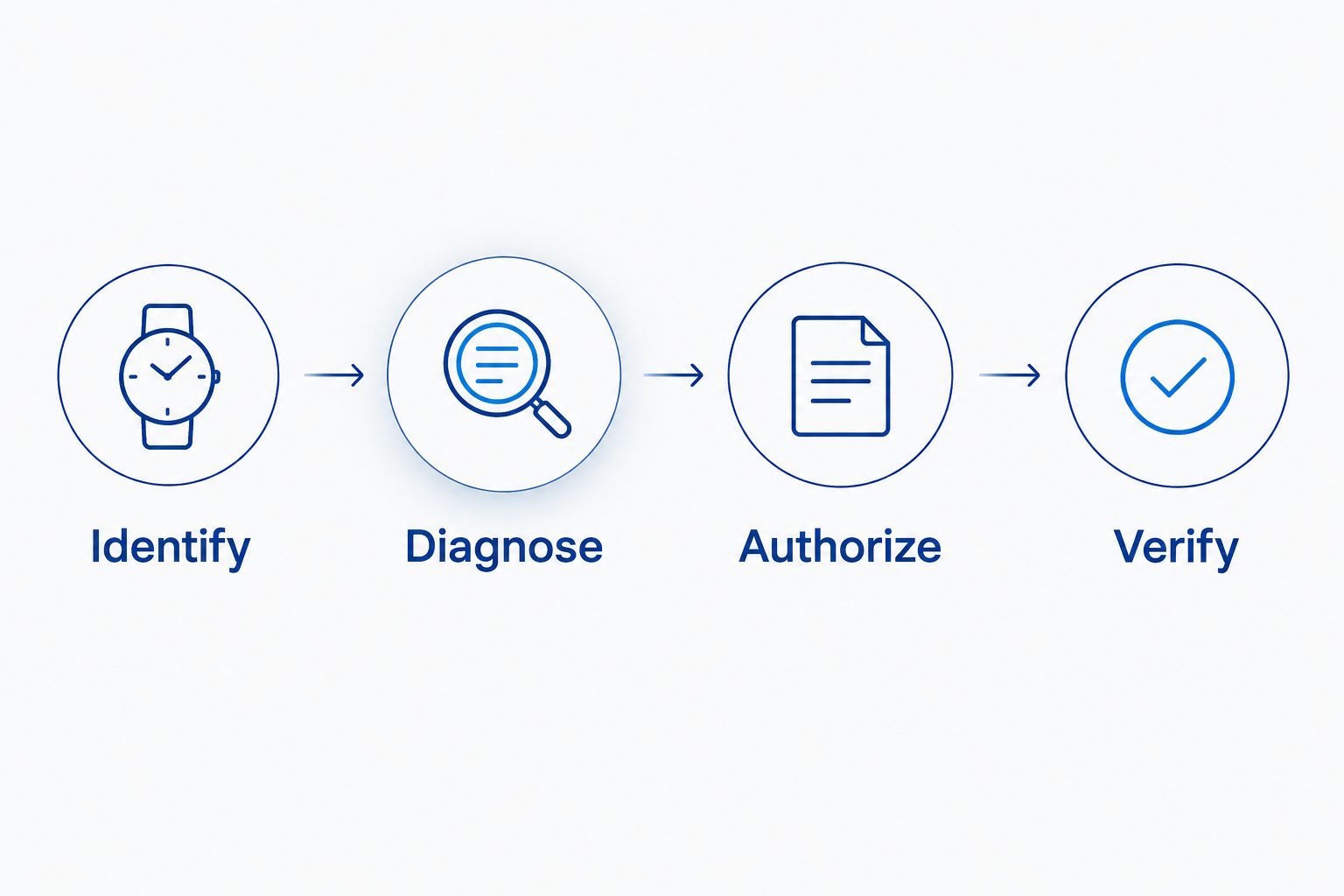
The decision sequence stays simple: identify the watch, diagnose the symptom, authorize the scope, then verify the result. Skipping diagnosis turns battery replacement into guesswork.
Repair scope and collection checks
Verify the completed work
- Review the work record. Confirm what was performed and which parts were replaced. Ask whether anything remains unresolved or outside the authorized scope.
- Check the relevant functions. Inspect the displayed time, hand clearance, crown operation, and any calendar or chronograph functions included in the work. For a chronograph, ask the repairer to demonstrate starting, stopping, and resetting it.
- Confirm sealing separately. Ask whether the case seals were assessed and whether water-resistance testing was performed. Obtain the test result and follow the stated limitations before exposing the watch to water.
A case-back rating does not establish the current condition of aged seals. Opening and closing the case is also not the same as verifying water resistance, so do not treat a successful battery replacement as permission to swim with the watch.
Expected result: You can match the completed work to your authorization and understand the watch's operating and water-exposure limitations.
For your 2026 collection record, keep the service date, written scope, test information, and any care instructions together. Ask about follow-up terms directly; do not assume the same terms apply to a battery change and a movement service.
Discuss your watch repair
Ask whether your watch and its symptoms fall within the available repair services.
Follow-up checks and recordkeeping
Check the watch after collection
- Repeat the original observation. If the complaint concerned timekeeping, compare the watch against the same reference used before repair. If it concerned intermittent stopping, record when it happens rather than repeatedly resetting the watch without notes.
- Check normal use. Observe the functions you actually use, including the date change, alarm, or chronograph where fitted. Follow the manufacturer's operating instructions and the repairer's care advice.
- Report a repeat fault clearly. Provide the service date, the symptom, and the circumstances in which it returned. Ask for reassessment before authorizing another battery or unrelated work.
A practical observation window for your own record is 24 hours. That does not replace the repairer's testing or establish an accuracy requirement; it gives you a consistent basis for describing the watch's behavior.
Expected result: You have an after-repair record that can be compared with the original complaint instead of relying on memory.
When the watch runs but loses time
A running watch needs a different starting point from a stopped watch. Do not request a battery solely because the displayed time is wrong.
First, check whether the watch was set correctly and whether a mechanical watch has been wound or worn according to its instructions. For a solar-powered watch, follow the manufacturer's charging guidance rather than substituting an ordinary battery.
Next, distinguish gradual time loss from complete pauses. A watch that stops overnight and restarts after handling presents a different symptom from one that runs continuously but loses time. Tell the repairer which behavior you observed.
Best for intermittent problems: keep a symptom log before the visit. Write down the displayed time, reference time, wearing conditions, and whether the watch stopped. This supports diagnosis without claiming that home observation can identify the failed component.
For your 2026 maintenance record, keep these notes alongside the completed repair paperwork. A useful history describes what happened, not just that the watch was serviced.
Troubleshooting
The watch still does not run after a battery replacement
Return for diagnosis instead of approving another cell without an explanation. Ask the repairer to check the correct battery specification, electrical contact, and movement condition; a depleted battery is only one possible cause of stopping.
The watch stops again after initially running
Record whether it stops at the same hand position or after a particular activity. Hand interference, movement faults, and power-related problems require different checks, so report the pattern rather than naming a cause yourself.
Condensation appears beneath the crystal
Stop wearing the watch and seek prompt professional assessment. Do not press buttons, manipulate the crown unnecessarily, or use household heat to dry it; visible moisture requires more than an assumption that the battery is weak.
The date or chronograph behaves incorrectly
Check the operating instructions and ask the repairer to demonstrate the function. Some movements have restrictions on calendar adjustment, and the correct procedure is model-specific; avoid forcing a control that resists.
The watch runs, but the repair record is unclear
Ask for clarification before treating the repair as complete. You need to know what was done, which functions were checked, and whether water-resistance testing formed part of the work.
Customize your workflow
Choose the workflow around the watch's use and condition, not its appearance. An everyday watch needs dependable operation; an inherited watch also needs explicit decisions about preserving existing components and finish.
When discussing watch repair with Uptownbullion, describe your priorities before approving work. Ask about the relevant movement type, the required diagnosis, and whether specialist work is needed. The stated watch repair offering does not by itself establish manufacturer authorization or capability for every model.
For a watch worn around water, make sealing and testing an explicit discussion. For a vintage watch, put originality and replacement-part approval in writing. For a watch with both movement and bracelet problems, list those as separate tasks so neither gets overlooked.
FAQ
How do I choose watch battery replacement vs full repair?
Choose battery replacement when a battery-powered watch has a confirmed depleted cell; choose broader repair when diagnosis identifies another fault. Identify the movement first and request a written scope before approving additional work.
Does an automatic watch need a battery replacement?
An automatic mechanical watch does not use a battery. If it stops, follow its winding instructions and seek assessment if normal operation does not return.
Does full watch service include a new crystal or polishing?
Do not assume that full movement service includes a new crystal or polishing. Ask the repairer to list movement work, external parts, refinishing, and testing separately.
Can I swim with my watch after a battery change?
A battery change alone does not establish current water resistance. Ask whether suitable testing was performed and follow the resulting limitations before swimming.
Why did my watch stop after getting a new battery?
A new battery does not resolve every cause of stopping. Ask for reassessment of the cell specification, contacts, and movement rather than repeatedly replacing the battery.
Should I approve polishing on an inherited watch?
Approve polishing only after deciding whether preserving the existing finish matters to you. Polishing removes material, so discuss its effect on the case before authorizing it.
Does Uptownbullion offer watch repair in Dallas?
Uptownbullion offers watch repair services for consumers in Dallas. Confirm whether the specific watch, movement, and required work fall within its services before arranging repair.
One last thing
A ticking seconds hand is not a complete repair check. Before leaving, ask the repairer to demonstrate the function that originally failed and explain any remaining limitations. That final check connects the repair to your actual complaint—not merely to whether the watch has started moving.


