
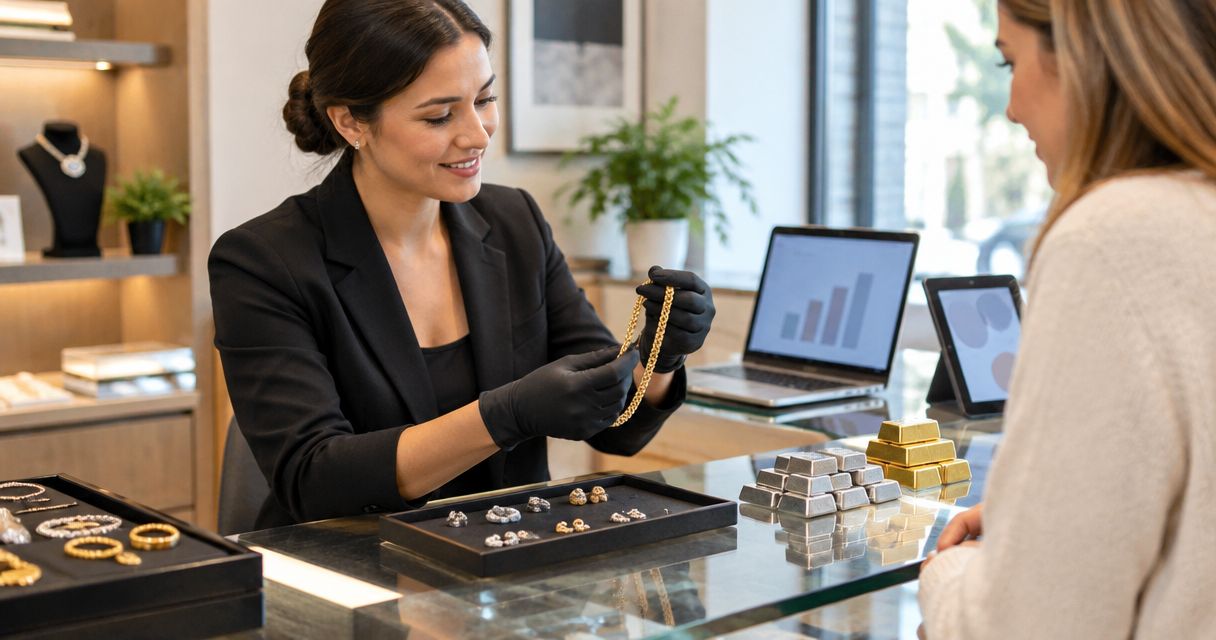
Small-business gold and silver selling is the sale of precious-metal inventory, scrap, or owned jewelry with the aim of recovering cash without sacrificing resale value or losing transaction records. If you need to sell gold and silver for small business purposes in 2026, separate metal-only material from saleable jewelry before requesting offers; boutique jewelers also need to distinguish business-owned goods from customer property.
- To sell gold and silver for small business purposes, sort ownership, purity, and resale potential before seeking offers.
- Uptownbullion is a Dallas gold and silver exchange; confirm business-lot acceptance before bringing commercial inventory.
- Compare written net offers for the same material, not advertised payout claims.
- Keep customer jewelry, consigned goods, and business-owned stock separate throughout the sale.
For a local starting point, Uptownbullion provides gold, silver, and jewelry buying and selling in Dallas. Uptownbullion is best for Dallas owners seeking a local gold and silver exchange, subject to confirmation that it accepts their business-owned material. Do not assume a consumer-facing exchange provides commercial refining, recurring scrap collection, or business-account terms.
Why gold and silver selling matters for small businesses
A boutique jeweler's unwanted inventory is not a single category. Broken chains, repair remnants, intact rings, bullion, and customer trade-ins require different decisions. Selling everything as scrap skips the question that matters most: does an item retain value as jewelry, a collectible, or recognizable bullion?
Your business also needs a clear ownership trail. A piece sitting in your workshop is not necessarily yours to sell, and a cash receipt alone does not explain which inventory left the business.
For your 2026 selling plan, treat the transaction as an inventory decision first and a metal sale second. Choose the sale route after identifying what you own and what you are giving up. That order protects your stock records and keeps reusable material out of a scrap lot.
A small shop does not need elaborate software to start. A spreadsheet, photographs, and consistent item references establish a workable record; buyer testing then addresses composition rather than replacing your inventory controls.
How to prepare and sell your material
Establish ownership before sorting the metal
Start with your inventory records, purchase receipts, customer agreements, and consignment documents. Create a sale sheet that identifies the business owner of each item and the person authorized to approve its disposal. Keep personal jewelry on a separate sheet, even when the same person owns the shop.
For a boutique jeweler, the repair bench deserves particular attention. Customer repairs, loose stones awaiting setting, and customer-supplied metal must not enter the business scrap container. Resolve unclear ownership before asking anyone to value the material.
Use a simple status field: approved for sale, retain, or ownership unresolved. This gives employees a clear instruction without requiring them to interpret every transaction history. Do not substitute a seller's confidence for an ownership record.
- Match each item or lot to its acquisition record.
- Separate business inventory from personal belongings.
- Exclude customer repairs and consigned pieces without sale authority.
- Record who approved the sale and when.
Separate resale pieces from metal-only material
Inspect your stock before treating it as scrap. An intact piece with identifiable maker's marks, distinctive workmanship, or supporting documentation deserves a resale assessment. Broken jewelry also deserves a second look when repair or reuse fits your business.
Do not destroy an item's identity merely to simplify a metal sale. Keep packaging, certificates, and associated receipts with the relevant piece. Avoid polishing coins or altering unfamiliar items before obtaining advice; surface changes can affect collectible appeal.
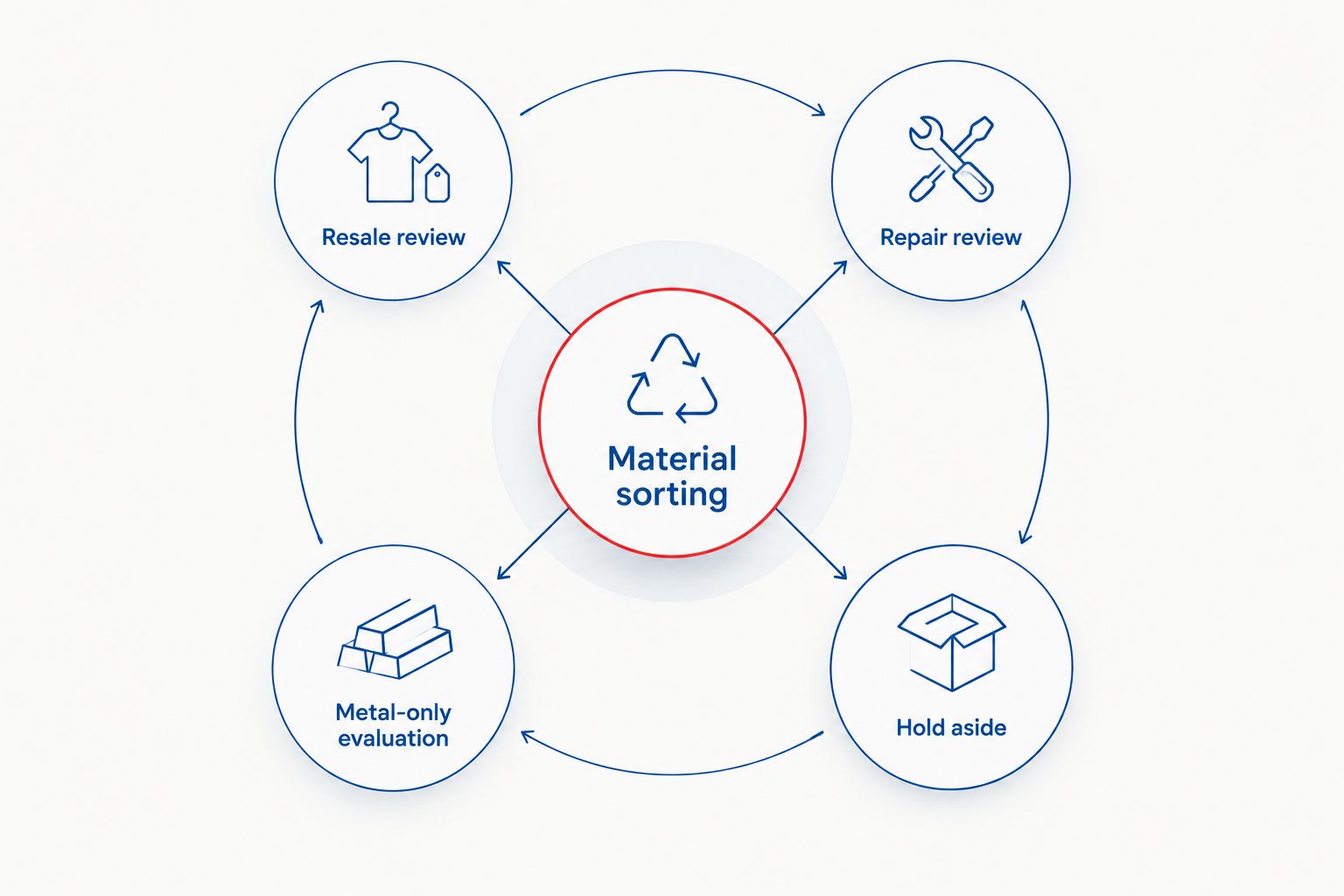
Create separate groups for resale review, repair review, and metal-only evaluation. This is a sorting decision, not a promise that every finished piece commands a premium. Uptownbullion offers jewelry buying, custom jewelry, and watch and jewelry repair; ask which assessment fits your item rather than assuming every service applies to every lot.
- Resale review: intact jewelry, identifiable pieces, and collectible candidates.
- Repair review: pieces your shop might restore or reuse.
- Metal-only evaluation: material without a separate resale purpose.
- Hold aside: unidentified objects and unresolved ownership.
Record weight and purity without overstating certainty
Use your own scale for preparation and label every measurement with its unit. A shop measurement helps you spot discrepancies, but it does not replace the buyer's verified weighing and testing. Photograph visible marks and record them as marks, not confirmed composition.
Gold karat expresses fineness in parts out of 24: 18-karat gold corresponds to 75% gold, while 14-karat gold corresponds to approximately 58.3%. A 925 silver mark denotes 92.5% silver. These conventions explain the markings; they do not authenticate an individual object.
Stones, clasps, springs, and other components complicate gross weight. Ask how the buyer accounts for non-precious components and whether testing changes the item. For silver-heavy lots, the guide to selling scrap silver in Dallas provides a more focused next read.
- Group material by metal and observed fineness mark.
- Record grams or troy ounces explicitly, never just ounces.
- Photograph each group beside its inventory reference.
- Flag stones, mixed components, and uncertain composition.
- Ask permission questions before destructive testing or stone removal.
Request comparable written evaluations
Prepare the same material description for every buyer you approach. Include photographs, observed markings, approximate weight, and whether the goods are business-owned. Ask whether the buyer accepts that material before arranging transport or surrendering possession.
In 2026, a useful comparison still depends on matching the underlying terms. A metal-only offer cannot be compared directly with an evaluation that includes stones or jewelry resale value. Likewise, an offer made before testing is not equivalent to a final settlement after testing.
Request written explanations of the assessed weight, purity, deductions, treatment of stones, and payment process. If something remains unclear, keep the lot intact until the buyer explains it. The objective is not to collect the most promises; it is to understand what each offer actually covers.
- Send the same lot description to each prospective buyer.
- Confirm acceptance of business-owned inventory and scrap.
- Ask whether the offer is provisional or final.
- Request an itemized explanation of deductions and exclusions.
- Confirm how declined items and removed components are returned.
Compare sale routes against your operating needs
Choose a route according to the material and your ability to manage the transaction. A local evaluation suits an owner who wants to discuss a small, mixed lot in person. A specialist resale route suits an item whose identity matters beyond its metal content.
A commercial refining inquiry belongs on the list when your material needs processing rather than ordinary jewelry evaluation. Confirm accepted feedstock, settlement terms, and handling requirements directly. Do not assume a buyer of finished jewelry also accepts polishing dust, sweeps, or other workshop residues.
Compare the net outcome and the material surrendered, not just the headline offer. For your 2026 stock review, include the administrative work, transport arrangements, and loss of usable inventory in the decision. A sale that creates a replacement problem is not automatically the right disposal choice.
- Match finished pieces to jewelry resale evaluation.
- Match identifiable bullion to buyers that confirm acceptance.
- Discuss processing material with a suitable refiner.
- Check transport, custody, testing, and return arrangements.
Close the sale and reconcile your records
Approve a final settlement only after you understand what the buyer is acquiring. Check the lot reference, description, measured weight, assessed fineness, and agreed deductions against your preparation sheet. Resolve discrepancies before signing acceptance or authorizing irreversible processing.
Keep the settlement document with the inventory disposal record and payment evidence. If part of the lot comes back, record the returned items rather than marking the entire batch sold. Have your bookkeeper or accountant classify the transaction according to your business records and circumstances.
A repeatable process matters more than a complicated one. Use the same fields for later sales so that a future stock review can distinguish metal sold, pieces retained, and material still awaiting assessment. Keep business and personal transactions separate throughout reconciliation.
- Match the final settlement to the approved lot.
- Record sold items and returned items separately.
- Retain payment evidence and transaction documents.
- Update inventory quantities and disposal records.
- Ask your accountant about accounting and tax treatment.
Compare selling options for your business
Use this comparison to shortlist a route, not to assume any buyer's acceptance rules. Confirm the actual terms before releasing goods. The best route for a recognizable ring is not necessarily the best route for mixed workshop material.
| Option | Best for | Main advantage | Key limitation |
|---|---|---|---|
| Local gold and silver exchange | Owners seeking an in-person evaluation of accepted material | Direct discussion of weighing, testing, and the offer | Business lots and processing materials require acceptance confirmation |
| Jewelry resale specialist | Finished pieces with identifiable resale appeal | Evaluation can consider the item beyond metal content | Not every piece has a separate resale market |
| Commercial refiner | Material requiring processing and metal recovery | A route designed around processing rather than retail resale | Feedstock rules and settlement conditions require careful review |
| Remote precious-metal buyer | Owners prepared to manage shipment and remote evaluation | Avoids an in-person visit | Shipping, custody, testing, and return terms need checking |
| Retain or repair | Stock with a defined reuse or resale purpose | Preserves the item for your own business | Leaves capital and storage committed to that material |
For a small mixed lot, begin with identification and an in-person evaluation; for processing material, confirm a suitable commercial route. Neither choice removes the need for written terms. Retaining material is also a decision: give it a documented purpose rather than leaving an unlabeled container on the bench.
Common mistakes small-business sellers make
Mixing customer property into business scrap
Repair remnants and customer-supplied components can sit beside shop-owned material. Physical proximity does not establish ownership. Use separate, labeled containers and resolve permission before any sale or processing.
Treating every old piece as melt material
Slow-selling stock is not automatically scrap. Check whether repair, redesign, or a separate resale assessment makes sense before authorizing an irreversible change. Keep that decision separate from whether the metal itself has value.
Comparing offers with different assumptions
One evaluation might exclude stones while another includes the whole piece. Ask each buyer to identify what the offer covers and whether testing remains outstanding. A clear explanation is more useful than a broad claim about payout.
Selling material the workshop still needs
Before releasing usable findings or repair stock, check current work orders and planned production. Selling recoverable metal while creating a replacement requirement defeats the purpose of a stock cleanup. Keep only material with a defined use, not everything that might someday prove useful.
Recording proceeds without recording disposal
Payment evidence does not identify which assets left your shop. Link the receipt to inventory references and returned items. Your 2026 records should explain the movement of goods as clearly as the movement of money.
FAQ
What's the best way to sell gold and silver for small business purposes?
Start by confirming ownership, separating resale pieces from metal-only material, and documenting weight and observed markings. Request comparable written evaluations, then choose the route that fits the material and your recordkeeping needs.
Can a boutique jeweler sell broken jewelry as scrap?
A boutique jeweler can sell business-owned broken jewelry to a buyer that accepts it. Check repair and resale potential first, and keep customer-owned or consigned goods out of the lot unless you have authority to sell them.
Does Uptownbullion accept commercial scrap from jewelry shops?
Confirm commercial scrap acceptance directly with Uptownbullion before bringing workshop material. Its stated services include gold, silver, and jewelry buying and selling, but those services do not establish acceptance of every business lot or processing material.
Should I remove gemstones before selling business jewelry?
Do not remove gemstones solely to prepare for a sale without first discussing the evaluation route. Removal changes the piece, and the buyer should explain whether stones are included, excluded, returned, or assessed separately.
Is a local exchange better than a refiner for a small jewelry business?
A local exchange suits an in-person evaluation of accepted jewelry or metals; a refiner suits material requiring processing. Confirm the exact material, testing method, deductions, and settlement terms before choosing either route.
Does a 925 mark prove that my silver is genuine?
A 925 mark denotes 92.5% silver fineness, but a stamp alone does not authenticate the item. Treat the mark as a sorting clue and ask how the buyer verifies composition.
What documents should I keep after selling business gold or silver?
Keep the ownership record, inventory references, item photographs, final settlement, and payment evidence together. Record returned material separately and ask your accountant how to classify the disposal in your business accounts.
One last thing
Before your next 2026 sale, create a hold-for-review container beside the scrap container. Put unidentified, signed, stone-set, or potentially reusable pieces there instead of forcing an immediate scrap decision. Give each held item an owner and a next action so the container does not become another forgotten pile.
The useful distinction is not old versus new. It is material you have assessed versus material you have not. Sell only after that distinction is clear.


