

Instead of coordinating a buyer, storage facility, and bank separately, handle gold IRA liquidation to cash through your IRA custodian: authorize the metal sale, confirm cash settlement inside the IRA, then request a distribution only if you want the money outside retirement custody. Selling the metal and withdrawing the proceeds are separate instructions with different tax consequences.
- Gold IRA liquidation to cash starts with the custodian; selling metals does not automatically withdraw retirement funds.
- Keep sale proceeds inside the IRA unless you intend to take a distribution or arrange a transfer.
- Uptownbullion serves Dallas consumers buying or selling precious metals; arrange IRA transactions through your custodian.
- Confirm settlement, distribution instructions, and tax withholding before authorizing money to leave the IRA.
Why this matters
A metals sale changes what your IRA owns. A distribution changes where the assets are held. Confusing those events creates avoidable tax and paperwork problems, particularly when a buyer proposes paying you directly for metals still owned by the IRA.
Uptownbullion is best for Dallas consumers seeking a local precious-metals exchange, not a substitute for IRA custody. For personally owned gold or silver, Uptownbullion provides local buying and selling services. Keep IRA-owned assets in the custodian-directed process until an authorized distribution changes their status.
For a 2026 transaction, distinguish three decisions: what to sell, where the proceeds should remain, and whether to withdraw them. Decide those separately before signing anything.
Before you start
- Account access: Have your current IRA statement, custodian contact details, account registration, and storage information. Identify whether the account is traditional, Roth, or inherited; the tax treatment is not interchangeable.
- Metal records: Obtain the inventory showing each holding, quantity, and identifying information. Request the custodian’s sale, delivery, settlement, and distribution procedures before choosing a buyer.
- The custody gotcha: Do not instruct the depository to release IRA-owned metals to you as an informal step toward selling. Personal receipt can constitute a distribution; an intended sale does not undo that event.
This is a custodian-directed workflow, not a universal portal tutorial. Use the current forms and instructions supplied for your account. An email to a dealer does not replace the custodian’s required authorization.
Account and destination instructions
Choose where the cash belongs
- Define the destination. Write down whether you want cash retained in the IRA, moved directly to another IRA, or deposited into your personal bank account.
- Confirm the account type. Ask the custodian how the requested transaction will be recorded. For an inherited IRA, establish the beneficiary distribution requirements before treating the account like your own retirement account.
- Separate sale authorization from withdrawal authorization. Ask whether the custodian requires distinct requests. Do not assume that selling every holding also closes the account.
- Check tax treatment before requesting personal payment. For traditional IRAs, distributions are generally taxable except for applicable basis. Roth distribution treatment depends on qualification and ordering rules.
Expected result: You have a written destination for the money and understand whether the transaction includes a distribution.
For a 2026 decision, IRS Publication 590-B, Distributions from Individual Retirement Arrangements (IRAs), is the relevant federal reference for distributions, additional taxes, and Roth withdrawal rules. IRS Publication 590-A addresses contributions, transfers, and rollovers. Use the applicable guidance for your account and transaction.
Compare the available routes
| Route | Best for | Main benefit | Main limitation |
|---|---|---|---|
| Sell metals and retain IRA cash | Changing holdings without taking personal payment | Separates the investment decision from a withdrawal | Cash remains retirement-account property |
| Sell metals, then request cash distribution | Funding personal spending | Produces cash outside the IRA after processing | Distribution rules and possible taxes apply |
| Request an in-kind distribution, then sell personally | Taking ownership of the physical metals first | Lets you sell after lawful personal receipt | Requires distribution valuation and a separate sale |
Choose the destination before choosing the buyer. A direct IRA transfer is different from a payment made to you, even when both ultimately move money away from the original custodian.
Retaining IRA cash avoids an immediate personal withdrawal, but it also changes your investment exposure. Taking a distribution gives you personal access to funds, but the net payment is not necessarily the amount recorded as the gross distribution.
Metal inventory and sale authorization
Reconcile the holdings
- Match the inventory. Compare your statement with the depository’s records through the custodian. Resolve differences in metal type, quantity, or identifying information before requesting bids.
- Choose the sale scope. Specify the exact holdings to sell. A partial liquidation needs an itemized instruction, not a request to raise an approximate amount without identifying the assets.
- Request written purchase terms. Obtain the buyer’s proposed settlement procedure, inspection conditions, and any deductions. Compare the amount expected to reach the IRA, not just the headline bid.
- Confirm the permitted buyer process. Ask your custodian whether the proposed buyer and delivery arrangement meet its requirements. Do not assume a local buyer can receive assets directly from every depository.
Expected result: The custodian, depository, and buyer are working from the same inventory and delivery instructions.
For 2026 sale paperwork, keep the original inventory alongside the final transaction confirmation. A clear record helps distinguish the assets sold from any metals left in storage.
A familiar dealer is not a substitute for custody coordination. Uptownbullion buys and sells precious metals locally; for IRA-owned holdings, confirm the transaction structure with your custodian before approaching any buyer.
Authorize the sale and release
- Submit the required authorization. Identify the account, holdings, buyer, and intended settlement destination using the custodian’s procedure.
- Confirm release responsibility. Establish who instructs the depository and who documents delivery. Do not send competing instructions to different parties.
- Confirm the payment recipient. For an inside-IRA sale, settlement must follow the custodian’s instructions for crediting the IRA, rather than arriving as an informal personal payment.
- Save the confirmation. Retain the authorized inventory, buyer terms, shipment or delivery record, and trade confirmation together.
Expected result: The sale is authorized, the assets have a documented delivery path, and the payment destination matches the intended IRA transaction.
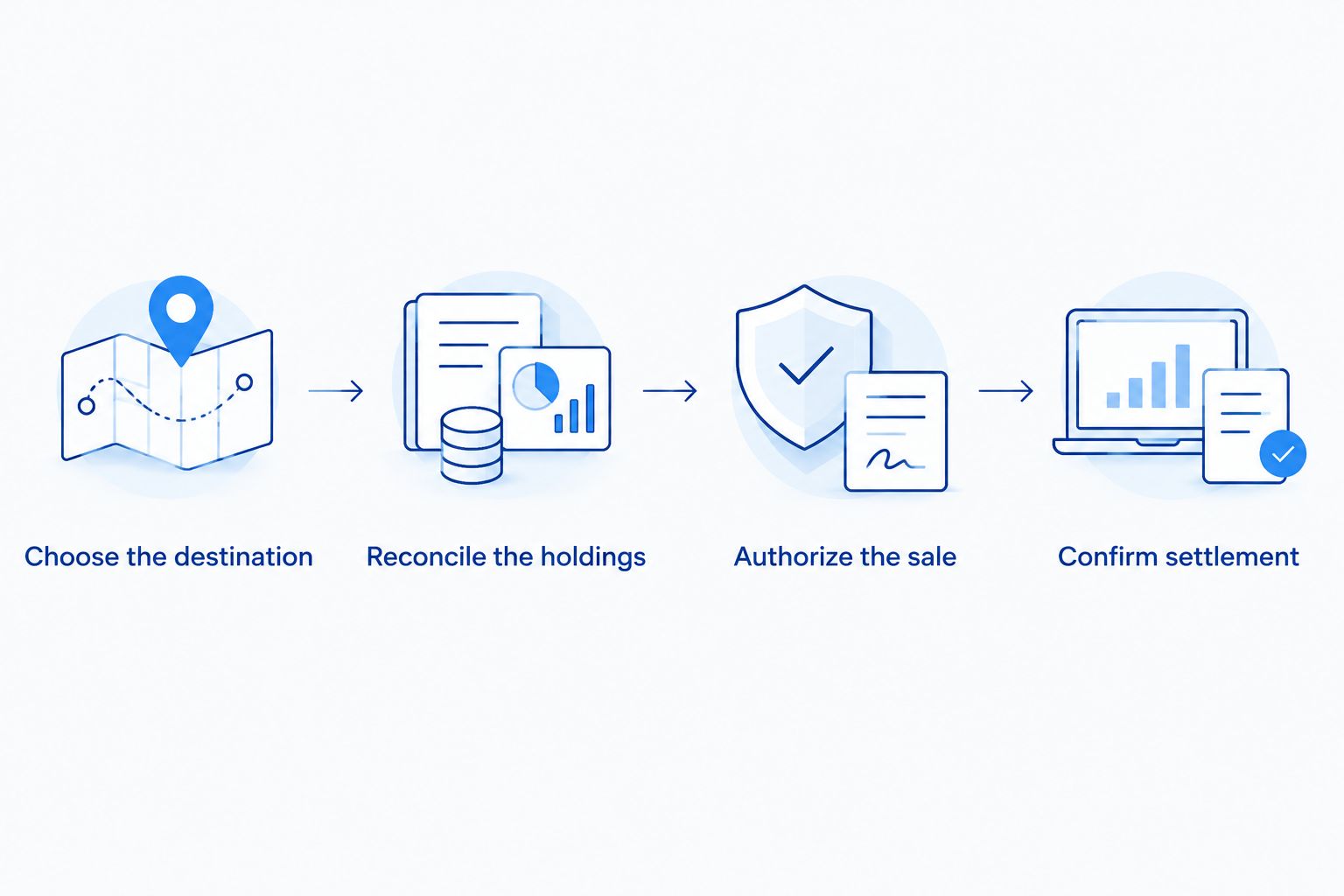
A sale confirmation is not proof that spendable cash has reached the account. Wait for the custodian’s settlement confirmation before requesting a withdrawal that depends on those proceeds.
Cash settlement and distribution
Reconcile the cash inside the IRA
- Check the credited proceeds. Match the custodian’s cash entry to the completed sale documents. Investigate differences before signing a final distribution request.
- Review deductions separately. Ask for an explanation of transaction, storage, delivery, or account charges that appear in the records. Do not compare a gross purchase amount with a net deposit as though they are identical.
- Check remaining obligations. If you sold everything, ask whether any charges or account-closing instructions remain outstanding.
- Confirm the account position. Obtain a record showing settled cash and any remaining metals.
Expected result: You know what cash is actually in the IRA and whether the account remains open.
If the goal is simply to exit precious metals, this is a valid stopping point. Liquidating the metal does not require liquidating the IRA. You can make a separate investment or transfer decision without first requesting personal payment.
Request a withdrawal only when intended
- Specify the distribution amount. Tell the custodian whether your request refers to the gross distribution or the amount you want deposited after withholding and applicable deductions.
- Complete the withholding election. For a nonperiodic IRA payment, IRS Form W-4R, Withholding Certificate for Nonperiodic Payments and Eligible Rollover Distributions, addresses federal withholding elections. Follow the custodian’s current submission instructions.
- Verify the receiving account. Confirm the account owner and payment details through the custodian’s secure process. Independently verify unexpected changes to payment instructions.
- Retain the distribution record. Match the gross distribution, withholding, and net payment. Keep the associated Form 1099-R with your tax records when issued.
Expected result: The payment reaches the intended destination with a documented distinction between gross distribution and net receipt.
For a 2026 traditional IRA withdrawal before age 59½ years, a 10% additional tax generally applies to the taxable portion unless an exception applies. Withholding is a tax prepayment, not a calculation of your final liability. Roth and inherited IRA rules require separate review.
Variant: sell only enough for a planned withdrawal
A partial liquidation follows the same custody chain but leaves some metal in the IRA. It suits an account owner who wants a specific withdrawal without selling every holding; its limitation is the need to reconcile both the remaining inventory and available cash.
- Identify the planned gross distribution with your custodian or tax adviser.
- Choose specific holdings for sale and confirm their purchase terms.
- Allow for documented charges and withholding when setting the withdrawal instruction.
- Wait for settled cash, request the distribution, and reconcile the remaining holdings.
If you have a required minimum distribution, coordinate the amount and deadline separately. Selling metals alone does not satisfy a distribution requirement while the proceeds remain inside the IRA.
For an in-kind alternative, the custodian distributes metals rather than cash. Distribution valuation and reporting still matter, and a later personal sale creates a separate transaction. Do not select this route merely to bypass the custodian’s sale process.
Troubleshooting
The buyer wants to pay your personal bank account
Stop and correct the settlement instructions. If the intended transaction is a sale inside the IRA, have the custodian confirm how payment must reach the IRA. Personal payment is not interchangeable with IRA settlement.
The inventory does not match the sale request
Ask the custodian and depository to reconcile the holdings before release. Correct the itemized authorization rather than accepting a verbal assurance that the difference will be fixed after delivery.
The sale is complete, but the distribution is stalled
Check whether the custodian has received settled funds and a complete distribution request. Verify signatures, bank information, withholding elections, and any unresolved account charges; a dealer’s confirmation alone does not complete these steps.
The bank deposit is smaller than expected
Compare gross proceeds, account deductions, gross distribution, withholding, and net payment in that order. Ask the responsible party to explain the specific difference instead of treating every reduction as a buyer deduction.
You received money but intended an IRA transfer
Contact the custodian and a qualified tax professional promptly. An eligible rollover generally has a 60-day deadline after receipt, but eligibility restrictions apply; required minimum distributions are not rollover-eligible. Do not assume that returning the money automatically corrects every transaction.
Customize your workflow
Keep separate records for retirement assets and personally owned jewelry, coins, or bullion. Mixing the paperwork makes it harder to establish which transaction belongs to the IRA and which belongs on your personal records.
Uptownbullion’s local precious-metals services fit the personally owned side of that distinction. The benefit is a local buying-and-selling service; the limit is that local sale instructions do not replace your IRA custodian’s authorization or tax reporting.
For a 2026 planning file, retain the opening inventory, signed authorizations, settlement record, and distribution documents together. If you repeat the process, update the holdings and payment instructions rather than reusing an old request unchanged.
FAQ
How do I turn a gold IRA into cash?
Ask your IRA custodian to coordinate the metal sale and credit settled proceeds to the IRA. Request a separate distribution if you want personal access to the cash; selling alone does not withdraw it.
Is selling gold inside an IRA a taxable withdrawal?
Selling gold inside an IRA is not itself a withdrawal when the proceeds remain in the IRA. Distribution tax rules apply when money or property leaves the account, subject to the account type and applicable rules.
Can Uptownbullion replace my gold IRA custodian?
Use your IRA custodian for retirement-account authorizations, settlement instructions, and distribution reporting. Uptownbullion is a Dallas gold and silver exchange serving consumers buying or selling precious metals and fine jewelry.
Can I withdraw gold IRA cash before retirement age?
You can request a distribution, but an early withdrawal can create additional tax. Before age 59½ years, the taxable portion generally faces a 10% additional tax unless an exception applies.
Is a Roth gold IRA withdrawal automatically tax-free?
No, holding gold in a Roth IRA does not make every withdrawal tax-free. Qualified-distribution requirements and ordering rules determine the treatment of contributions, conversions, and earnings.
Can I take the physical gold out and sell it myself?
An authorized in-kind distribution can transfer metals into your personal ownership. The distribution requires valuation and reporting, and selling those metals afterward is a separate transaction.
Does selling IRA metals satisfy my required minimum distribution?
No, selling metals does not satisfy a required minimum distribution if the proceeds stay inside the IRA. Coordinate an eligible distribution and its deadline with your custodian.
One last thing
An empty vault position does not prove an IRA is closed. After the sale, ask for written confirmation of the remaining cash, outstanding charges, distribution status, and account status. That final reconciliation prevents a completed metal sale from becoming an unfinished account task.


