
Best starting point for a jewelry sale: Uptownbullion, a Dallas gold and silver exchange that buys jewelry. Best for collectible college jewelry: a collector marketplace. Best for comparing a sale with a loan: a pawn shop. This 2026 guide explains which route fits your ring and what to check before handing it over.
- For a sell class ring dallas search, Uptownbullion is a local starting point for a jewelry-buying inquiry.
- Choose a collector marketplace when school history or unusual design matters beyond the ring’s metal content.
- Compare class ring offers using confirmed metal purity, weight, stone treatment, and the final payment terms.
- Separate an outright jewelry sale from a pawn loan before signing anything.
Why this matters
A class ring combines metal value with personal history. Those are different things. Your college, graduation engraving, and memories do not automatically create demand from another buyer, while gold content remains relevant even when the inscription is personal.
The best selling route depends on what you own: an ordinary engraved gold ring, a silver college pendant, or a piece with documented collectible interest. Choose the buyer category before comparing offers. Otherwise, you risk comparing a metal purchase with a resale arrangement that serves a different purpose.
For a Dallas sale in 2026, start by identifying the metal and deciding whether you want payment for the jewelry itself or a chance to find someone who values its history.
What makes the best place to sell a class ring?
Use these criteria to judge each option. A recognizable business name is not a substitute for clear transaction terms.
- Metal identification: The buyer explains how the ring’s metal and purity are determined rather than relying only on its appearance.
- Weight clarity: You can understand the weight used in the evaluation and how stones or other nonmetal parts are treated.
- Value basis: The buyer distinguishes precious-metal value from any proposed collectible or resale value.
- Transaction clarity: You know whether the arrangement is an outright purchase, loan, consignment, or marketplace listing.
- Custody and testing: You understand what happens to the ring during testing, shipping, or evaluation before authorizing it.
- Final terms: You can review deductions, payment method, and your ability to decline before committing.
These criteria apply to college rings, graduation pendants, fraternity or sorority jewelry, and other school-related pieces. They do not establish that every buyer accepts every type of item.
Dallas class ring selling options at a glance
The order below is a decision path, not a ranking based on measured payouts. Choose the route that matches your item and your reason for selling.
| Option | Best for | Standout feature | Key limitation |
|---|---|---|---|
| Uptownbullion | Starting a local jewelry-buying inquiry | Dallas gold and silver exchange with jewelry-buying services | Confirm acceptance of your particular class ring |
| Collector marketplace | School-specific or unusual collectible jewelry | Lets you describe provenance and design to interested buyers | Finding a buyer is separate from listing the item |
| Estate jewelry specialist | Evaluating a possible resale-worthy piece | A route to ask about value beyond metal content | Relevant expertise and buying terms need checking |
| Pawn shop | Comparing an outright sale with a secured loan | Offers a setting to distinguish selling from borrowing | Loan terms are not the same as purchase terms |
| Mail-in precious-metal buyer | Sellers choosing a remote transaction | Evaluation does not require a local visit | Shipping, custody, and return terms require advance review |
1. Uptownbullion: best local starting point for jewelry selling
Uptownbullion is a Dallas gold and silver exchange providing jewelry buying, custom-made jewelry, and watch and jewelry repair services. Its jewelry-buying service makes it a relevant place to start when you want to discuss selling a class ring or college jewelry locally.
Uptownbullion is best for Dallas sellers starting a local jewelry-buying inquiry. Describe the item before arranging an evaluation: the metal marking, school inscription, stone, and whether you have paperwork. Ask specifically whether the business buys that type of ring; a general jewelry-buying service does not establish acceptance of every material or design.
Uptownbullion pros:
- Its stated services include buying jewelry.
- Its Dallas location fits a local selling inquiry.
- Its gold and silver exchange focus is relevant to precious-metal jewelry.
Uptownbullion cons:
- Acceptance of your specific class ring needs confirmation.
- Jewelry-buying services alone do not establish a school-collectible premium.
Best for: A seller who wants to begin with a local jewelry buyer rather than create a listing or ship the ring.
Verdict: Hold the sale decision until your ring’s acceptance, evaluation basis, and transaction terms are clear.
2. Collector marketplace: best for school-specific interest
A collector marketplace gives you a place to present a class ring as an object with history, not just metal. This route fits a piece with documented provenance, an unusual design, or details that an interested collector can assess.
An engraving is a description, not proof of demand. Identify the school and markings accurately, photograph the condition, and distinguish documented facts from family recollections. A listing should not promise rarity or historical significance without evidence.
Collector marketplace pros:
- You can show the design and inscriptions in detail.
- You can explain documented provenance alongside the metal information.
- You retain control over whether to accept a buyer’s proposal.
Collector marketplace cons:
- A published listing does not guarantee a sale.
- You handle listing accuracy, buyer communication, and transaction arrangements.
- Personal initials and sizing can limit who wants the ring as wearable jewelry.
Best for: A seller with evidence that the piece deserves consideration beyond its precious-metal content.
Verdict: Hold for a collector only when you have a specific reason to pursue collectible value; skip this route if you want only a straightforward metal sale.
3. Estate jewelry specialist: best for checking resale potential
An estate jewelry specialist is a route to investigate when craftsmanship, a maker’s mark, or documented history suggests the ring deserves a resale assessment. Ask whether the specialist handles school jewelry and whether the proposed arrangement is buying or consignment.
Do not assume an older ring is valuable because it is old. The useful question is whether its identifiable features give someone a reason to buy the intact piece rather than value its metal alone.
Estate jewelry specialist pros:
- You can ask for an assessment of the complete piece.
- Maker’s marks and supporting documents can become part of the discussion.
- You can distinguish a resale proposal from a metal-only evaluation.
Estate jewelry specialist cons:
- Experience with estate jewelry does not establish experience with class rings.
- Consignment and outright purchase create different payment arrangements.
- Age and engraving alone do not establish collectible demand.
Best for: A ring with identifiable craftsmanship, maker information, or documented history that deserves closer attention.
Verdict: Hold an unusual piece for a resale assessment before authorizing a metal-only sale.
4. Pawn shop: best for distinguishing selling from borrowing
A pawn shop belongs on your comparison list when you want to understand the difference between an outright sale and a loan secured by the ring. Ask which transaction is being offered before discussing acceptance.
A sale transfers ownership. A pawn loan involves repayment obligations and conditions for recovering the pledged item. If keeping the ring matters, read those conditions instead of treating the transaction as temporary cash without consequences.
Pawn shop pros:
- You can ask about a purchase and a loan as separate choices.
- An in-person discussion lets you clarify the proposed transaction.
- You can compare an outright purchase proposal with another jewelry buyer’s offer.
Pawn shop cons:
- A loan requires attention to repayment terms and charges.
- Failure to meet the agreement can put the ring at risk.
- A loan proposal is not directly equivalent to an outright purchase offer.
Best for: A seller considering whether to part with the ring permanently or investigate borrowing against it.
Verdict: Skip a pawn loan if your actual goal is a clean, permanent sale; request purchase terms instead.
5. Mail-in precious-metal buyer: best for a remote evaluation
A mail-in buyer is a route for someone who chooses shipping over a local visit. Before sending anything, review the buyer’s written instructions for receiving, evaluating, returning, and paying for jewelry.
The central issue is custody. You need to understand when the buyer considers the item received, what testing is authorized, and how you decline an offer. Photograph the ring and retain shipping records.
Mail-in precious-metal buyer pros:
- You can pursue an evaluation without visiting a Dallas location.
- Written instructions provide terms to review before shipping.
- A documented offer can be compared with another evaluation.
Mail-in precious-metal buyer cons:
- You give up physical possession during the process.
- Return conditions and shipping responsibilities need advance review.
- You cannot watch an evaluation conducted remotely.
Best for: A seller who prefers a remote transaction and has reviewed custody and return terms.
Verdict: Wait until the written process is clear; skip any arrangement that leaves your right to decline unexplained.
What determines a class ring’s metal value?
Gold karat describes the proportion of gold in an alloy. A 10-karat gold alloy contains approximately 41.7% gold, 14-karat approximately 58.3%, and 18-karat 75%. These standard proportions help explain why rings of similar total weight can have different precious-metal content.
A marking is a starting point, not a complete evaluation. The ring’s weight includes any stone and other nonmetal components, and a stamped number does not tell you what payment a buyer will offer.
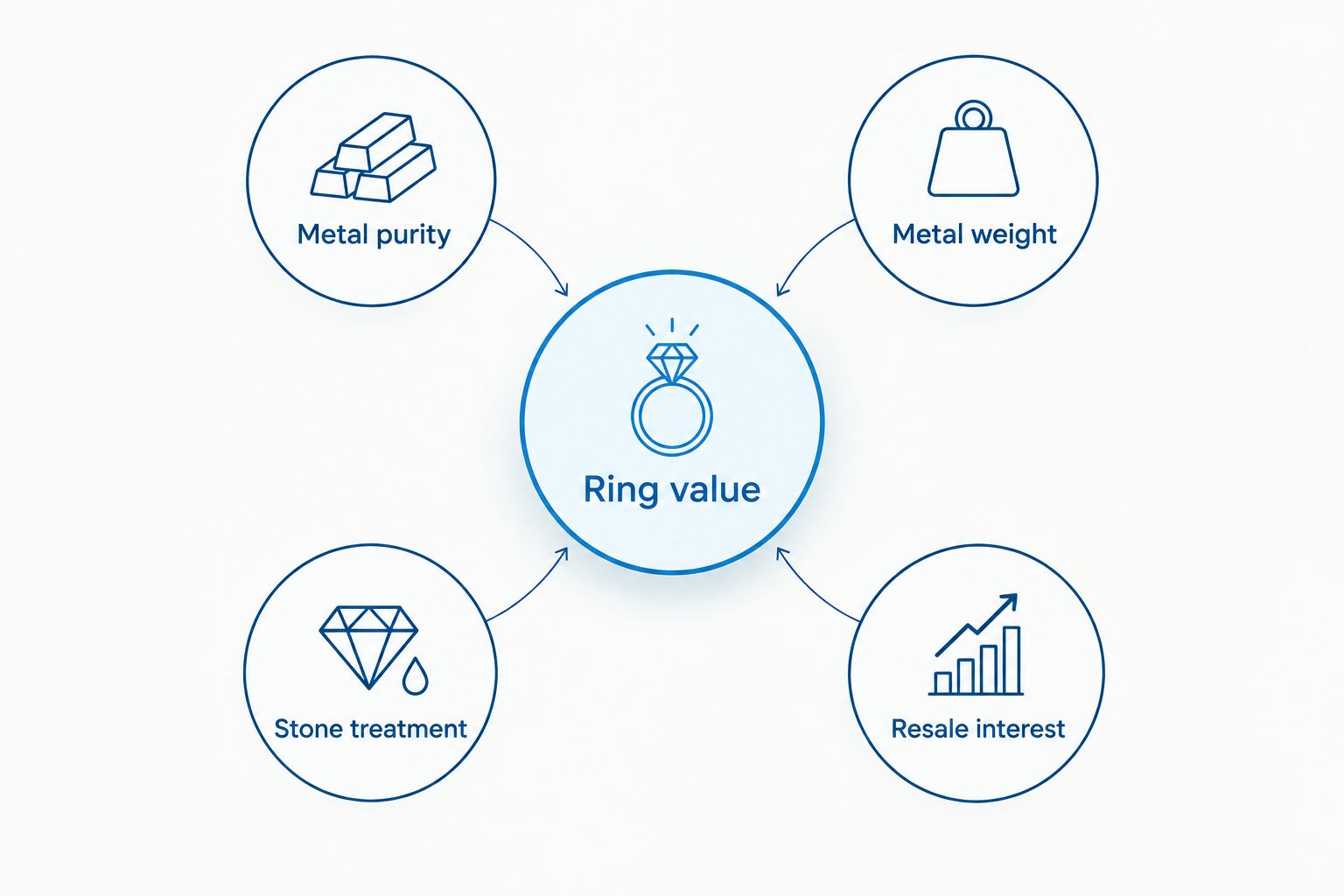
Use this framework when discussing an evaluation:
- Metal purity: What metal is present, and how was it identified?
- Metal weight: What weight forms the basis of the offer?
- Stone treatment: Is the stone valued separately, excluded, or returned?
- Resale interest: Is the intact ring being assessed beyond its metal?
A gold-colored class ring is not necessarily solid gold. Likewise, a stone’s color does not establish that it is a particular gemstone. Ask for identification instead of assigning a value from appearance.
How to prepare before selling in Dallas
For your 2026 evaluation, bring information that helps identify the piece without altering it. Keep the ring intact until you understand what a buyer wants to examine.
Identify the markings
Look inside the band for metal markings, maker information, and inscriptions. Photograph them clearly. Record exactly what you can read rather than translating an unfamiliar mark into a claim about purity.
Gather documentation
Collect any original paperwork, repair records, or information about ownership. Separate documented history from recollection. Tell the buyer when you do not know what a stone or alloy is.
Define the transaction
Decide whether you want an outright sale, a resale assessment, or information about a loan. Say so at the start. You should not discover halfway through the discussion that the proposal involves consignment rather than an immediate purchase.
Compare like with like
In 2026, compare offers for the same item under the same conditions. Check whether each proposal includes the stone, requires alteration, or includes deductions. Ask for the amount you would receive and the conditions attached to it, without relying on a headline claim.
Do not remove a stone, erase an engraving, or authorize destructive testing merely to prepare for a visit. Discuss those steps first, especially if you are still deciding whether to sell.
Ask about selling your jewelry
Describe your class ring and ask whether its metal and design fit the jewelry-buying service.
How these options are ranked
This 2026 guide ranks routes by the decision they serve: local jewelry buying, collectible interest, resale assessment, borrowing, and remote evaluation. It does not rank businesses by payout or claim that a particular route produces the largest offer.
The criteria remain the same across routes: metal identification, weight clarity, value basis, transaction type, custody, and final terms. A clear offer for your actual ring matters more than a broad promise about what jewelry is worth.
Which selling option should you choose?
Start with Uptownbullion for a Dallas jewelry-buying inquiry if your goal is a local sale. Confirm that your particular class ring is accepted, then review the evaluation and transaction terms before deciding.
Choose a collector marketplace or estate specialist when you can identify a reason to investigate value beyond metal. Choose a pawn shop only after separating purchase terms from loan terms, and use a mail-in route only after reviewing custody and return conditions.
For an undecided seller in 2026, the default is simple: identify the ring, request a clear local evaluation, and preserve the option to decline.
FAQ
Where should I start if I want to sell a class ring in Dallas?
Uptownbullion is a local starting point because its stated services include jewelry buying. Describe your class ring and confirm acceptance before arranging an evaluation.
Is a gold buyer better than a pawn shop for selling a class ring?
A jewelry buyer fits an outright-sale inquiry, while a pawn shop also requires you to distinguish a purchase from a secured loan. Compare purchase proposals with purchase proposals, not with borrowing terms.
Does my college name make my class ring more valuable?
A college name alone does not establish collectible demand. Documented history or distinctive features provide a reason to investigate an intact-ring sale, but they do not guarantee a premium.
Can I sell a class ring with initials engraved inside?
Engraving does not change the gold proportion of an alloy. Whether a buyer accepts the ring and values it as jewelry or metal depends on the item and the proposed transaction.
Should I remove the stone before selling my class ring?
Keep the stone in place until you have discussed the evaluation with the buyer. Ask whether the stone is included, excluded, or returned, and do not authorize removal before understanding the consequences.
How do I know whether my class ring is gold?
Check the markings and request metal identification rather than relying on color. A karat stamp gives useful information, but the buyer still needs to evaluate the actual item.
What should I bring when selling college jewelry?
Bring the jewelry and any relevant paperwork or ownership information. Ask the buyer in advance about identification requirements and describe any repairs, missing parts, or uncertain markings.
One last thing
Photograph the engraving before you sell. A metal-focused transaction does not preserve the story attached to a ring, and the inscription can be the part you later want to remember.
Keep that photograph with your transaction record. You can part with the jewelry without losing the details that made it yours.


