
Best local starting point for a gold or silver case: Uptownbullion. Best for collectible pocket watches: a specialist antique-watch dealer. Best for a documented rarity: a specialist auction house. This 2026 Dallas guide compares those selling routes with private sales so you can choose based on the watch, not just the nearest counter.
- For sell antique pocket watches Dallas searches, start with the distinction between case metal and collectible watch value.
- Uptownbullion is a local starting point for Dallas sellers with gold or silver pocket-watch case questions.
- Choose an antique-watch specialist when the movement, originality, maker, or provenance needs evaluation.
- Compare outright sales, auctions, and private sales before accepting an offer or authorizing changes.
Why this matters
An antique pocket watch is more than its case. Its movement, dial, condition, originality, and ownership history can affect what a collector will pay.
Uptownbullion is best for Dallas pocket-watch sellers seeking a local gold-and-silver exchange as their first point of contact. Confirm whether the business will assess your particular watch before visiting; jewelry buying and watch repair do not automatically mean every antique pocket watch qualifies for purchase.
This guide ranks selling routes by their fit for different watches. A convenient location is useful, but the right buyer must understand the part of the watch that gives it value.
What makes the best place to sell an antique pocket watch?
Use these criteria before choosing a buyer in 2026:
- Relevant expertise: Ask whether the buyer evaluates antique pocket watches, rather than only modern wristwatches or precious-metal jewelry.
- Separate value explanations: Request a clear distinction between the case metal and the watch's collectible qualities.
- Condition awareness: Look for questions about the movement, dial, case, repairs, and replacement parts.
- Clear transaction terms: Establish whether the arrangement is an outright purchase, consignment, auction, or introduction to another buyer.
- Careful handling: Agree before anyone opens the case, tests metal, removes parts, or performs work.
- Documented handover: Keep identifying photographs and a written record whenever you leave the watch for assessment or sale.
Dallas pocket-watch selling routes at a glance
| Rank and option | Best for | Standout feature | Key limitation |
|---|---|---|---|
| 1. Uptownbullion | A local starting point for gold or silver case questions | Dallas gold-and-silver exchange offering jewelry buying and watch repair | Confirm antique pocket-watch assessment and purchasing scope first |
| 2. Specialist antique-watch dealer | Collector interest in the complete watch | Focus on identification, movement, and originality | Specialist knowledge does not remove the need to compare offers |
| 3. Specialist auction house | A documented rarity needing collector exposure | Competitive bidding through a cataloged sale | Acceptance, fees, and sale outcomes depend on the auction agreement |
| 4. Direct collector sale | An informed owner prepared to manage the transaction | Direct discussion with a potential end buyer | You handle descriptions, payment safeguards, and delivery arrangements |
1. Uptownbullion: best local starting point for case-metal questions
Uptownbullion is a Dallas gold-and-silver exchange offering jewelry buying, custom-made jewelry, and watch and jewelry repair. Those services make it a relevant first inquiry when you have a pocket watch with a gold or silver case and need to discuss your options.
Start by describing the watch rather than assuming it belongs in a scrap transaction. Ask whether the complete watch can be assessed and whether a specialist opinion should come before any decision about the case.
Uptownbullion pros:
- Local Dallas business serving consumers buying or selling precious metals and fine jewelry.
- Jewelry buying and watch repair are both part of its stated services.
- A relevant contact when your questions involve both a watch and its precious-metal case.
Uptownbullion cons:
- Confirm whether your specific antique pocket watch falls within its purchasing scope.
- A collectible movement or unusual watch can require a separate antique-watch specialist's opinion.
Best for: Dallas owners who want a local conversation about a gold or silver pocket-watch case before choosing a selling route.
Use the contact page to ask what information to send and whether to bring the watch in. Hold: confirm the assessment scope before making the trip.
2. Specialist antique-watch dealer: best for the complete collectible watch
A specialist antique-watch dealer is the strongest starting route when your main question concerns the watch as a collectible object. Choose a dealer who can explain the movement, dial, case, and condition together.
Ask what supports the identification. A maker's name alone is not a full assessment, and a case marking does not establish the identity or age of the movement inside it.
Specialist antique-watch dealer pros:
- Can evaluate the relationship between the movement, dial, and case.
- Can explain how condition and replacement parts affect collector interest.
- Offers a route to discussing an outright sale of the complete watch.
Specialist antique-watch dealer cons:
- You still need to compare the explanation and terms with another appropriate route.
- An outright dealer offer reflects a resale transaction, not necessarily what an eventual collector pays.
Best for: Owners of signed, unusual, mechanically interesting, or apparently original pocket watches.
For a 2026 sale, ask for the reasoning behind the offer, not just a verbal description such as “old” or “rare.” Hold: obtain an identification-based assessment before accepting.
3. Specialist auction house: best for a documented rarity
A specialist auction house is a route to consider when a watch has unusual features, supporting records, or a credible attribution that needs collector attention. The first step is an inquiry about suitability, not an assumption that the watch belongs in a particular sale.
Ask who will describe the watch and what examination supports the catalog entry. Then read the seller agreement, including charges, reserve terms, custody, and what happens if the watch does not sell.
Specialist auction house pros:
- Brings the watch to bidders through a structured sale.
- Provides an opportunity to present provenance and technical details together.
- Uses bidding rather than a single buyer's offer to determine the result.
Specialist auction house cons:
- You do not control whether bidding produces an acceptable result.
- Seller charges and unsuccessful-sale terms require careful review.
Best for: Owners with a potentially significant watch and enough flexibility to follow an auction process.
Compare expected net proceeds with an outright offer, using written terms rather than promotional estimates. Hold: review the complete seller agreement before consigning.
4. Direct collector sale: best for an informed, hands-on seller
A direct collector sale puts you in charge of presenting the watch and agreeing on the transaction. It suits an owner who can describe the watch accurately and manage questions about condition, payment, and delivery.
Do not describe a movement as serviced, original, or fully working unless you have support for that statement. If you have only observed it ticking, say exactly that; ticking alone does not establish accurate timekeeping or service condition.
Direct collector sale pros:
- Lets you discuss the watch directly with an interested collector.
- Gives you control over the description and supporting photographs.
- Allows you to decide whether a proposed transaction meets your requirements.
Direct collector sale cons:
- You are responsible for accurate disclosures and transaction safeguards.
- Disputes about condition or delivery become yours to resolve.
Best for: Experienced sellers who understand the watch and are comfortable managing the sale themselves.
For inherited watches with uncertain identification, establish what you have before advertising it. Skip: avoid a direct sale until you can describe the watch accurately.
Identify the watch before discussing an offer
Build a simple record before handing over your pocket watch. Keep the watch, chain, box, and any papers together while documenting them separately.
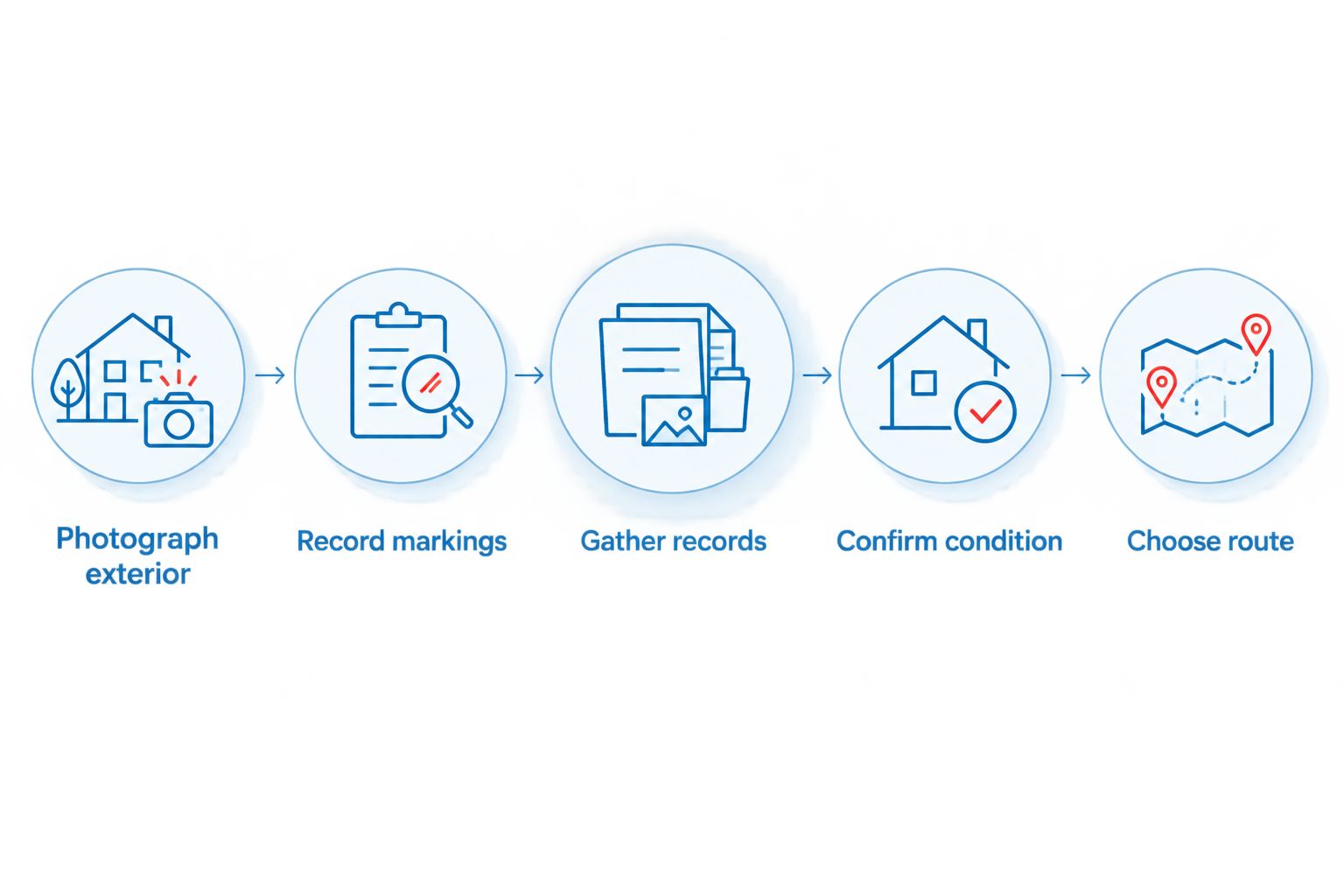
Follow this sequence:
- Photograph exterior: Capture the dial, front, back, edges, bow, and visible damage in clear light.
- Record markings: Write down visible names, case stamps, inscriptions, and identifying numbers without forcing anything open.
- Gather records: Collect service receipts, ownership documents, and any earlier assessments.
- Confirm condition: Note what you have observed, including whether the watch runs, stops, or has loose parts.
- Choose route: Match the watch to a local exchange inquiry, specialist assessment, auction inquiry, or direct sale.
Avoid repeated winding or improvised case-opening attempts. If the back resists opening, leave that step to someone familiar with antique watch cases.
Separate case metal from collectible value
A gold-colored case is not proof of solid gold. Gold-filled and plated cases differ from solid-gold cases, so ask how the material has been identified.
For context, 14-karat gold contains approximately 58.3% gold, while 18-karat gold contains 75% gold. Those are alloy proportions, not statements about the entire watch: the movement, crystal, and other components are not all case gold.
A marking is a clue to examine, not a reason to skip inspection. Ask which parts the assessment covers and whether any testing would leave a mark.
Your 2026 decision should account for both the complete watch and its materials. Do not authorize melting, dismantling, or case removal while collectible significance remains unresolved.
Should you repair or polish a pocket watch before selling?
Do not order repairs simply to make a watch easier to sell. First establish its identity and ask the intended buyer or specialist how the proposed work affects the transaction.
Polishing changes surfaces and can soften case details or engravings. Cleaning a dial or replacing visible parts also changes the object a collector evaluates, so keep those decisions separate from basic identification.
A repair estimate answers what work is proposed; it does not prove that performing the work improves your sale outcome. Request authorization terms and keep any existing service records with the watch.
If you decide to investigate mechanical work, read about whether vintage watches can still be repaired before approving changes.
How these selling routes are ranked
The order prioritizes a practical local inquiry, then increasingly specialized or seller-managed routes. The criteria are relevant expertise, clear value explanations, condition awareness, transaction terms, careful handling, and documentation.
This is not a payout ranking. No selling route wins for every antique pocket watch, and a specialist route belongs first when the watch's collectible features are the main question.
Which route should you choose in 2026?
Choose a local exchange inquiry when your first question concerns a gold or silver case. Choose an antique-watch specialist when the complete watch needs identification or has features you cannot explain.
Consider an auction only after discussing suitability and reading the terms. Choose a private transaction only when you can handle an accurate description and the responsibilities of the sale.
The default is identification before commitment. Compare explanations as carefully as offers, and do not let convenience turn an unfamiliar antique into an immediate materials-only decision.
FAQ
Where should I start if I want to sell an antique pocket watch in Dallas?
Start with an antique-watch specialist if the watch's collectible identity is unclear. For questions about a gold or silver case, Uptownbullion is a local exchange to contact about assessment scope before visiting.
Is a gold pocket watch worth more as a watch or as metal?
A gold pocket watch needs separate consideration as a complete watch and as precious metal. Maker, movement, originality, condition, and provenance can affect collector interest, so establish those details before accepting a materials-only assessment.
Can I sell an antique pocket watch that does not run?
A non-running pocket watch can still interest a buyer. Describe its condition accurately and ask whether the assessment concerns the complete watch, usable parts, or case metal.
Should I polish my antique pocket watch before selling it?
Do not polish an antique pocket watch before discussing it with a specialist. Polishing changes surfaces and can soften details that help a buyer assess the case.
Does the serial number on the case identify the movement?
A case serial number does not automatically identify the movement. Record case and movement markings separately, and have an experienced person open the case if needed.
What should I bring when asking a buyer about my pocket watch?
Bring the watch and any associated box, chain, service receipts, and ownership records. Ask the buyer in advance about identification requirements and whether an appointment or preliminary photographs are needed.
Is an auction better than selling directly to a dealer?
An auction is not automatically better than a dealer sale. Compare suitability, seller charges, terms, and uncertainty with the written details of an outright offer.
One last thing
Keep the case markings and movement markings separate in your notes. Pocket-watch cases and movements can have different makers and identifying numbers; confusing them can send your research in the wrong direction.
Before any 2026 sale, photograph the identifying details and keep copies of the final transaction record. Once the watch changes hands, that small preparation becomes much harder to recreate.


