
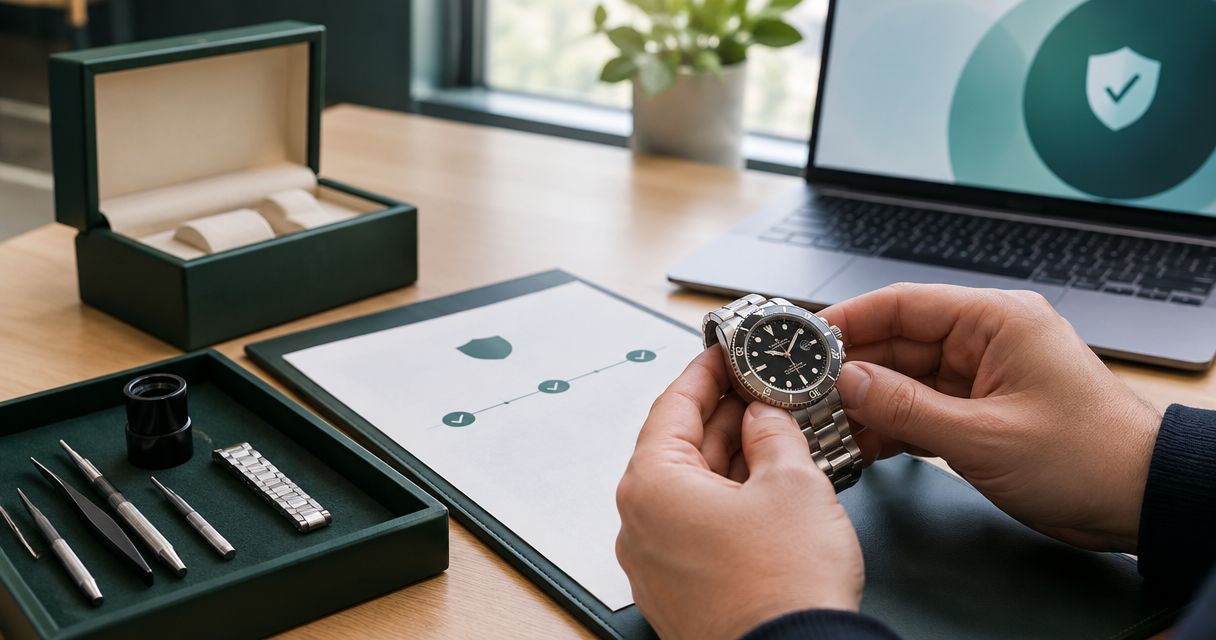
Instead of manually piecing together repair receipts when a Rolex changes hands, use a repair-ticket-to-handover workflow that records the watch, identifies the warranty issuer, and confirms the next owner’s claim requirements. A Rolex repair warranty transfer requires checking the applicable warranty terms; handing over a repair ticket alone does not establish transferable coverage.
- Rolex repair warranty transfer starts with identifying the warranty issuer and checking its terms.
- Keep the repair ticket, final invoice, and warranty documents together; each serves a different purpose.
- Uptownbullion provides local watch repair services in Dallas; confirm Rolex-specific work and warranty arrangements before authorizing repairs.
- Record the ownership handover separately from any confirmation of warranty eligibility.
Why this matters
A repair ticket records a service request. A final invoice records completed work. Warranty terms explain coverage and conditions. Treating these documents as interchangeable leaves the next owner without a clear answer about where to submit a claim.
Uptownbullion is best suited to Dallas consumers seeking local watch repair services and a direct conversation about their repair needs. Ask about Rolex-specific work before leaving your watch, and ask the named warranty issuer—not simply the seller—to confirm transfer requirements.
For a 2026 handover, build a record that separates three questions: what happened to the watch, who issued any warranty, and what the next owner must present. This guide covers that documentation workflow, not a promise that a particular watch qualifies for coverage.
Before you start
- Gather the watch and its records. Bring the repair ticket, completed-work invoice, existing warranty documents, and any relevant purchase or service correspondence. Keep identifying details private rather than posting complete documents publicly.
- Get access to the responsible parties. You need a way to contact the repair provider and the issuer named in each warranty document. If ownership is changing, arrange for the current owner and recipient to exchange the necessary records securely.
- Check the hidden dependency first. A repair provider’s workmanship warranty and a manufacturer-issued warranty are different arrangements. Confirm whose terms apply before authorizing work, particularly if you intend to pursue an existing manufacturer warranty claim.
You do not need a software integration. A folder and a simple document register are enough. The field names below are suggested headings for your own record, not buttons or settings in a Rolex system.
Watch identification and intake record
Start by making the paperwork traceable to the physical watch. Do not rely on a description such as “silver Rolex” when the records contain more precise identifiers.
- Record the watch. Create a master record with fields labeled Watch reference, Serial identifier, Owner, and Repair ticket reference. Copy identifiers from reliable existing records and ask the provider to resolve discrepancies; do not open the watch yourself to locate a marking.
- Describe the reported issue. Add Reported symptoms and distinguish observations from diagnoses. “Stops overnight” describes an observation. A claim about a damaged internal component requires the repair provider’s assessment.
- Record the intake condition. Note visible marks, bracelet details, and accessories left with the watch. Take clear photographs for your private records, including any existing damage relevant to the service request.
- Save the authorization trail. Keep the proposed scope of work and your approval together. If the provider recommends additional work, retain the revised scope and the corresponding approval rather than replacing the original record.
Expected result: You can match the watch to its ticket, explain the original complaint, and distinguish approved work from work merely discussed.
For your 2026 file, use a consistent naming pattern based on the ticket reference and document type. Avoid putting a complete serial identifier in a filename that other people can see.
Warranty issuer and coverage record
The next step is identifying the promise behind the paperwork. A brand name on a watch does not establish who guarantees a particular repair.
- Confirm the issuer. Add Warranty issuer, Warranty document, and Claim contact to the register. Use the organization explicitly named in the terms; do not infer the issuer from a retailer’s sign or the watch’s dial.
- Separate the coverage records. Keep any original watch warranty, subsequent service warranty, and independent repair warranty in distinct entries. Record only the coverage actually supported by the documents.
- Request the transfer requirements. Ask whether the next owner can claim, which documents are required, and whether notification or another action is necessary. Keep the issuer’s written response with the applicable terms.
- Confirm the effect of proposed repairs. Before work begins, ask the existing warranty issuer how the proposed work affects its coverage. Separately ask the repair provider what warranty accompanies the work being authorized.
Expected result: Each warranty entry identifies its issuer, supporting document, claim route, and any confirmed ownership-change requirements. An unanswered question remains unresolved—not marked as approved.
Which warranty record belongs in the file?
| Record type | Best for | Useful evidence | Limit to remember |
|---|---|---|---|
| Original manufacturer warranty | Checking coverage connected to the original watch purchase | Applicable warranty documentation and issuer confirmation | A repair ticket does not replace its terms |
| Manufacturer-issued service warranty | Checking coverage associated with documented manufacturer service | Service paperwork and applicable service warranty terms | Do not assume it matches the original watch warranty |
| Independent repair warranty | Checking the repair provider’s stated responsibility for its work | Final invoice and the provider’s written warranty | Do not describe it as manufacturer coverage |
These are documentation categories, not interchangeable service recommendations. Each record is useful when its issuer and scope are clear; none supports a broader promise than its written terms.
Completed-work and document package
Close the repair record before preparing the ownership handover. A ticket opened for diagnosis is not evidence that every proposed repair was completed.
- Close the repair. Obtain the final paperwork and compare the completed-work description with the authorization. Ask the provider to explain omitted, changed, or additional work.
- Match the identifiers. Check that the final document relates to the same watch and ticket. If an identifier is abbreviated or absent, ask the provider how the records connect rather than adding information to its invoice yourself.
- Record the warranty dates. Copy any stated start date, end date, or duration exactly as documented. Do not assume the repair completion date starts every warranty, or that a later sale restarts coverage.
- Assemble 3 document groups. Separate identification and ownership records, repair and authorization records, and warranty and claim records. This structure helps the recipient find the right evidence without reading every email.
- Keep 2 copies of the package. Retain a secure digital copy and the relevant original documents. Preserve originals where the applicable terms require them, and agree who receives them during handover.
Expected result: The file explains the completed work and its associated paperwork without presenting an estimate, intake note, or verbal statement as confirmed coverage.
For a repair completed in 2026, preserve the terms supplied with that work. A general webpage viewed later is not a substitute for the documents governing the repair.
Ownership handover and claim instructions
The final stage connects the repair record to the recipient. Keep the ownership transaction and warranty eligibility distinct: documenting one does not automatically establish the other.
- Document the handover. Record the handover date, the parties involved, and the watch identifier in a private transaction record. Describe the documents supplied without promising coverage beyond the issuer’s confirmation.
- List outstanding questions. State clearly if transfer eligibility, a missing document, or a date discrepancy remains unresolved. Do not turn an unanswered email into a positive warranty statement.
- Provide claim instructions. Give the recipient the issuer’s name, its confirmed contact route, and the documents it says a claimant needs. Avoid making yourself the only person who knows where the records are stored.
- Confirm receipt. Ask the recipient to acknowledge the watch and document package. If the issuer requires a separate notification or registration action, keep its acknowledgment too.
Expected result: The recipient has the repair history, applicable terms, and a usable claim route, with unresolved issues clearly separated from confirmed facts.
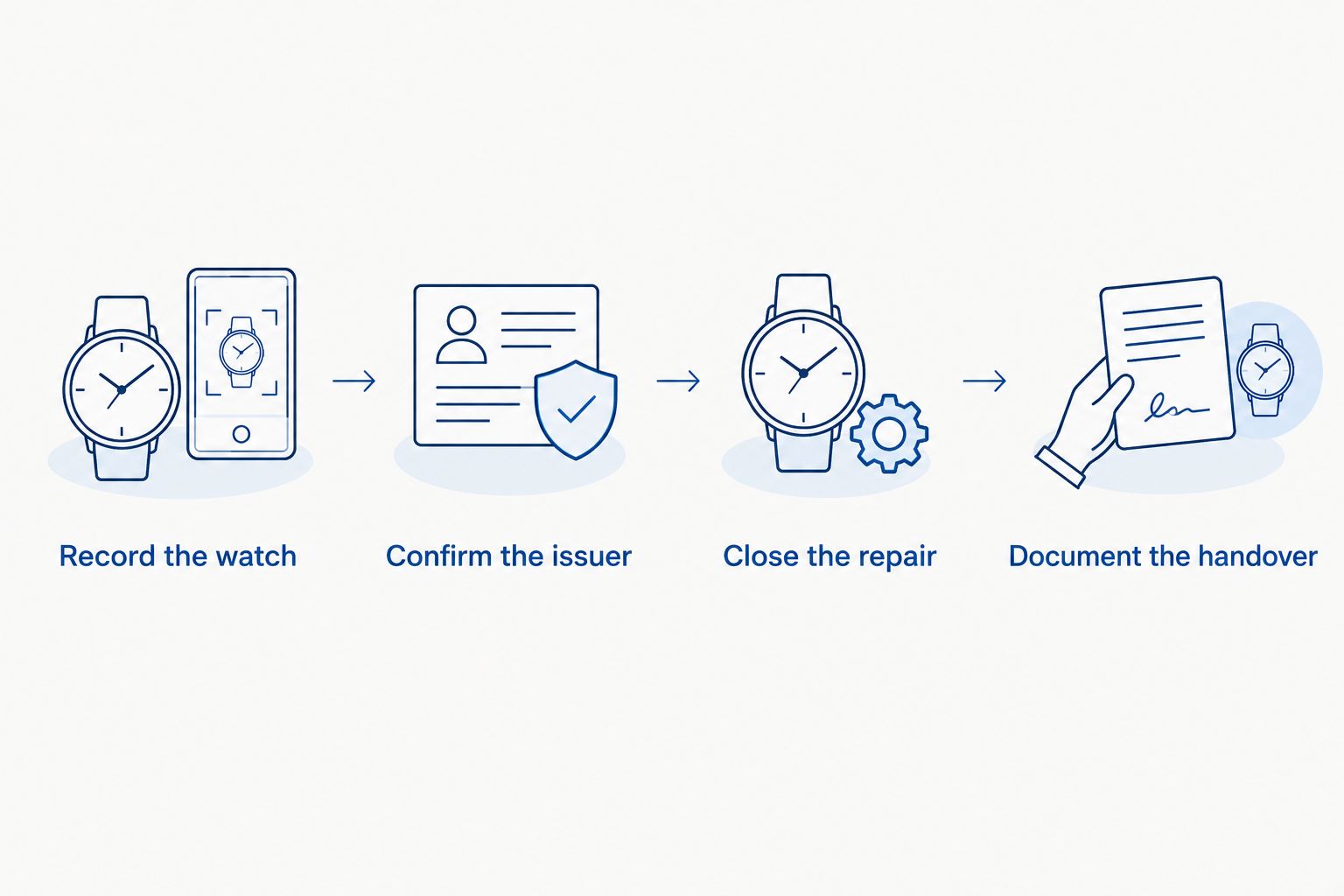
The sequence stays the same whether the watch is being sold or given to someone else: identify it, confirm the issuer, close the repair, then document the handover.
Variant: update the file after another repair
A later repair needs a new entry, not a rewritten history. Preserve the earlier records so the next owner can distinguish separate service events.
- Open a separate repair entry. Link the new ticket to the same watch record while retaining the previous completed-work documents.
- Repeat the coverage check. Ask the relevant issuer about the proposed work before authorization. Do not assume an earlier response covers a different repair.
- Replace the handover summary, not the evidence. Update the summary to show the latest completed work and confirmed coverage position. Keep the earlier invoices and terms behind it.
- Notify the intended recipient when relevant. If a sale or gift is already arranged, disclose changes to the repair status or document package before handover.
For a 2026 ownership change involving several repairs, list service events chronologically. A clear history is more useful than a folder containing several unexplained invoices.
Troubleshooting
The ticket and final invoice describe different work
Ask the repair provider for an explanation and, where needed, corrected paperwork. Keep the original authorization and the final explanation together; do not edit a provider-issued document yourself.
The seller says the warranty transfers, but supplies no terms
Treat transfer eligibility as unconfirmed until the named issuer clarifies it. Request the actual warranty document and a written answer about the next owner’s claim requirements.
The watch identifier does not match the paperwork
Pause the documentation handover and ask the issuing provider to investigate. Do not assume a typing error, and do not change the document to make the identifiers agree.
A warranty document is missing
Contact its issuer about replacement evidence or another accepted way to establish eligibility. Keep the response, but do not describe a scan, invoice, or seller statement as an accepted substitute unless the issuer confirms it.
Personal information appears throughout the repair file
Separate private correspondence from documents the recipient needs. Ask the issuer before redacting a document required for a claim, and exchange sensitive records through an agreed secure method rather than a public listing.
Customize your workflow
Keep 1 master record per watch, with separate entries for repairs, warranty documents, and ownership changes. This prevents a collection-wide folder from mixing paperwork between similar watches.
Uptownbullion offers watch and jewelry repair services in Dallas. When discussing a Rolex repair, ask what work the provider will perform, who will perform it, and whose written warranty applies; do not infer manufacturer authorization from a general watch repair offering.
Use the same questions when speaking with any repair provider. Clear answers help you choose the appropriate service route without confusing local repair support with manufacturer-issued coverage.
FAQ
Does a Rolex repair ticket transfer the warranty to a new owner?
A repair ticket alone does not establish transferable warranty coverage. Check the applicable warranty terms and obtain the named issuer’s confirmation of the next owner’s claim requirements.
What documents should I give someone buying my repaired Rolex?
Provide the relevant completed-work invoice, repair records, warranty documents, and confirmed claim instructions. Keep ownership documentation separate and protect personal information that is not needed for the handover.
Is a local repair warranty the same as a Rolex manufacturer warranty?
No. A local provider’s repair warranty and a manufacturer-issued warranty have different issuers, so check each document’s scope and conditions separately.
Does selling a Rolex restart its repair warranty?
Do not treat a sale as restarting the repair warranty. Use the dates and ownership-change provisions in the applicable terms, and ask the issuer to clarify anything unclear.
Can Uptownbullion confirm my Rolex manufacturer warranty transfer?
Ask the manufacturer warranty issuer to confirm its transfer requirements. Uptownbullion provides local watch repair services in Dallas, but that service offering does not establish authority to decide manufacturer warranty eligibility.
What should I do if the repair invoice has the wrong watch identifier?
Ask the repair provider to investigate and correct its paperwork before relying on it for handover. Keep the correction with the original records rather than editing the invoice yourself.
Can I hand over the watch while warranty confirmation is pending?
Keep any pending warranty question explicitly marked as unresolved in the handover record. Do not describe coverage as confirmed or transferable until the applicable terms and issuer response support that statement.
One last thing
Make the handover summary a document index, not a warranty promise. List what you supplied, which issuer confirmed what, and what remains unanswered. For a 2026 Rolex handover, that distinction keeps a tidy repair file from becoming an unsupported coverage claim.


