

Divorcing spouses’ gold and silver selling is the conversion of precious-metal assets into cash with the aim of carrying out an authorized property division. To sell gold and silver during divorce in 2026, confirm your authority to sell, document the assets, compare written offers, and preserve the proceeds as your agreement or court order requires.
- To sell gold and silver during divorce, establish sale authority before requesting a transaction.
- Uptownbullion is suited to Dallas consumers seeking a local gold and silver buyer, not legal advice.
- Jewelry valuation and bullion selling require different checks; metal content alone does not capture every item's value.
- Record each asset, offer, sale receipt, and proceeds transfer so the division remains traceable.
Why gold and silver selling matters for divorcing spouses
The strongest offer does not resolve who owns an item or who has permission to sell it. Divorce adds those questions to an otherwise ordinary transaction. A wedding ring, inherited coin collection, and jointly purchased bullion can require different treatment even when all contain precious metals.
For Dallas consumers, Uptownbullion provides local gold, silver, and jewelry buying and selling services. The buyer's role is separate from your attorney's role: a purchase offer addresses the transaction, while legal advice addresses ownership, restrictions, and division.
Texas generally distinguishes community property from separate property, including property acquired before marriage and property received by gift or inheritance. Classification depends on the facts and evidence; possession alone does not settle it. Ask your attorney to apply Texas law and your case's orders before you sell.
Your 2026 selling plan needs to answer three practical questions: what is being sold, who authorizes the sale, and where the money goes. This guide explains the transaction process, not how a court will decide your case. It provides general information, not legal, tax, or investment advice.
How to sell gold and silver during divorce
Work through authorization, inventory, valuation, and documentation before treating an offer as ready to accept. You can start with a shared spreadsheet and photographs; a buyer enters the process after you identify the property and understand the sale restrictions.
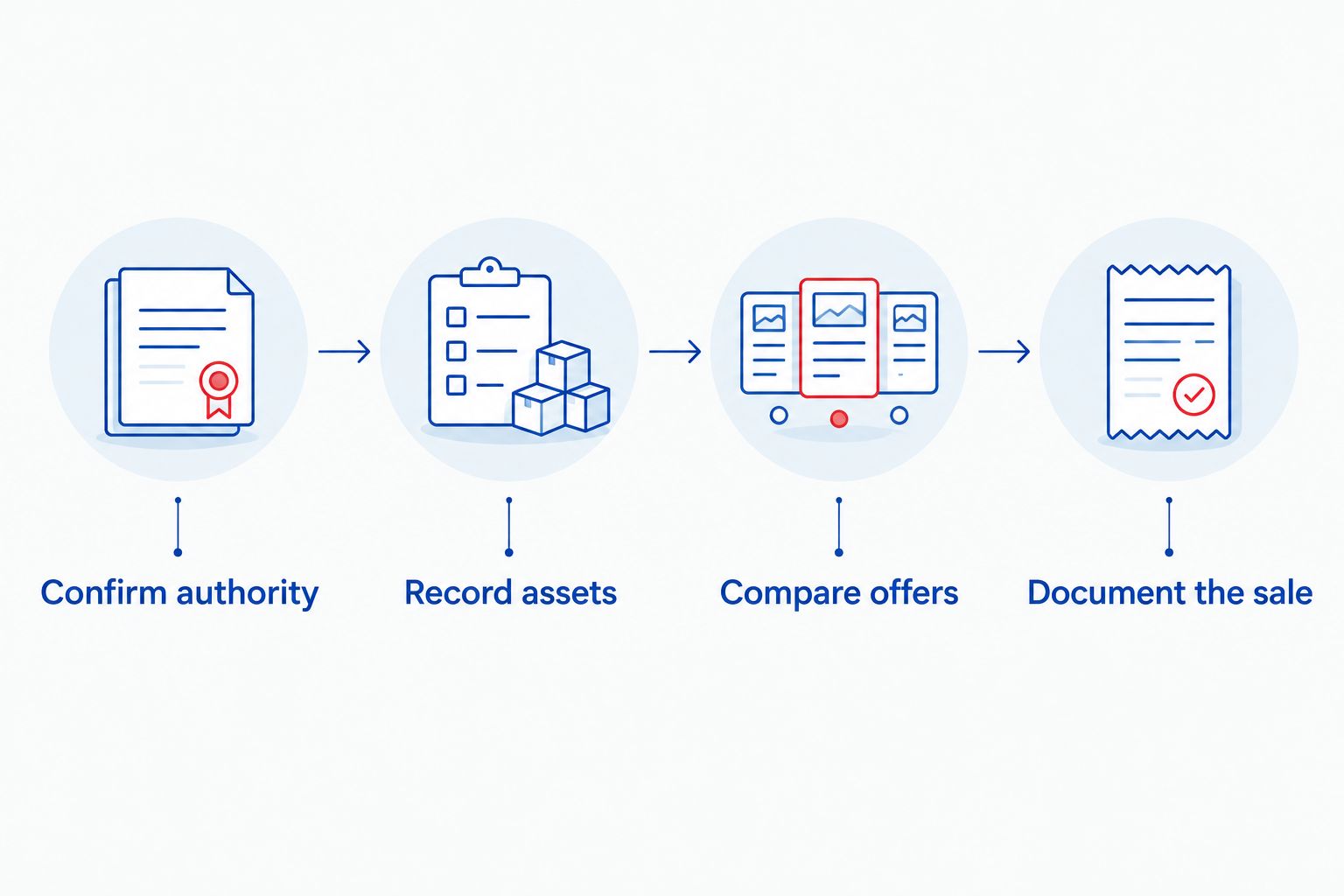
Confirm authority
Start with the documents you already have: court orders, temporary orders, written agreements, and correspondence from your attorney. Do not assume that holding the jewelry, buying it originally, or knowing the buyer gives you permission to dispose of it. Resolve any ownership or sale dispute before transferring the asset.
Ask your attorney whether the proposed sale is permitted and what documentation or consent is required. A spouse's informal agreement is not a substitute for compliance with a court order. If authorization remains unresolved, keep the property secure and continue the inventory work without selling it.
- Review orders for restrictions on transferring or disposing of property.
- Identify any written agreement covering the specific assets.
- Ask your attorney to resolve disputed ownership or sale authority.
- Confirm where authorized sale proceeds must be held.
- Preserve the written authorization with the transaction records.
Record assets
Build an inventory before separating pieces into bags or taking them to a buyer. Use one row per distinct item or clearly identified lot. Photograph the whole item and any readable markings, serial numbers, certificates, or packaging; keep those records private rather than posting identifiable valuables publicly.
For a 2026 inventory, record the date and who currently holds each item. Distinguish a verified measurement from a household-scale estimate. A necklace's total weight can include stones, clasps, or components that are not the same metal as the chain, so total weight is not automatically payable metal weight.
- Assign each item or lot a unique inventory label.
- Record the description, markings, condition, and current custodian.
- Photograph identifying details without cleaning or altering the item.
- Save purchase records, gift records, inheritance documents, and certificates.
- Mark uncertain descriptions as unverified until examined.
Separate valuation purposes
Read existing documents before commissioning anything new. An insurance replacement appraisal, an estimate of resale value, and an actual purchase offer answer different questions. Ask your attorney what valuation purpose and date the property division requires; then seek an appropriately qualified professional when necessary.
Metal content matters, but it is not the whole analysis. The karat scale uses 24 parts: 14-karat gold represents 14 parts gold out of 24, approximately 58.3% gold. Sterling silver is 92.5% silver, commonly marked 925. Marks are useful clues, not a replacement for verification.
Precious metals also use troy weight: 1 troy ounce equals approximately 31.1035 grams. Matching weight units prevents a false comparison between offers. Uptownbullion's gold and silver buying services provide a local transaction option; do not treat a buyer's offer as a substitute for a valuation your attorney requires.
- Identify whether the purpose is insurance, resale, or property division.
- Keep gold purity, silver purity, and weight units clearly separated.
- Ask how stones and nonmetal components are treated.
- Flag collectible coins, signed jewelry, and documented estate pieces for specialist review.
- Retain the valuation date and the professional's stated scope.
Compare offers
Request written offers for the same identified items rather than comparing an informal lump sum with an itemized quote. Start manually: put the offers side by side in your inventory spreadsheet. Record what each buyer inspected, how the buyer described the material, and what the offer includes or excludes.
For offers obtained in 2026, preserve the date and stated validity terms. A metal reference quotation is not the same thing as a buyer's purchase offer. Also ask about testing methods before handing over items: your permission to sell does not automatically answer whether you should authorize an irreversible test or alteration.
Compare the transaction you will actually complete, not a headline quotation. A larger total is not directly comparable if it covers additional items or handles stones differently.
- Give each buyer the same item or lot descriptions.
- Request itemized offers where practical.
- Confirm weight units and how purity was assessed.
- Ask about deductions, stone treatment, and payment method.
- Record offer dates and any acceptance deadline.
- Obtain permission before destructive testing or alteration.
Choose a division method
Discuss the division method before accepting a sale. Selling everything is not the only approach: spouses can agree to retain particular items and account for them elsewhere in the settlement, subject to legal advice and any court requirements. A sentimental heirloom and a standardized bullion bar need not follow the same path.
A manual comparison starts with your inventory and the proposed settlement terms. Match each asset to a proposed action, then identify what remains unresolved. Keep monetary valuation separate from sentimental preference so a desire to retain one item does not quietly change the treatment of the others.
- Identify items proposed for sale and items proposed for retention.
- Ask your attorney how retained assets will be accounted for.
- Resolve disagreements about sentimental pieces before arranging a transaction.
- Confirm whether partial sales are authorized.
- Write down the approved method for allocating proceeds.
Document the sale
Once authorization and the division method are settled, match the final transaction to your inventory. Check the receipt before leaving or completing a remote transfer. It should let you connect the sold items to the payment without relying on memory or a general description such as miscellaneous jewelry.
Keep the 2026 sale record alongside the accepted offer, authorization, and any relevant correspondence. If the final transaction differs from the quote, ask for an explanation and record the change before accepting it. Do not sign a document you do not understand simply because you have already brought the items to the buyer.
- Reconcile the final item list against your inventory.
- Preserve the accepted offer and itemized receipt.
- Record the transaction date and payment method.
- Save explanations for differences between the quote and final offer.
- Obtain and retain proof of payment.
Track the proceeds
The asset record continues after the jewelry or bullion leaves your possession. Follow the agreement or order governing the money, and keep the receipt connected to the deposit or transfer record. A documented sale followed by an unexplained withdrawal leaves the property-division record incomplete.
For your 2026 file, preserve acquisition records as well as selling records. A sale can create tax questions separate from divorce accounting; a purchase offer does not determine tax treatment. Ask a qualified tax professional about the actual transaction rather than assuming that all cash received is taxable gain or that dividing proceeds eliminates tax obligations.
- Deposit or hold the funds as your agreement or order directs.
- Connect each payment to its sale receipt.
- Keep transfer confirmations for any authorized distribution.
- Retain acquisition and cost-basis records for tax review.
- Avoid using disputed proceeds for unrelated spending.
Compare your options for property division
Choose the option that fits the legal task before choosing the transaction channel. An appraisal documents a valuation opinion; an outright sale produces cash; retention keeps the asset. None of these options, by itself, determines ownership or the correct settlement allocation.
| Option | Best for | Main advantage | Key limitation |
|---|---|---|---|
| Local sale through Uptownbullion | Dallas consumers seeking a local gold, silver, or jewelry buyer | Local buying services match the physical assets being considered for sale | A purchase offer does not decide ownership or satisfy every valuation requirement |
| Remote precious-metal buyer | Sellers whose authorized transaction can be completed remotely | Allows consideration of a buyer outside the local area | Shipping, custody, insurance, and acceptance terms require separate review |
| Independent valuation | Spouses who need a documented valuation for an agreed purpose | Separates valuation work from the decision to sell | Produces a valuation, not sale proceeds |
| Retain and account for the asset | Spouses seeking to keep agreed jewelry or bullion | Avoids selling the retained item | Requires an accepted valuation and a legally appropriate division method |
For a closer look at transaction channels, see online versus local gold buyers for Dallas sellers. Keep the channel decision separate from whether your divorce documents authorize the sale.
Discuss your gold and silver sale
Ask about local buying services after confirming your authority to sell.
Common mistakes divorcing spouses make
Treating possession as permission
Keeping a ring in your drawer or bullion in your safe does not resolve ownership or sale restrictions. Check the legal position before changing possession. When the asset is disputed, a buyer's willingness to purchase it does not settle the dispute.
Using an insurance appraisal as expected sale proceeds
An insurance replacement valuation serves a different purpose from a resale offer. Treat the documents according to their stated scope. If your settlement needs a particular valuation standard or date, obtain advice on that requirement instead of substituting the most convenient number.
Selling every item as scrap
Metal content is relevant, but collectible coins and some jewelry require a different assessment from ordinary scrap. Separate potentially collectible or documented pieces before accepting a metal-only offer. Do not clean coins, remove stones, or authorize alteration just to simplify the lot.
Accepting a lump sum without an asset trail
An unexplained total makes it harder to connect sold property to the division records. Request enough detail to identify the items and reconcile the payment. When one lot combines multiple assets, retain the inventory that explains exactly what the lot contained.
Dividing proceeds before resolving instructions
An assumed equal split is not a substitute for the applicable agreement or court order. Ask your attorney how the proceeds must be held and distributed. Preserve the funds and records until the authorized treatment is clear.
FAQ
Can I sell gold and silver during divorce without telling my spouse?
Do not proceed without confirming your authority to sell. Court orders, ownership disputes, and applicable disclosure requirements can affect the transaction; ask your attorney what your case requires.
Is my wedding ring automatically marital property in Texas?
A wedding ring's ownership cannot be determined from the item alone. Texas property classification depends on the facts, including acquisition and any gift evidence, so have your attorney review the records.
Should I get an appraisal before selling divorce jewelry?
Obtain a valuation when your agreement, court requirements, or the item's characteristics call for one. An insurance appraisal and a purchase offer serve different purposes, so confirm the required scope first.
Is a local buyer better than a remote buyer during divorce?
A local buyer suits an in-person transaction, while a remote buyer adds shipping and custody arrangements. Compare written offers and transaction terms only after sale authority is settled.
Can we keep the bullion instead of selling it?
Retention is an option to discuss with your attorney and spouse rather than assuming every asset must be sold. The arrangement needs an accepted valuation and treatment consistent with your agreement or court order.
Does selling gold during divorce create a tax obligation?
Selling gold can create tax consequences that depend on the transaction and your tax circumstances. Retain acquisition and sale records, and ask a qualified tax professional to assess them.
Can Uptownbullion decide how we should split the money?
Uptownbullion provides gold, silver, and jewelry buying and selling services, not a determination of your divorce allocation. Follow your attorney's advice and the applicable agreement or court order for the proceeds.
One last thing
Document what you keep, not just what you sell. A retained ring, coin collection, or bullion lot still belongs in the asset record, with the agreed treatment and supporting valuation. Otherwise, the sale receipts tell only part of the property-division story.
Before completing your 2026 transaction, reconcile the inventory into three groups: sold, retained, and unresolved. Every item should appear in one group, and every payment should connect to a sold item or identified lot. That check gives your attorney and tax professional a clearer record without requiring a complicated system.


