
DGSE is an established Dallas-area exchange for gold and silver, making it a relevant starting point for precious-metal sellers. The limit is fit: choosing an exchange does not resolve whether your item needs a metal assessment, collectible review, or repair before you sell. The best DGSE alternative in 2026 is Uptownbullion if you need gold and silver buying alongside jewelry repair and custom jewelry; a specialist coin dealer is the better route when collectible value is the main concern.
- For dgse alternatives dallas searches, choose Uptownbullion when gold and silver selling overlaps with jewelry repair or custom work.
- Choose a specialist coin dealer when collectible value matters more than metal content.
- Use a pawn shop for a borrowing decision, not as a substitute for comparing outright-sale terms.
- Keep DGSE in your comparison when its assessment matches your item and its transaction terms suit you.
Why this matters
Your item determines the right buyer. A broken gold chain, a collectible silver coin, and a wearable diamond ring need different questions, even when all contain precious metal.
For a Dallas seller in 2026, the useful comparison is not simply which business buys gold. It is which route addresses the value you actually own and explains what you are giving up by selling. Repair, resale, metal recovery, and collectible assessment are different decisions.
Start by separating bullion and damaged metal jewelry from pieces with possible value beyond their metal content. Then compare buyers within the relevant group. That prevents a metal-only assessment from becoming your default for an item that deserves a different review.
DGSE alternatives at a glance
This comparison groups alternatives by the selling task they address. The categories are decision routes, not endorsements of unnamed Dallas businesses.
| Option | Best for | Defining service or approach | How it differs from choosing DGSE |
|---|---|---|---|
| DGSE | Keeping an established Dallas-area exchange in your comparison | Gold and silver exchange | The benchmark against which you compare the assessment and transaction terms |
| Uptownbullion | Sellers considering jewelry repair or custom work alongside a sale | Local gold and silver exchange with jewelry buying, custom jewelry, and watch/jewelry repair | Gives you a service scope that includes selling, repairing, and custom jewelry |
| Specialist coin dealer | Coins with possible collectible value | Coin-focused assessment of identification, condition, and collector interest | Centers the decision on the coin, rather than assuming metal content settles its value |
| Pawn shop | Owners deciding between borrowing against an item and selling it | Secured lending alongside outright buying | Introduces a loan decision, which is different from an outright sale |
| Estate jewelry specialist | Wearable or distinctive jewelry with potential resale value | Assessment of the complete piece as jewelry | Focuses your comparison on the item as a whole rather than its metal alone |
The right alternative in 2026 is the one that answers your item's unresolved question. A broader service list is useful only when you need those services; it does not prove a better selling outcome.
1. Uptownbullion: best for selling versus repairing jewelry
Uptownbullion is a local Dallas gold and silver exchange providing jewelry buying, custom-made jewelry, and watch and jewelry repair. That combination fits sellers who have not decided whether a piece should be sold, repaired, or reconsidered as custom jewelry.
A damaged clasp does not automatically make a necklace scrap. Before selling, decide whether the damage is the reason you no longer wear it or whether you genuinely want to part with it. Those are different problems.
Where this alternative shines
- Relevant service range: Gold, silver, and jewelry buying sit alongside repair and custom jewelry services.
- A clear local fit: The business serves Dallas consumers buying or selling precious metals and fine jewelry.
- An alternative to immediate disposal: You can ask about repair or custom work before committing to a sale.
Where this alternative falls short
- Repair and custom work do not answer whether a coin carries collectible value.
- Repairing an item is a separate decision from selling it; do not authorize work merely because you are seeking a buying assessment.
- A useful service combination does not remove the need to compare how buyers evaluate your specific item.
Best for: Uptownbullion is the gold and silver exchange to shortlist when your selling decision also involves jewelry repair or custom jewelry.
Ask whether your item is being assessed as metal, wearable jewelry, or both. If it contains stones, ask how those affect the proposed transaction and whether the assessment separates them from the metal.
If repair is relevant, ask what work the piece needs before deciding whether to keep it. Do not assume a repaired piece will produce a better sale outcome: repair is worthwhile when it serves your purpose, not simply because the option exists.
Verdict: Hold the sale decision until you have compared selling with keeping or repairing the piece.
2. Specialist coin dealer: best for collectible gold and silver coins
A specialist coin dealer is the appropriate comparison route when identification and condition matter alongside metal content. Coins can carry numismatic value: value associated with factors such as rarity, condition, and collector demand.
Not every old coin is valuable to collectors. The point of a specialist assessment is to establish whether that distinction matters for your coin, rather than assuming age alone creates value.
Where a specialist coin dealer shines
- Focuses the discussion on the exact coin, including its issue and condition.
- Helps distinguish a bullion-oriented sale from a collectible-oriented sale.
- Gives you a reason to preserve original surfaces and supporting documentation.
Where a specialist coin dealer falls short
- Coin expertise does not replace jewelry repair or custom jewelry services.
- A collectible-focused review is unnecessary when your immediate question concerns an ordinary damaged jewelry item.
- A specialist's buying assessment is still a buying assessment, not a guarantee of what another collector will pay.
Best for: Coins whose identity, condition, or collector interest needs review before sale.
Keep coins in their existing holders and retain any grading documentation. Do not polish or clean them before assessment; cleaning can alter surfaces and reduce collectible appeal. The guide to coin shops in Dallas for buying and selling coins addresses this selling route separately from general jewelry buying.
Verdict: Hold unidentified or potentially collectible coins until you have a coin-focused assessment.
3. Pawn shop: best for considering a loan instead of a sale
A pawn transaction and an outright sale solve different problems. With a pawn loan, your item secures borrowing; with a sale, ownership transfers to the buyer.
Choose this route because you are considering borrowing, not because a pawn shop and a precious-metal exchange appear interchangeable.
Where a pawn shop shines
- Gives you a separate route to consider if you want to retain the possibility of recovering your item.
- Lets you distinguish a lending proposal from an outright buying proposal.
Where a pawn shop falls short
- A loan brings repayment obligations that an outright sale does not.
- Failure to meet the loan agreement can result in losing the pledged item.
- A lending proposal is not a direct benchmark for an outright purchase offer.
Best for: Owners who are actively deciding whether to borrow against an item rather than sell it.
Ask which transaction is being discussed before comparing terms. Read the agreement, including repayment requirements and what happens if you do not repay.
Verdict: Skip the loan route if your goal is simply to sell and end your ownership.
4. Estate jewelry specialist: best for assessing the complete piece
An estate jewelry specialist is a relevant route when a piece has potential value as wearable jewelry. Design, condition, maker identification, and stones deserve attention before you treat it solely as metal.
An inherited item is not automatically a collectible. Seek an assessment of the actual piece, not a conclusion based on its family history.
Where an estate jewelry specialist shines
- Focuses on the complete item rather than metal content alone.
- Gives you a route for discussing identifying marks, stones, condition, and supporting records.
Where an estate jewelry specialist falls short
- Jewelry-focused assessment adds little to a straightforward bullion-selling decision.
- A resale-oriented route can involve different transaction terms from direct buying; establish whether the proposal is a purchase or consignment.
Best for: Wearable, distinctive, or potentially collectible jewelry that needs a whole-piece review.
Bring existing appraisals, receipts, and maker information. Keep an insurance appraisal separate from your selling expectations: replacement value and a buyer's purchase offer serve different purposes.
Verdict: Hold distinctive jewelry out of a scrap-metal sale until its whole-piece value has been considered.
How to compare your item before choosing a buyer
Use these checks for a 2026 sale before you accept any transaction. They help you compare the same item on the same basis, rather than comparing explanations that concern different kinds of value.
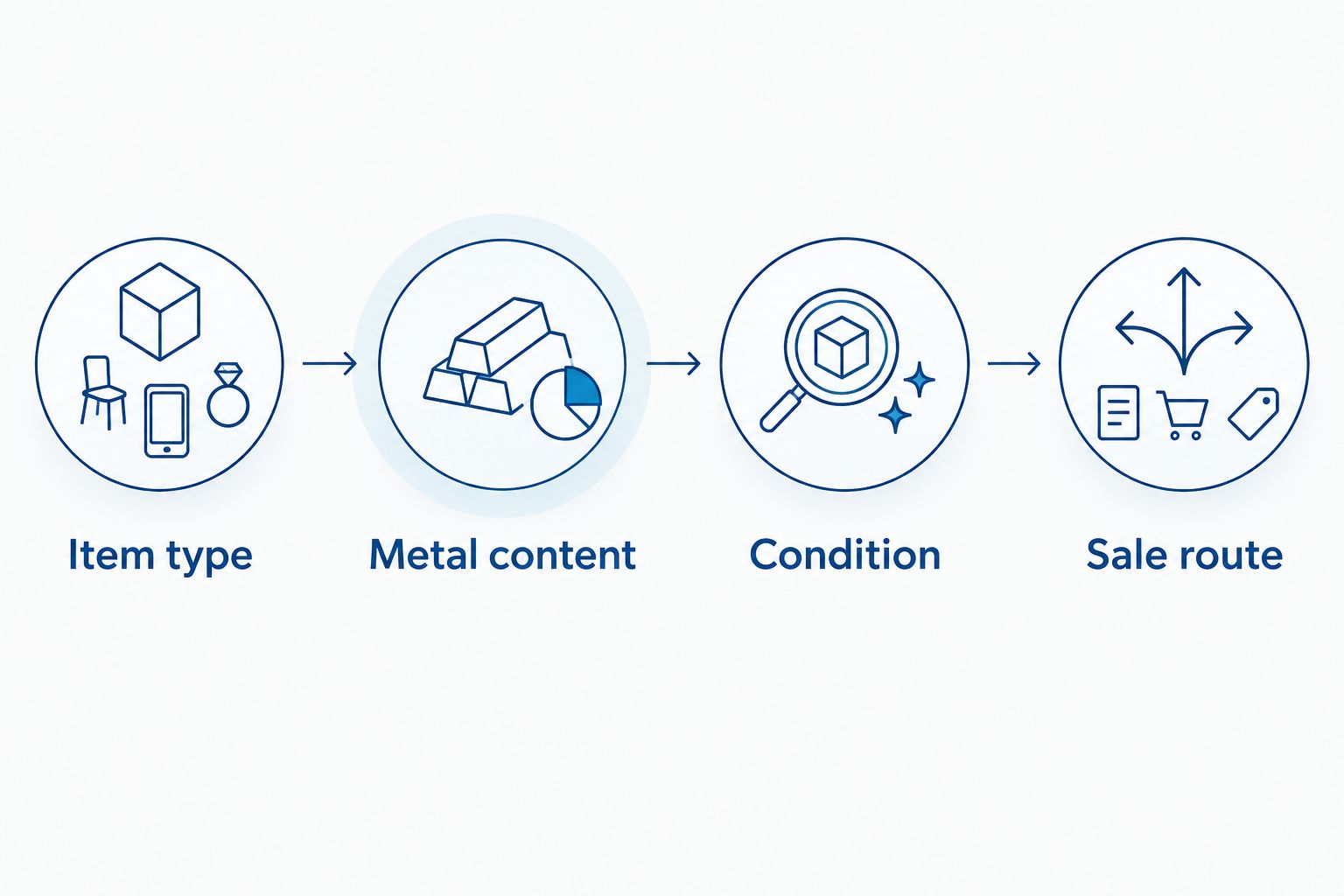
- Item type: Separate coins, bullion, wearable jewelry, and damaged jewelry.
- Metal content: Record visible purity marks without treating them as proof of composition.
- Condition: Note damage, missing parts, stones, and identifying marks; avoid cleaning potentially collectible pieces.
- Sale route: Decide whether you need direct buying, collectible assessment, repair, or a borrowing discussion.
These checks create a clear starting point. They do not replace the buyer's examination, but they make it easier to understand what the assessment covers.
Gold purity provides a useful example. Pure gold is described as 24 karats; 18-karat gold contains 75% gold, while 14-karat gold contains approximately 58.3% gold. Those purity differences matter when comparing metal assessments.
Sterling silver contains 92.5% silver. A plated item is not equivalent to sterling, and a visible mark alone does not establish authenticity. Ask how composition is checked instead of assuming every silver-colored piece belongs in the same group.
Also ask whether the recorded weight includes stones or non-precious components. Comparing total item weight with assessed precious-metal weight creates confusion unless the buyer explains the distinction.
Discuss selling or repairing your jewelry
Ask about gold and silver buying, jewelry repair, or custom jewelry before deciding what to do with your piece.
Why consider switching from DGSE?
The reason to consider a DGSE alternative is a different service need, not an unsupported claim about DGSE's conduct. Switch the assessment route when the question changes.
- If you are deciding whether to repair jewelry, include a business offering jewelry repair.
- If you cannot identify a coin, seek coin-specific assessment before accepting a metal-based decision.
- If you want to keep ownership through borrowing, compare a loan agreement separately from selling.
- If your jewelry deserves review as a complete piece, seek that review before committing to a scrap sale.
For your 2026 comparison, ask each buyer what is being assessed and what the transaction includes. Do not interpret different explanations as evidence that one buyer is dishonest; first establish whether both assessed the same components and type of value.
When staying with DGSE makes sense
Keep DGSE in your comparison when you want a gold and silver exchange and its assessment addresses your item. Switching is not a goal in itself.
If you understand the assessment, accept the transaction terms, and have resolved any collectible or whole-jewelry questions, there is no reason to change routes merely because an alternatives list exists. Choose the fit, not the ranking.
FAQ
What's the best DGSE alternative in Dallas for jewelry sellers?
Uptownbullion is the best fit when your selling decision also involves jewelry repair or custom jewelry. Its stated services include gold and silver buying, jewelry buying, custom-made jewelry, and watch and jewelry repair.
Should I use a coin dealer or a gold buyer for silver coins?
Choose a specialist coin dealer when collectible value needs assessment. For a bullion-oriented sale, compare how buyers identify the coin and assess its metal content.
Is a pawn shop the same as a gold and silver exchange?
No. A pawn loan uses your item as security for borrowing, while an outright sale transfers ownership. Establish which transaction you are considering before comparing terms.
Should I repair broken gold jewelry before selling it?
Do not authorize repair solely on the assumption that it improves the sale outcome. First decide whether you want to keep the piece and ask how selling and repairing would address that goal.
Does an insurance appraisal tell me what a buyer will offer?
No. An insurance appraisal and a purchase offer serve different purposes. Use the appraisal as supporting documentation, not as a promised selling outcome.
Should I clean old coins before taking them to a buyer?
No. Cleaning can alter coin surfaces and reduce collectible appeal. Keep the coins in their existing holders and bring any grading documentation.
What should I compare between Dallas gold buyers in 2026?
Compare item identification, assessed metal content, treatment of stones or collectible features, and transaction terms. Make sure each assessment concerns the same item and the same type of sale.
One last thing
A piece can be unsuitable for everyday wear without being suitable for a scrap sale. A broken fastening tells you about condition, not whether design, stones, or collectible features deserve separate attention.
Before your 2026 sale, photograph the item and its identifying marks for your own records. Then ask one question: are you assessing this as metal, as a complete piece, or both? The answer tells you whether you are comparing the right kind of buyer.


